
Viksit Bharat @2047
India’s Roadmap to a Developed Nation
The Vision at a Glance
| What it is | A national mission to make India a fully developed, high-income country by 2047 — the centenary of independence. |
| Timeline | The 25-year “Amrit Kaal”, from 2022 to 2047. |
| Coordinated by | NITI Aayog, through a dedicated vision document and the Governing Council. |
| Headline target | A US$30 trillion economy with per-capita income near US$18,000. |
| Guiding framework | “GYAN” — Garib (poor), Yuva (youth), Annadata (farmers) and Nari (women). |
A Nation’s Century-Long Promise
When India turns a hundred as an independent nation in 2047, the babies born today will be in the prime of their working lives. What kind of country should they inherit? Viksit Bharat @2047 — “Developed India by 2047” — is the government’s answer. It is not a single scheme but an umbrella aspiration: to lift India from a lower-middle-income economy into the ranks of the developed world within one generation.
The idea was framed in the Prime Minister’s 2022 Independence Day address, which cast the years to 2047 as the “Amrit Kaal.” It became participatory on 11 December 2023, when the Viksit Bharat @2047: Voice of Youth platform invited citizens to help shape the roadmap. Since then it has become the organising theme of budgets and national planning.

What Does “Developed” Actually Mean?
“Developed” is not a slogan — it has a number attached. The World Bank calls a country high-income once its gross national income per person crosses roughly US$14,000 (revised upward each year). India today sits near US$2,700. Closing that gap means multiplying the average citizen’s income several times over in about two decades.
The scale of the leap is easiest to see side by side:
| Indicator | Where India is now | The 2047 aspiration |
| Economy size | ~US$4 trillion (4th largest, 2025) | US$30 trillion (up to US$32 tn) |
| Per-capita income | ~US$2,700 | ~US$18,000 (high-income) |
| Growth needed | — | ~7.9% a year, sustained (Panagariya) |
| Global rank | 4th largest | Among the top economies; 3rd is the near-term aim |
Understanding these numbers — nominal versus real growth, and how per-capita income is measured — is where a grounding in the fundamentals of the Indian economy becomes essential.
The Human Foundation: The GYAN Framework
If the targets describe the “what,” the government’s answer to “who benefits” is a neat mnemonic — GYAN. Presenting the Interim Budget on 1 February 2024, the Finance Minister named four groups as the “major castes” of focus, summed up in a single idea: the country progresses when they progress.
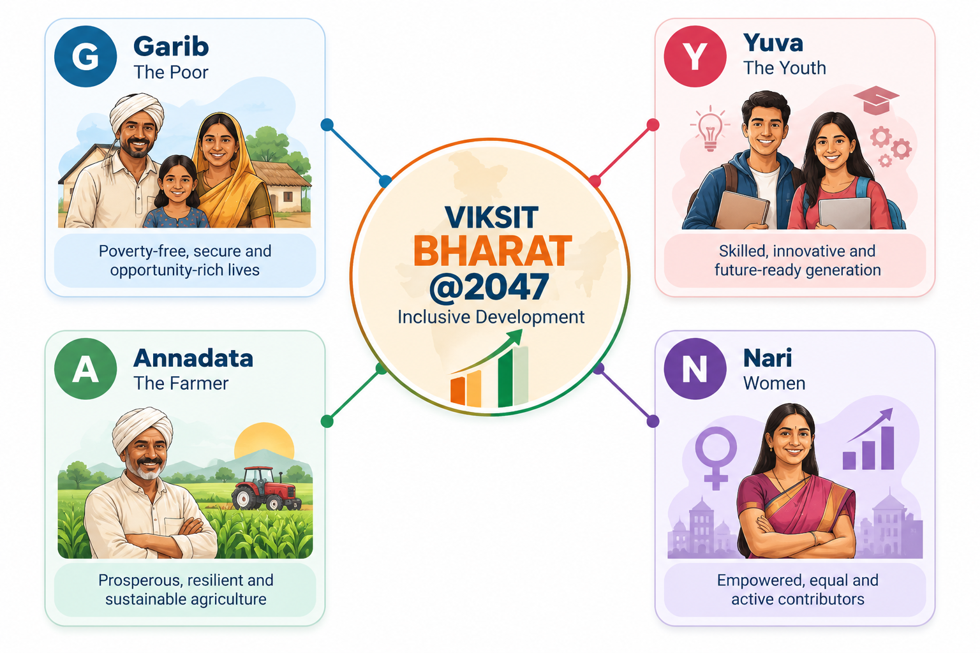
This framing ties a developed nation to inclusive growth rather than aggregate wealth alone — connecting the vision directly to social justice and the structure of Indian society. The delivery engine for this inclusion — Direct Benefit Transfer, digitised welfare and targeted programmes — links it to the wider architecture of government schemes.
NITI Aayog’s Strategic Architecture
Behind the political framing sits the technical planning, led largely by NITI Aayog, which is preparing a detailed vision document and has driven the roadmap through forums such as the ninth Governing Council meeting chaired by the Prime Minister. Its strategy rests on four broad imperatives:
- Economic competitiveness and growth — productivity, innovation and regulatory simplification.
- National security and stability — modern defence and cyber-security.
- Global partnerships and strategic influence — deeper trade and diplomatic ties.
- Legal reform and good governance — transparent, efficient institutions.
Crucially, NITI Aayog stresses that “developed” is more than money: the vision bundles sustainability, social inclusion, security and global leadership together. It also flags a weakness — research and development spending, at well under 1% of GDP, must rise toward the ~2% that innovation-led economies sustain.
The Economic Engine: Manufacturing, Infrastructure and Jobs
An economy cannot grow eightfold on services alone. Three levers do the heavy lifting:
- Manufacturing. Production-Linked Incentives, “Make in India” and a push into electronics, semiconductors and defence aim to raise industry’s share of output — the domain of India’s industrial sector.
- Infrastructure. The PM Gati Shakti National Master Plan (2021) knits together the planning of roads, rail, ports and logistics to cut delays and costs, backed by heavy public capital spending on the infrastructure sector.
- Services. The fast-growing services sector — IT, finance and beyond — remains a major export earner and employer.
The Demographic Dividend: A Window That Will Not Stay Open
India’s greatest asset is its people. With a median age of about 28–29 and most of the population under 35, India enjoys a “demographic dividend” — a large working-age population relative to dependents, the same phase that powered East Asia’s fastest growth. But a dividend is only realised if that workforce is healthy, educated and employed.
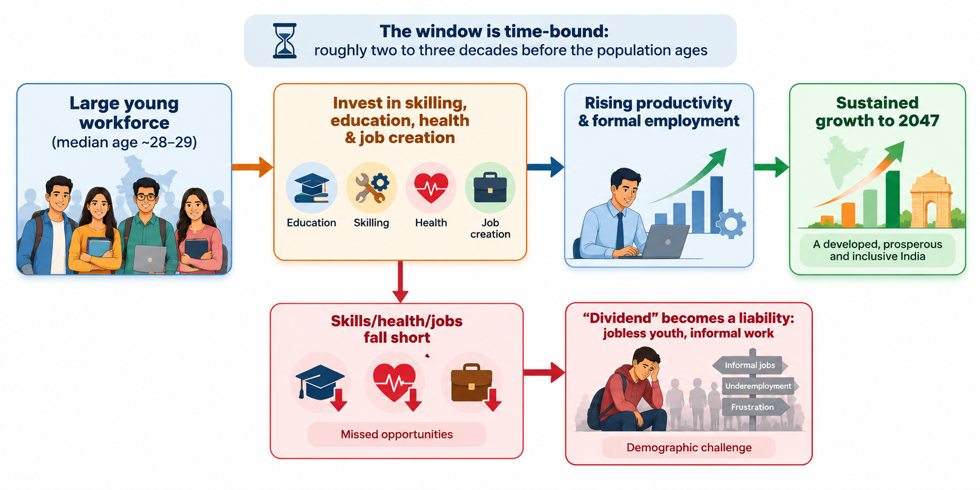
That makes skilling, education and job creation the hinge on which Viksit Bharat turns — and the government’s own analysis acknowledges the scale of the skilling challenge. The window is also time-bound: as fertility falls and the population ages, the worker-to-dependent ratio will decline. These questions of population, employment and human capital sit at the heart of Indian society as a subject of study.
Green Growth: Development Without the Old Mistakes
A distinctive feature of the 2047 vision is that India intends to grow without repeating the high-carbon path of earlier industrialisers. At the 2021 Glasgow summit it announced “Panchamrit” — five climate pledges — and the progress so far has run ahead of schedule:
| Commitment | Target | Progress |
| Non-fossil electricity capacity | 500 GW by 2030 | 50% reached in June 2025 |
| Net-zero emissions | By 2070 | Anchored by the renewable build-out |
Energy transition, green hydrogen and climate adaptation are therefore core to the model — tying Viksit Bharat firmly to the study of the environment and climate policy.
Digital Public Infrastructure and Governance
India’s digital public infrastructure — Aadhaar, UPI and the wider “India Stack” — is frequently cited as proof that the country can build world-class systems at scale. Real-time payments, digital identity and paperless welfare have reshaped how citizens meet the state, and the vision treats this as a template for leapfrogging in health, education and finance.
None of it works without capable institutions. The quality of the bureaucracy, the speed of the courts, the ease of doing business and the strength of federalism will decide whether targets become outcomes — the concerns of polity and governance. Externally, India’s rising weight in the G20, trade diplomacy and strategic partnerships links the domestic project to international relations.
Saptadhara Vision for Viksit Bharat 2047
From the Red Fort in his 80th Independence Day address, the Prime Minister unveiled “Saptadhara” — a seven-point reform blueprint to achieve Viksit Bharat by 2047.
The Seven Pillars
| Pillar | Thrust |
| Manufacturing Excellence | Turn domestic manufacturing into a competitive global supply-chain hub on cost, quality and scale. |
| Technological Innovation | Position India as a leader in digital tech, data infrastructure and AI solutions. |
| Gati Shakti | Seamless mobility via high-speed rail, expressways and port-led infrastructure. |
| India’s Soft Power | Cultural outreach — knowledge systems, yoga, Ayurveda, tourism and creative industries. |
| Agricultural & Food Processing | Connect farms to global markets; promote millets, spices and processed foods. |
| Green and Blue Economy | Leadership in green hydrogen, renewable storage, coastal tourism and ocean technologies. |
| Defense Shakti | Strengthen domestic production of advanced military systems, drones and next-gen technologies. |
A Balanced View: The Challenges Ahead
An honest assessment weighs the obstacles as seriously as the ambition:
| Challenge | Why it matters |
| Arithmetic of growth | Sustaining ~8% growth for two decades, through shocks and climate stress, is a feat almost no large economy has managed. |
| Inequality & jobs | GDP can rise while millions stay in low-productivity, informal work — which is why social justice stays central to the debate. |
| Human capital | Public spending on health and education is modest as a share of GDP; a young but under-skilled workforce cannot power a high-income economy. |
| The middle-income trap | Fast-growing economies can stall once wages rise but innovation and institutions lag. A big total economy with modest per-capita income is still a developing country. |
An Aspiration That Demands Delivery
Viksit Bharat @2047 is best read as a national compass, not a guarantee. It points in a clear direction — a high-income, inclusive, sustainable and globally influential India — and the early signals are encouraging: a fast-growing economy now ranked fourth in the world, a clean-energy transition ahead of schedule, and a digital backbone many richer nations envy.
Yet the distance between a US$4 trillion economy with a US$2,700 per-capita income and a US$30 trillion economy with US$18,000 is vast, and it will be closed only by decades of disciplined delivery — on jobs, health and education, manufacturing, and governance. The vision has supplied the ambition. Whether 2047 delivers a developed India depends on how faithfully that ambition reaches the everyday lives of the Garib, the Yuva, the Annadata and the Nari in whose name it was framed.