
Fundamentals of Earthquake
An earthquake is nothing but the shaking or trembling of the earth’s surface.
But the question is—why does the earth shake?
It happens because of seismic waves (also called earthquake waves). These waves are generated when there is a sudden movement or sudden release of energy in the earth’s crust or upper mantle.
👉 If the energy is released in the crust, we usually get shallow-focus earthquakes.
👉 If it is released deeper, in the upper mantle, then we may get intermediate or even deep-focus earthquakes.
So, in simple terms, an earthquake is nature’s way of releasing stored energy inside the earth, which travels outwards in the form of seismic waves and shakes the ground.
Terms
Focus and Epicentre
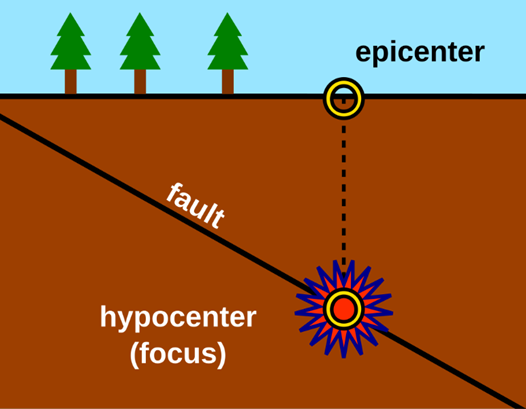
Now, let us carefully differentiate between Focus and Epicentre, two terms that UPSC often tests.
- Imagine you are bursting a cracker underground.
- The exact point where the cracker explodes is called the Focus or Hypocentre.
- The point directly above that, on the earth’s surface, where people will first feel the vibration, is called the Epicentre.
So:
- Focus = actual origin point inside the earth.
- Epicentre = surface point directly above the focus.
To measure and record earthquakes, we use instruments called Seismograph or Seismometer.
👉 And another technical term: Isoseismic line.
This is a line on a map that connects all points experiencing the same intensity of shaking. Think of it like contour lines on a topographic map, but instead of height, here we measure intensity of shaking.
Foreshocks, Aftershocks, and Swarms
- Foreshock: A small earthquake that occurs before the main earthquake. It’s like nature giving us a “warning tremor.”
- Aftershocks: Smaller earthquakes that occur after the main quake. They are very common and can continue for days, weeks, or even months. They happen because the earth’s crust is still adjusting to the new position after the big release of energy.
- Earthquake Swarms:
- Sometimes, instead of one big earthquake, a region experiences many small earthquakes over a period of time.
- If no big earthquake follows, such a cluster of small quakes is called a swarm.
- These are often linked with volcanic activity. Why? Because as magma moves underground, it cracks rocks, generating many small tremors.
- In fact, swarms act like “markers” to track the path of moving magma inside volcanoes.
Causes of Earthquakes.
Broadly, earthquakes are caused by natural processes (like fault rupture, plate tectonics, volcanic activity) and sometimes even by human activities (like mining, dam construction, nuclear testing).
1. Fault Zones – The Immediate Cause
The most direct cause of shallow earthquakes is the sudden release of stress along a fault rupture in the earth’s crust.
👉 Why does this happen?
- Deep inside the earth, rocks are under intense temperature and pressure.
- These conditions keep changing the volume and density of rocks, and at some point, the accumulated stress becomes too much.
- This stress is suddenly released along a crack in the crust—called a fault—and that’s when an earthquake happens.
Now, the size of the earthquake depends on the length and width of the fault rupture.
- Thrust/Reverse Faults (Convergent boundary): Longest ruptures (up to ~1000 km) → very powerful quakes.
- Strike-Slip Faults (Transform boundary): About half to one-third the length of thrust fault ruptures.
- Normal Faults (Divergent boundary): Shortest ruptures → relatively weaker earthquakes.
2. Plate Tectonics – The Fundamental Cause
Earthquakes are closely linked with the movement of tectonic plates. Different types of faults are associated with different plate boundaries:
- Normal Faults (Divergent Boundary):
- Plates move apart.
- Earthquakes here are generally smaller (less than magnitude 7).
- Strike-Slip Faults (Transform Boundary):
- Plates slide past each other horizontally.
- Can cause major earthquakes (up to magnitude 8).
- Famous example: San Andreas Fault in California, where the Pacific Plate and North American Plate slide past each other.
- Reverse Faults (Convergent Boundary):
- Plates collide, and one plate is forced under the other (subduction zone).
- Produces the most powerful earthquakes in the world → called Megathrust Earthquakes.
- Almost all earthquakes of magnitude 8 and above belong to this category.
- Example: 2004 Indian Ocean Earthquake (Sumatra), which triggered the deadly tsunami.
3. Volcanic Activity – A Secondary Cause
Volcanoes and earthquakes are natural partners, but the earthquakes caused by volcanoes are generally weaker and more localized compared to tectonic earthquakes.
- Cause: Movement of magma + release of elastic strain energy along tectonic faults near volcanoes.
- Importance: These quakes can act as early warnings of volcanic eruptions.
- Example: Before the 1980 eruption of Mount St. Helens (USA), volcanic earthquakes were recorded.
👉 However, note an important point:
- While volcanoes and earthquakes both concentrate in regions like the Circum-Pacific Belt (“Ring of Fire”),
- Most major shallow earthquakes occur nowhere near volcanoes.
4. Human-Induced Earthquakes
Humans too can trigger earthquakes, though most are of minor magnitude.
Activities like:
- Mining (blasting, deep excavation),
- Large-scale petroleum extraction,
- Nuclear tests,
- Construction of artificial lakes (reservoirs) → all can disturb the stress balance in rocks and trigger tremors.
5. Reservoir-Induced Seismicity (RIS)
This deserves special attention because UPSC has asked about it.
- When a large and deep artificial reservoir is created (for example, behind a dam), the pressure of the water column alters the stress in the crust below.
- Water seeps into the faults, weakens the rock structure, and lubricates the faults.
- This added pressure can trigger earthquakes.
Examples:
- 1967 Koynanagar Earthquake (Maharashtra):
- Magnitude 6.3, more than 150 deaths.
- Believed to be triggered by the filling of the Koyna Dam reservoir.
- 2008 Sichuan Earthquake (China):
- Around 68,000 deaths.
- Some geologists link it to the filling of the Zipingpu Dam near the epicentre.
Depth of Focus – The Vertical Dimension of Earthquakes
Earthquakes don’t just differ in magnitude or cause; they also differ in how deep they originate inside the earth.
👉 Quakes can occur anywhere between the surface and about 700 km below the surface.
For scientific purposes, this entire range (0–700 km) is divided into three zones:
- Shallow-focus earthquakes: 0–70 km deep
- Intermediate-focus earthquakes: 70–300 km deep
- Deep-focus earthquakes: 300–700 km deep
Now here’s the important part:
- 70–85% of all earthquake energy comes from shallow quakes.
- 12–15% comes from intermediate quakes.
- Only 3–5% from deep-focus quakes.
So, while deep earthquakes may sound powerful, shallow ones are far more destructive, because their energy is concentrated near the surface.
Case Study: Italy vs. Myanmar (2016)
- Italy (2016): Magnitude 6.2, shallow (only 10 km deep), killed ~300 people.
- Myanmar (2016): Magnitude 6.8, deeper (84 km deep), very few deaths.
👉 This shows us that depth of focus matters more than magnitude alone when it comes to destruction.
1. Shallow-Focus Earthquakes (0–70 km)
- Most common → also called “crustal earthquakes”.
- Generally, of smaller magnitude (1 to 5), but some can be very strong and destructive.
- Occur frequently and randomly.
- Many occur along submarine ridges, so people often don’t feel them.
- Why dangerous?
- Even low-magnitude shallow quakes can cause high surface damage, because all the energy is released close to the ground.
2. Deep-Focus Earthquakes (70–700 km)
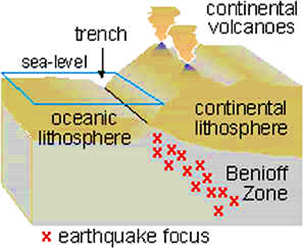
- Found in Benioff zones (sloping seismic zones that mark subduction).
- Also called intraplate earthquakes, since they occur within the subducting slab.
- Usually larger magnitude (6–8), as plate collisions release huge energy.
- But relatively less destructive → because the focus is deep, so the energy dissipates before reaching the surface.
Examples:
- Okhotsk Sea Earthquake (2013): Magnitude 8.3 at 609 km depth → strongest deep-focus quake ever recorded.
- Vanuatu Earthquake (2004): Depth 735.8 km → deepest earthquake in history, though magnitude was just 4.2.
Wadati–Benioff Zone
This is a very important UPSC keyword.
- It is a zone of subduction, where earthquakes occur frequently.
- Named after seismologists Kiyoo Wadati and Hugo Benioff.
- Here, earthquakes may occur as deep as 700 km.
- Most powerful earthquakes in the world occur along these zones → i.e., Convergent Boundaries.
Types of convergent boundaries and Wadati–Benioff zones:
- C–C (Continent–Continent): Example – Himalayas.
- O–O (Ocean–Ocean): Example – Mariana Trench subduction.
- C–O (Continent–Ocean): Example – Andes (Nazca plate under South American plate).
So, whether it is slipping on the subduction thrust fault or movement within the downgoing plate, Benioff zones are the hotbeds of the world’s most destructive megathrust earthquakes.
4 Comments