
Relations with Nepal under British India around 18th Century
Let’s start in the 18th century.
Gorkha Conquests in the West (1767 onwards)
- Prithvi Narayan Shah—a powerful and ambitious ruler—was the last king of the small Gorkha Kingdom and the first king of a unified Nepal.
- In 1767, he attacked the Kathmandu Valley, which was then ruled by the Malla dynasty. This disrupted trade between Nepal and Patna (where the British had a strong presence).
- The Malla kings, desperate for help, asked the British in Calcutta for support.
- The British sent Captain Kinloch from Patna to attack the Gorkhas, but the mission failed—the Gorkhas successfully defended themselves.
After this victory, the Gorkhas expanded their power from Bhutan in the east to the Sutlej River in the west, building a strong military reputation.
Nepal–Sikh Conflict – Clash of Mountain and Punjab Power
How it Started (1805–1809)
- In 1805, Sansar Chand, ruler of Kangra State (modern Himachal Pradesh), attacked neighbouring Bilaspur.
- Bilaspur sought help from the Gorkhas, who crossed the Sutlej and attacked Kangra.
- In 1809, Sansar Chand turned to Maharaja Ranjit Singh of Punjab for help—offering him the Kangra fort as payment.
Ranjit Singh had a bigger vision—he wanted to expand eastward and knew the Gorkhas could be an obstacle. So, he agreed to help.
The War
- In 1809, after a long and fierce battle, Ranjit Singh’s Sikh forces defeated the Gorkhas.
- The Gorkhas retreated beyond the Sutlej.
- True to his deal, Ranjit Singh kept the Kangra fort and 66 villages (to maintain the fort’s garrison) and returned the rest of the territory to Sansar Chand.
The End of Kangra’s Independence
- In 1828, Ranjit Singh conquered the rest of Kangra State, ending its independence. The region became part of the Sikh Empire.
The Anglo–Nepal War (1814–1816)
We’ve already seen that the British and the Gorkhas were expanding powers, and sooner or later, their frontiers were bound to clash. That’s exactly what happened in the early 1800s.
The Road to War
- In 1801, Sadat Ali Khan, the Nawab of Awadh, handed over Gorakhpur to the British East India Company. This brought the British right to the edge of Gorkha-controlled territory, across an ill-defined border.
- In 1804, Amar Singh Thapa, a prominent Gorkha general, conquered Palpa and demanded rent from Butwal—a territory near Gorakhpur.
- The EIC warned the Gorkhas to stay out of their claimed land. The dispute dragged on for a decade, and by 1814, Lord Hastings decided enough was enough—war was formally declared.
The British thought it would be an easy campaign. But here’s the twist—the Gorkhas fought ferociously and repeatedly defeated British armies in the early phase. The British soon realised this was no “walkover” war.
The Turning Point – Battle of Malaun (1815)
- Lasted from 14 April to 15 May 1815—one of the bloodiest phases of the war.
- In the end, the British under General Ochterlony defeated the Gorkhas.
- Amar Singh Thapa surrendered on 15 May 1815.
Terms of the 1815 agreement between Amar Singh Thapa and the British:
- Gorkha territory west of the Mahakali River was ceded to the British.
- All forts surrendered.
- Nepali soldiers could join the British Army.
However, Nepal’s government refused to accept the British demand to station a Resident in Kathmandu—so peace talks broke down, and fighting resumed in early 1816.
Treaty of Sugauli (1816)
The British pushed forward and came within 50 miles of Kathmandu. Finally, Nepal agreed to formal peace:
Terms of the Treaty:
- Accepted a British Resident in Kathmandu.
- Ceded Garhwal and Kumaon.
- Abandoned claims to the Tarai.
- Withdrew from Sikkim.
- Gave up all territory west of the Kali River and east of its present borders.
📌 Impact – Nepal lost about one-third of its territory to the EIC.
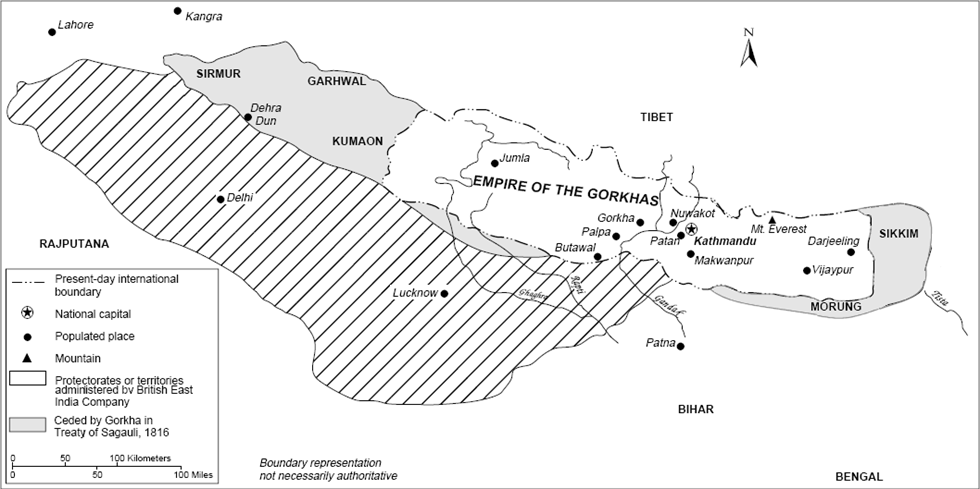
Why the British were Happy
- Got better trade access to Central Asia.
- Acquired hill stations like Shimla and Mussoorie.
- Won over a new source of military manpower—the Gorkhas.
The Gurkhas in the British Army
The British were deeply impressed by Gorkha bravery and resilience. After the Battle of Malaun (1815), they started recruiting them into special Gorkha regiments.
Key points about recruitment:
- Initially, only Nepalis were taken; after 1947, Indian citizens could also join.
- In 1947, after independence, a Tripartite Agreement between Nepal, India, and Britain allowed continued Gorkha recruitment into both the Indian and British armies.
- Today, over 20,000 Nepali nationals serve in seven Gorkha regiments of the Indian Army.
- Every year, around 1,400 Nepali youth are recruited into India’s forces.
💬 Famous praise: Field Marshal Sam Manekshaw once said—
“If a man says he is not afraid of dying, he is either lying or he’s a Gurkha.”
Cultural Note – Gorkhalis vs. Nepalis
Many descendants of Gorkha soldiers identify as Gorkhalis, not Nepalis—especially in regions like Darjeeling, where demands for Gorkhaland have emerged. This is partly because, when Gorkhas crossed the Mahakali River to annex hill states, the idea of a “nation called Nepal” was still not formalised.
A Notable Figure – Ram Chand Thakur (1914–2002)
- Served in Gorkha Rifles from Kangra, Himachal Pradesh.
- Later joined Netaji Subhas Chandra Bose’s INA.
- Composed martial songs like “Kadam Kadam Badaye Ja”, still sung in the Indian military.
The Pause in Recruitment (2022)
- In 2022, India launched the Agnipath Scheme for short-term soldier recruitment.
- Nepal objected to applying this scheme to Nepalese Gorkhas, saying it violated the 1947 Tripartite Agreement, which required political consensus for changes.
- As a result, recruitment of Nepalese Gorkhas into the Indian Army was temporarily halted.
Why This Episode Matters for UPSC
- Shows how British frontier policy was shaped by both security and manpower needs.
- Anglo–Nepal War outcomes directly affected British influence in the Himalayas.
- Gorkha recruitment created a long-lasting military tradition still relevant in India’s armed forces.
For chapter-wise Modern Indian History Notes for UPSC Prelims and Mains, refer to the complete Modern Indian History notes page.