
Introduction to Ocean Deposits
Let’s say you are standing on a beach, feeling the sand under your feet. Now, picture the vast ocean stretching before you. What lies beneath those endless waters? As we dive deeper, we enter a world where the ocean floor is covered with a variety of materials—remnants of rocks, marine life, and even microscopic organisms. These materials, accumulating over millions of years, are collectively known as ocean deposits.
But where do these deposits come from? What are they made of? To understand this, let’s embark on a journey from the shallow coastal waters to the depths of the abyssal plains.
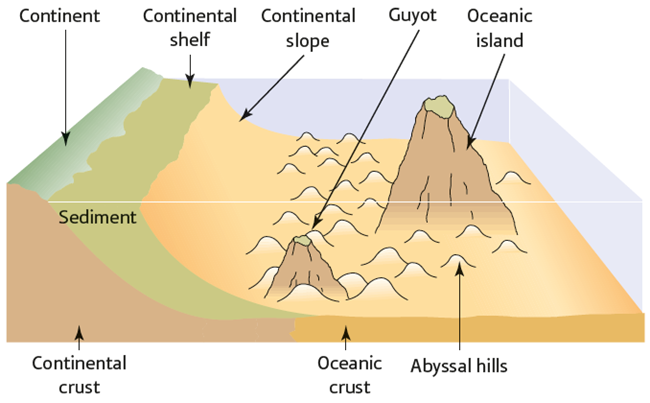
Types of Ocean Deposits
As we move from the shoreline to the deep sea, ocean deposits change in nature. They can be broadly classified into two types based on their source and location:
1. Terrigenous Deposits
Our journey begins at the continental shelf and slope—the submerged extensions of land that gradually descend into the ocean. Here, we find terrigenous deposits, which are primarily made up of rock fragments, sand, and mud. These materials originate from the land, transported by rivers, wind, and glaciers.
Think of the mighty Ganges or Brahmaputra rivers, which carry sediments from the Himalayas and deposit them into the Bay of Bengal. Over time, these sediments accumulate along the continental shelf and slope, forming layers of terrigenous deposits.
However, the story doesn’t end here. Sometimes, ocean currents and underwater landslides transport these deposits further into the deep sea, blurring the distinction between terrigenous and pelagic deposits.
2. Pelagic Deposits
Now, let’s venture beyond the continental slope into the vast, open ocean, where sunlight barely reaches. Here, the ocean floor is covered with pelagic deposits—fine-grained sediments that slowly settle from the water above.
Unlike terrigenous deposits, which originate from land, pelagic deposits mainly come from the remains of marine plants and animals. Microscopic organisms like foraminifera and radiolarians, after completing their life cycle, sink to the ocean floor, forming biological sediments. Additionally, mineral-rich particles from volcanic eruptions and deep-sea chemical processes also contribute to these deposits.
However, just like the terrigenous deposits can travel far into the deep sea, pelagic deposits can sometimes extend up to the continental slope, making the boundary between the two types less rigid than it appears.
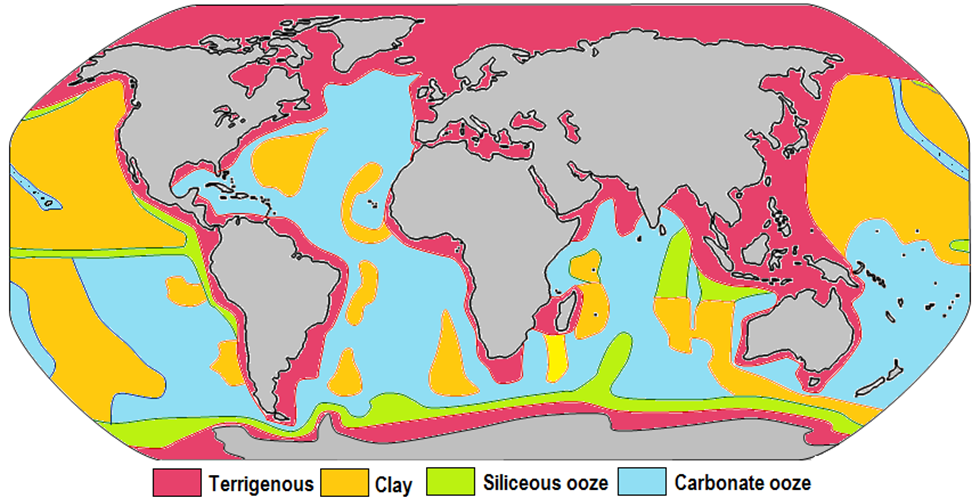
So, in conclusion: The ocean floor is not just a barren expanse but a dynamic and ever-changing landscape, shaped by forces of nature over millions of years. Whether it’s the terrigenous sediments washing down from towering mountains or the pelagic remains of tiny marine creatures, every particle tells a story of Earth’s geological and biological history.
In the next sections we will explore about terrigenous and pelagic sediments in greater detail.