
Introduction to Indian Soils
We can say soil as the interface between life and lifelessness. It is formed from rocks (non-living) but becomes the foundation for plants, crops, and forests (living). So, to understand soil, we need to ask three questions:
- Where does it come from?
- How is it formed?
- What types are found in India?
Characteristics of Indian Soils
Imagine the vast landscapes of India—from the fertile Indo-Gangetic plains to the rocky Deccan Plateau and the arid Thar Desert. The soil beneath these lands is as diverse as the climate and topography. But what makes Indian soils unique? Let’s explore.
1. Age and Maturity
🕰 Ancient Origins – Most Indian soils are old and mature, having evolved over thousands of years under diverse climatic conditions.
🏞 Peninsular Plateau vs. Indo-Gangetic Plain – The soils of the Peninsular Plateau are much older compared to those of the Great Northern Plain, which have been recently formed by river deposition.
2. Nutrient Deficiency
🧪 Low in Nitrogen & Minerals – Indian soils lack essential nutrients like nitrogen and mineral salts, affecting crop productivity.
🌿 Low Organic Matter – Many soils, especially in dry regions, are deficient in humus and organic materials, reducing their fertility.
3. Variation in Soil Depth
🌊 Thick Soils in Plains & Valleys – The Indo-Gangetic Plains have deep layers of fertile soil, thanks to continuous deposition by rivers.
⛰ Thin Soil Cover in Hills & Plateaus – In contrast, hilly and plateau regions have shallow, rocky soils that are less suitable for agriculture.
4. Fertile vs. Infertile Soils
🌾 Highly Fertile Soils – Alluvial soils (found in river valleys) and black soils (ideal for cotton farming) are highly productive.
🏜 Infertile Soils – Laterite, desert, and alkaline soils have low fertility and require proper soil management to improve yield.
5. Soil Exhaustion
🚜 Centuries of Cultivation – Indian soils have been continuously used for agriculture for hundreds of years, leading to loss of fertility. Overuse without proper replenishment has depleted essential nutrients.
Conclusion: The Need for Sustainable Soil Management
Indian soils, though diverse, face serious fertility challenges. To ensure sustainable agriculture, practices like crop rotation, organic farming, and soil conservation techniques must be adopted.
Geological Classification of Indian Soils
India’s geography can broadly be divided into two parts:
- Peninsular India – The ancient landmass, hard rocks, plateau region.
- Extra-Peninsular India – The Indo-Gangetic and Brahmaputra plains in the north.
Let’s understand these two with a relatable analogy.
Analogy: Think of Peninsular India as an old kitchen slab, where over centuries, stains and wear develop right there on the surface. And Extra-Peninsular India is like a freshly renovated floor, where layers of new tiles are laid by workers (in our case—rivers!).
🪨 Soils of Peninsular India:
- Formed in situ (Latin: in the original place).
- That is, rocks break down over time—through heat, rain, wind—and form soil right there.
- These are called sedentary soils, because they don’t move much from their original place.
- Example: Black soil of the Deccan Plateau, Red soil of Tamil Nadu, etc.
🌊 Soils of Extra-Peninsular India:
- These are transported soils.
- Brought and deposited by rivers and winds—especially the mighty rivers like the Ganga, Yamuna, and Brahmaputra.
- Formed in layers, very deep, and rich in fertility.
- Known as azonal soils, because their characteristics don’t depend on climate or rocks of the place—they’re influenced more by where the river brings the soil from.
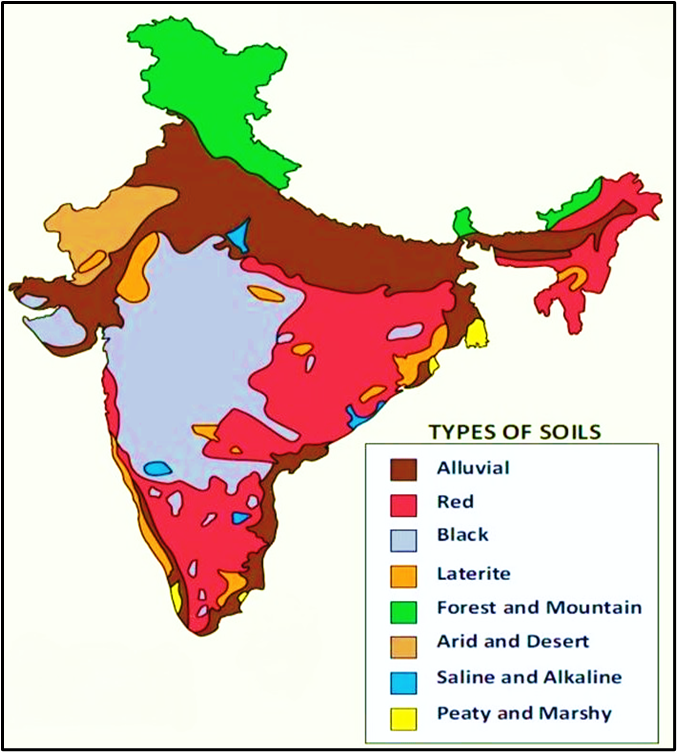
Major Soil Groups in India
Let’s now introduce the main cast in the Indian soil story. These are the 8 major soil types you must remember for UPSC.
a. Alluvial Soils – “The lifeline of Indian agriculture”
b. Black Soils – “The cotton soil” or “Regur soil”
c. Red Soils – “Iron-rich but nutrient-poor”.
d. Laterite and Lateritic Soils – “Rain-washed and iron-rich”
e. Forest and Mountain Soils – “Soils of slopes and heights”
f. Arid and Desert Soils – “The sandy challenge”
g. Saline and Alkaline Soils – “Soils with excess salts”
h. Peaty and Marshy Soils – “Organic overload”
We will explore each of these soil types in a greater detail in upcoming sections
🧠 Final Takeaway:
Soil is not just dust under our feet—it is the history of rocks, the journey of rivers, and the foundation of agriculture.
| Region | Soil Origin | Type |
| Peninsular India | In-situ (Sedentary) | Red, Black, Laterite |
| Extra-Peninsular India | Transported by rivers (Azonal) | Alluvial |
Each soil type is like a character in a drama, shaped by its geology, climate, vegetation, and human use.
🧠 Mnemonic to Remember All 8 Soil Types
Here’s a catchy mnemonic to help you remember the 8 major soil types in order:
“All Black Rats Love Forests And Salty Peanuts“
- A – Alluvial
- B – Black
- R – Red
- L – Laterite
- F – Forest/Mountain
- A – Arid/Desert
- S – Saline/Alkaline
- P – Peaty/Marshy
Summary Table:
Before you dive into the summary table below, I recommend reading through the detailed descriptions of each soil type in the upcoming sections. This will help you understand the nuances better and make the summary more meaningful.
| Soil Type | Formation/Origin | Major Areas | Key Characteristics | Crops Grown | Challenges |
|---|---|---|---|---|---|
| Alluvial Soil | Deposited by rivers (Indus, Ganga, Brahmaputra) | Indo-Gangetic plains, coastal areas | Fertile, sandy to clayey, rich in potash and lime, poor in phosphorous | Wheat, rice, sugarcane, pulses, oilseeds | Prone to erosion, poor phosphorous |
| Black Soil (Regur) | Formed from lava rocks (volcanic) | Deccan plateau – Maharashtra, MP, Gujarat | Clayey, moisture-retentive, rich in lime, iron, magnesium; poor in nitrogen and phosphorous | Cotton, sugarcane, jowar, soybean | Cracks in dry season, poor drainage |
| Red Soil | Formed by weathering of ancient crystalline rocks | TN, Karnataka, AP, Odisha, Chhattisgarh | Reddish due to iron, porous, non-retentive, poor in nitrogen, lime, humus | Millets, pulses, groundnut, potato | Requires fertilization |
| Laterite Soil | Leaching under heavy rainfall and high temp. | Western Ghats, Eastern Ghats, NE India | Acidic, low fertility, rich in iron and aluminum | Tea, coffee, cashew, rubber | Infertile without fertilizers |
| Arid/Desert Soil | Formed in arid regions with high evaporation | Rajasthan, Gujarat, parts of Punjab & Haryana | Sandy texture, saline/alkaline, low humus, poor organic matter | Bajra, pulses (with irrigation) | Salinity, low water retention |
| Mountain/Forest Soil | Formed by organic matter & forest vegetation | Himalayan region, Western & Eastern Ghats | Varied texture, rich in humus in lower altitudes, acidic in higher altitudes | Tea, spices, temperate fruits | Prone to erosion on slopes |
| Saline and Alkaline Soil | Poor drainage, dry regions | Arid/semi-arid areas of UP, Punjab, Rajasthan | Saline, poor fertility, contains sodium and potassium salts | Rice (with gypsum treatment) | Unfit for crops without treatment |
| Peaty and Marshy Soil | Organic matter from waterlogged areas | Kerala, coastal Bengal, Odisha delta | High in humus and organic content, blackish, acidic | Rice, jute | Waterlogging, salinity |