
Cement Industry
Imagine a building without cement. Not possible, right?
Cement is the glue that binds our infrastructure—homes, roads, bridges, dams. That’s why it is classified as a core industry, meaning it’s essential for economic development.
The presence of a strong cement industry shows two things:
- Construction is happening → implies development
- People can afford to build → implies prosperity
That’s why even per capita cement consumption is seen as an index of economic well-being.
📊 Key Fact:
- India’s per capita consumption: ~240-250 kg
- World average: ~500-550 kg
(As of 2024)
This shows that while we’ve made progress, we still have immense scope for growth.
🏭 Nature of the Industry: Advanced but Raw-Material Oriented
The cement industry is one of India’s most advanced, due to:
- Use of modern technology
- High efficiency of Indian plants
- Low production cost
But despite being advanced, it is raw material-oriented. Why? Let’s explore
🏗️ Manufacturing of Cement
Raw Materials
- Calcareous (lime-rich): limestone, marl, chalk, cement rock.
- Argillaceous (clay-rich): clay, shale, slate, blast furnace slag.
- Choice of raw material determines process suitability.
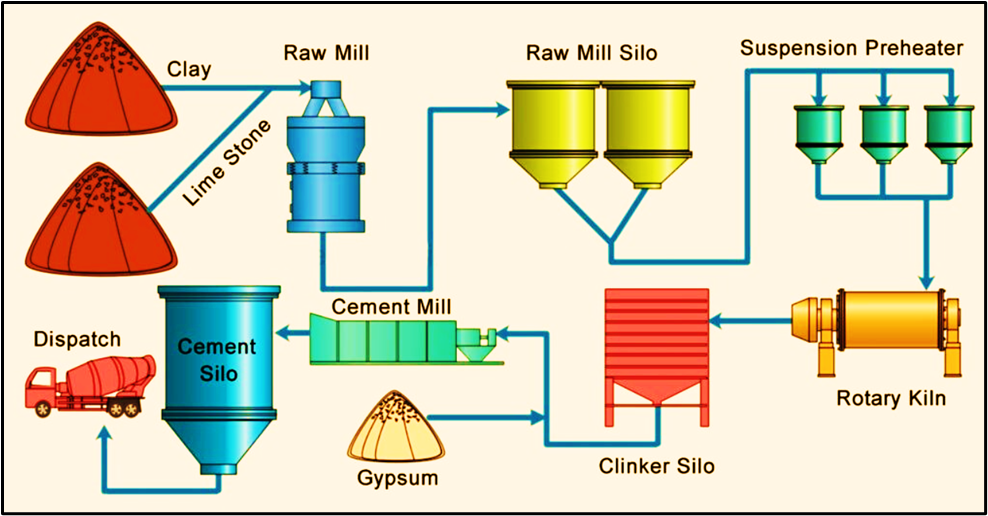
Processes of Manufacture
Two main methods: Dry Process & Wet Process.
🔹 Dry Process
- Preferred when raw materials are hard.
- Steps:
- Crushing → dry mixing.
- Add ~14% water → cohesion → lumps.
- Feed lumps into rotary kiln → calcination → clinkers formed.
- Clinkers cooled → ground in tube mills.
- Add 2–3% gypsum → retard setting.
- Final product: Ordinary Portland Cement (OPC).
🔹 Wet Process
- Suitable when raw materials are soft.
- Steps:
- Crushing + water → slurry in wash mill.
- Pulverization with steel balls.
- Slurry composition adjusted in silos (~40% moisture).
- Sent to rotary kiln → heated to 1500–1600°C → clinkers formed.
- Clinkers cooled → ground in tube mills.
- Add gypsum → final cement powder.
Key Reactions
- Calcination in kiln:
- Removal of volatiles.
- Oxidation → formation of clinkers.
- Role of gypsum: controls setting time by coating cement particles.
Comparative Insights
| Aspect | Dry Process | Wet Process |
|---|---|---|
| Raw material type | Hard | Soft |
| Energy requirement | Lower | Higher (due to slurry evaporation) |
| Cost | Cheaper | Costlier |
| Homogeneity control | Less | Better (slurry allows proportioning) |
🗺️ Locational Factors: The Geographical Logic
Raw Materials – Especially Limestone
- Cement production typically requires:
- 60–65% limestone
- 20–25% silica
- 5–12% alumina
- Small amounts of gypsum, slag, sea shells
- For every 1 tonne of cement → 1.5 tonnes of limestone is needed.
Hence, the ideal location for a cement plant is:
Near limestone deposits, especially where it’s high quality and abundant.
That’s why we see cement plants along the Vindhyan ranges—Eastern Rajasthan to Jharkhand.
⚡ Energy (Coal + Electricity)
- Energy forms ~40% of production cost
- Used in:
- Grinding raw material
- Running kilns (coal as fuel and heat source)
Thus, power availability is crucial.
🚚 Transportation
- Cement is a heavy, low-cost item.
- Transporting it over long distances makes it expensive.
Hence, there are two key location strategies:
- Near raw material source (to avoid transporting limestone)
- Near markets (to avoid transporting cement itself)
Sometimes a middle ground is chosen, balancing both.
🏙️ Market Access
A ready market is essential for such a bulky commodity.
- Urban areas
- Industrial zones
- Infrastructure corridors
Without market access, even a well-placed plant will struggle to survive.
🌍 Regional Pattern
- Vindhyan belt (Rajasthan → MP → Chhattisgarh → Jharkhand): high limestone, dense cement clusters
- Northern plains (Punjab, Haryana, UP): lack limestone → less cement industry
📈 Growth of Cement Industry: From Deficiency to Global Leadership
Let’s take a historical look:
🔁 Pre-1980s: Scarcity and Control
- Cement was under price and production control
- Demand outpaced supply
- Black marketing was common
📉 Partial Decontrol in 1982:
- Industry was freed partially from price controls
- Suddenly, production boomed
- India became self-sufficient in cement within 5 years
🚀 Post-Liberalization Growth:
- Technology upgraded
- Capacity expanded
- Many mini plants emerged to tap scattered deposits
- India became 2nd largest producer (after China)
🧪 Mini Cement Plants: Small but Strategic
Why were mini plants promoted?
- Limestone deposits are often scattered in remote areas
- Building a large plant there is economically unviable
- So, the government encouraged mini plants with incentives like:
- 50% reduction in excise duty
- Supportive infrastructure in rural zones
Benefits:
- Brings employment to remote regions
- Makes cement affordable and accessible locally
🛠️ Major Government Programmes Driving Demand
To utilize the excess capacity in cement production, the government launched:
- 🏠 Housing for All
- 🛣️ PMGSY (Grameen Sadak Yojana)
- 🚘 Four-lane highway development (Golden Quadrilateral, Bharat Mala)
These massive infrastructure projects provide sustained demand for cement.
⚠️ Problems Faced by the Industry
Despite all this, challenges remain:
🚛 Inadequate Transportation
- Roads and railways not always efficient for bulk material
- High logistics cost
🔋 Shortage of Power
- Especially in rural regions or peak demand seasons
🏭 Shortage of Coal
- Coal is needed not just for fuel but also to fire limestone kilns
- Often diverted to power sector or affected by poor mining logistics
📉 Low Per Capita Consumption
- Despite growth, India’s per capita use is much below global average
Indicates untapped potential—especially in rural housing and infrastructure.
🧩 Conclusion: Cementing the Foundation of India’s Development
To conclude:
If steel is the skeleton of infrastructure, cement is the muscle that gives it strength.
The Cement Industry of India today is:
- Technologically advanced
- Globally competitive
- Resource-dependent
- Yet full of untapped potential
With sustained infrastructure growth, rural development, and better power/logistics, this industry can not only grow further, but also raise India’s per capita consumption, employment, and export capacity.