
Petroleum and Mineral Oil
What is Petroleum (Crude Oil)?
Imagine a world millions of years ago—swamps, shallow seas, and dense forests filled with tiny plants and animals. When they died, their remains got buried under layers of mud and sediment. Over millions of years, under high pressure and temperature, this organic matter slowly transformed into a thick, black liquid we now call petroleum or crude oil.
🔹 The term Petroleum comes from Latin:
- Petra = rock
- Oleum = oil
So, petroleum literally means “oil from rock.”
And rightly so—petroleum is extracted from sedimentary rocks, which act like the sponge that holds this liquid gold.
If you are interested in knowing the history of Crude oil, here is a YouTube Video for you: How Oil Was Discovered? | Brief History of Crude Oil
Composition of Petroleum
Petroleum is not a single substance—it’s a complex mixture.
- 90–95% Hydrocarbons – These are compounds made of hydrogen and carbon.
- 5–10% other organic compounds – These contain elements like oxygen, nitrogen, sulphur, and even traces of organometallic compounds (organic molecules bonded with metals).
👉 Think of crude oil as a cocktail of various chemicals, each with different properties.
How is Crude Oil Processed?
Once we extract crude oil from underground, we don’t use it directly. It undergoes refining, specifically a process called fractional distillation.
Imagine you heat a pot filled with different liquids—each boils at a different temperature. Similarly, in a distillation tower:
- Lighter substances like gasoline vaporize and rise to the top.
- Heavier ones like bitumen stay at the bottom.
This way, we separate crude oil into different fractions based on boiling points—each fraction having its own use.
Mineral Oil: A Special Byproduct
Now, among these fractions is mineral oil—a byproduct from the heavier end of crude oil.
- It’s colourless, odourless, and has excellent lubricating properties.
- Since it doesn’t evaporate easily and doesn’t react with most substances, it’s used in:
- Industrial lubrication
- Cosmetics (e.g., baby oil)
- Medical applications
- Pest control
Analogy: Think of mineral oil as the calm, stable cousin of volatile fuels like petrol 😊
Key Features at a Glance
📌 Petroleum:
- Fossil Fuel – Non-renewable and formed over geological timescales.
- Complex Composition – Includes various hydrocarbons like alkanes, alkenes, and aromatics.
- Viscosity Varies – Can be thin like kerosene or thick like tar.
- Extraction – Requires advanced drilling technologies and infrastructure.
📌 Mineral Oil:
- Derivative of crude oil – Not found naturally; it’s made by refining.
- Mostly alkanes – Straight and branched chains of hydrocarbons.
- Multi-use – Found in products from your engine oil to face creams.
Applications of Petroleum Products
- Transportation
Fuels like gasoline, diesel, and jet fuel power cars, ships, planes—basically, our entire transport system. - Industrial Feedstock
Petroleum is the raw material for many industries:- Plastics
- Chemicals
- Fertilisers
- Petrochemicals
From synthetic fibres (like polyester) to pharmaceuticals, petroleum derivatives are everywhere. - Lubricants
Used in machinery to reduce friction and wear, ensuring smooth operation. - Asphalt and Bitumen
Think of roads—what binds the gravel? Bitumen, a thick residue from petroleum refining. - Aviation Fuel
Aircraft run on jet fuel, a highly refined, energy-dense form of petroleum. - Fertilisers
Though not directly petroleum, natural gas, often found alongside oil, is used to make ammonia-based fertilisers essential for modern agriculture.
So, Petroleum isn’t just fuel—it’s the foundation of the modern industrial world. From transportation to fertilisers, from cosmetics to construction, its reach is vast. Mineral oil, though just a byproduct, has quietly found its own essential niche.
Understanding these basics is vital in Economic Geography because they show how natural resources shape economic activity, industrial development, and global geopolitics.
Formation of Petroleum & Natural Gas
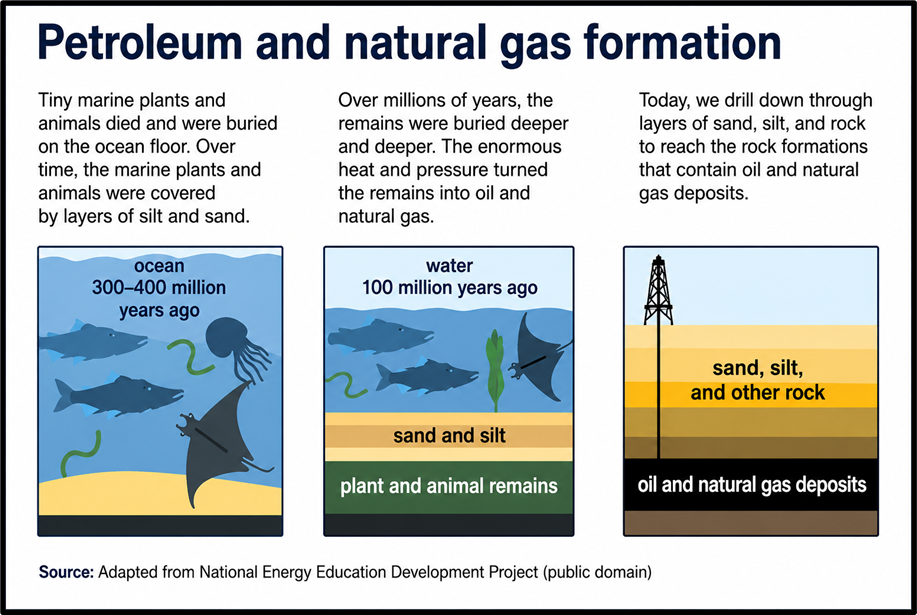
Imagine you’re looking at a calm, shallow sea millions of years ago. It was teeming with tiny sea plants and microscopic animals. Now, these creatures didn’t just vanish when they died. Instead:
- Their remains settled on the ocean floor.
- Over time, these remains got buried under layers of sediment and rock.
- As more and more layers piled up, enormous heat and pressure started acting on this buried organic material.
- This heat and pressure gradually transformed the dead matter into petroleum and natural gas—a process that took millions of years.
👉 This is why we call petroleum a fossil fuel—because it literally comes from the ancient “fossils” of marine life.
Today, we use drilling technologies to penetrate these sedimentary rock layers and extract oil and gas.
Conditions for Formation of Petroleum
Now here comes an important point:
Not all sedimentary rocks contain petroleum.
Then what makes a sedimentary basin productive?
There are three essential geological conditions required for an oil reservoir to exist. You can think of it like setting up a three-step filtration system:
1. Porosity
This refers to the tiny empty spaces (pores) within the rock.
- These pores act like storage units where oil or gas can accumulate.
- Without porosity, there’s no space to hold the oil.
🧠 Analogy: Think of a sponge. Its pores hold water. Similarly, porous rocks hold petroleum.
2. Permeability
This is the ability of rock to allow fluids to flow through it.
- Even if oil is present, unless it can move through the rock, you can’t extract it.
🧠 Analogy: Compare a sponge (permeable) and a plastic block (impermeable). You can squeeze water out of a sponge, not from plastic.
3. Impervious Cap Rock
A porous rock like sandstone or fissured limestone must be sealed below by an impermeable layer—like shale or clay.
- This cap rock acts like a lid, preventing the oil or gas from escaping upward.
- Without this cap, hydrocarbons would just leak away over time.
Where is Oil Typically Found?
Oil is commonly found in the crests of anticlines—that is, upward folds in sedimentary rock layers.
These folds trap the migrating oil and gas, allowing them to accumulate.
👉 The migration of hydrocarbons is crucial. After being generated in source rocks, they must:
- Move to a porous reservoir
- Be trapped under an impermeable layer (called a geological trap)

Types of Traps: How Nature Stores Petroleum
Think of traps as natural containers that collect and preserve hydrocarbons. There are two major types:
1. Stratigraphic Traps
These traps are formed due to changes in rock layers over time (not due to folding or faulting).
- The reservoir rock gets sealed by an overlying impermeable layer.
- Often found in shale gas and tight gas formations.
🧠 Example: Like a hidden pocket in a jacket formed by stitching—contents stay hidden unless you know where to look.
2. Structural Traps
These are created due to tectonic forces like folding and faulting.
- Anticlinal folds and faults act as natural containers.
- These are the classic locations for conventional petroleum and gas.
🧠 Example: Imagine a bent straw—oil collects in the upward bend.
Also Found with Petroleum: Natural Gas
Natural gas is often found alongside petroleum, especially in the same traps. In some cases, it’s found separately in deeper formations. Gas can also occur as:
- Associated gas (with oil)
- Non-associated gas (found independently)
Key Products of Petroleum
- Gaseous fuels: LPG (cooking/heating), refinery gases (industrial fuel, petrochemicals).
- Liquid fuels: petrol (cars/two-wheelers), diesel (transport, generators, agriculture), kerosene (lighting/cooking), ATF (aircraft).
- Other products: petrochemicals (plastics, synthetic fibres, fertilisers, detergents), lubricating oils & greases, paraffin wax (candles, cosmetics), bitumen/asphalt (roads, waterproofing), petroleum coke (metallurgy).
The Major Fuels at a Glance
| Fuel | What it is | Key Properties | Main Uses |
| LPG | Propane + butane, liquefied under pressure | Colourless/odourless (odour added), highly flammable, high calorific value, clean | Cooking, industrial heating, auto-LPG |
| Petrol | Light hydrocarbons from distillation | Highly volatile, highly flammable, high calorific value, clean flame | Cars, motorcycles, small engines, petrochemicals |
| Diesel | Heavier, long-chain hydrocarbons | Less volatile, higher calorific value, high flash point, efficient; emits PM & NOx | Trucks, buses, trains, generators, agriculture |
| Kerosene | Medium-range hydrocarbons | Moderate volatility, high calorific value, smoky flame if unrefined | Cooking/lighting, ATF base, industrial heating |
| ATF | Refined kerosene + additives | High energy density, low freezing point, high flash point, stable; high CO₂ | Jet aircraft engines |
Issues with Petroleum
- Non-renewable & finite; high greenhouse-gas (CO₂) emissions; air pollution (SO₂, NOx, PM → smog, acid rain, COPD).
- Oil spills — marine pollution during extraction/transport.
- Water & soil contamination; health hazards; import dependence (energy insecurity); price volatility (geopolitics); and environmental degradation from drilling.
✅ Now, let’s quickly recap:
- Petroleum and natural gas form from marine organic matter buried under sedimentary layers over millions of years.
- For commercial accumulation, porosity, permeability, and a cap rock are essential.
- Oil and gas migrate from source rocks to reservoirs, where they are trapped.
- These traps are either stratigraphic (due to layering) or structural (due to folding/faulting).
- Natural gas is usually found with or near petroleum deposits.