
Distribution of Petroleum in India
🧬 How Did Petroleum Form in India?
To understand where petroleum is found in India, we must first grasp how and when it formed.
Think of the Tertiary period—roughly 3 million years ago—as a long, slow natural chemical factory running under the Earth 😊. At this time:
- The Earth was covered with gulfs, estuaries, and river deltas, rich in aquatic life—including microscopic plants and animals (phytoplankton and zooplankton).
- Dense forests also existed in and around these water bodies.
- When these organisms died, they sank to the sea or river bottoms and got buried under layers of mud and sand.
- With pressure, heat, and millions of years, these dead remains got transformed into hydrocarbons, i.e., crude oil and natural gas.
🔁 Key Point: Most of this transformation happened during the Lower and Middle Tertiary, which means Indian petroleum reserves are mostly locked in sedimentary rocks from this era, especially in anticlines (arch-shaped rock folds) and fault traps (cracked rock layers).
🛢️ Oil Production in India: Who Produces the Most?
Let’s look at how this ancient oil reserve translates into present-day production.
🧭 A surprise for many: India’s seas produce more oil than its land. Offshore areas (undersea regions near the coast) contribute nearly half of India’s crude oil production, and about 66% of natural gas.
📊 Here’s how production looks by region (2023-24: Provisional):
| Region/State | Share of Total Production (%) |
|---|---|
| Offshore | 51.18% |
| Gujarat | 16.9% |
| Rajasthan | 15.0% |
| Assam | 14.8% |
🧠 Note: States like Assam and Gujarat are India’s oldest oil-producing areas, but Rajasthan and offshore fields are now the biggest contributors.
🗺️ Extent of Oil-Bearing Strata in India
India has 26 sedimentary basins spread over a huge area of 3.36 million km². These basins are geological zones with layered rocks, ideal for trapping oil.
To manage exploration, the government has divided these basins into three categories:
🥇 Category I: Producing Basins (Commercial Reserves)
These are already discovered and producing oil and gas. They cover ~10 lakh km² and include:
| Basin Name | Estimated Reserves (MMTOE) |
|---|---|
| Mumbai Offshore | 9,646 |
| Krishna-Godavari (KG) | 9,555 |
| Assam Shelf | 6,001 |
| Rajasthan | 4,126 |
| Cambay (Khambhat Gulf) | 2,586 |
| Cauvery | 1,964 |
| Assam-Arakan Fold Belt | 1,633 |
| Total (Category I) | 35,511 MMTOE |
🧠 MMTOE = Million Metric Tonnes of Oil Equivalent
This tells us not just how much oil, but also the combined energy value of oil and gas reserves.
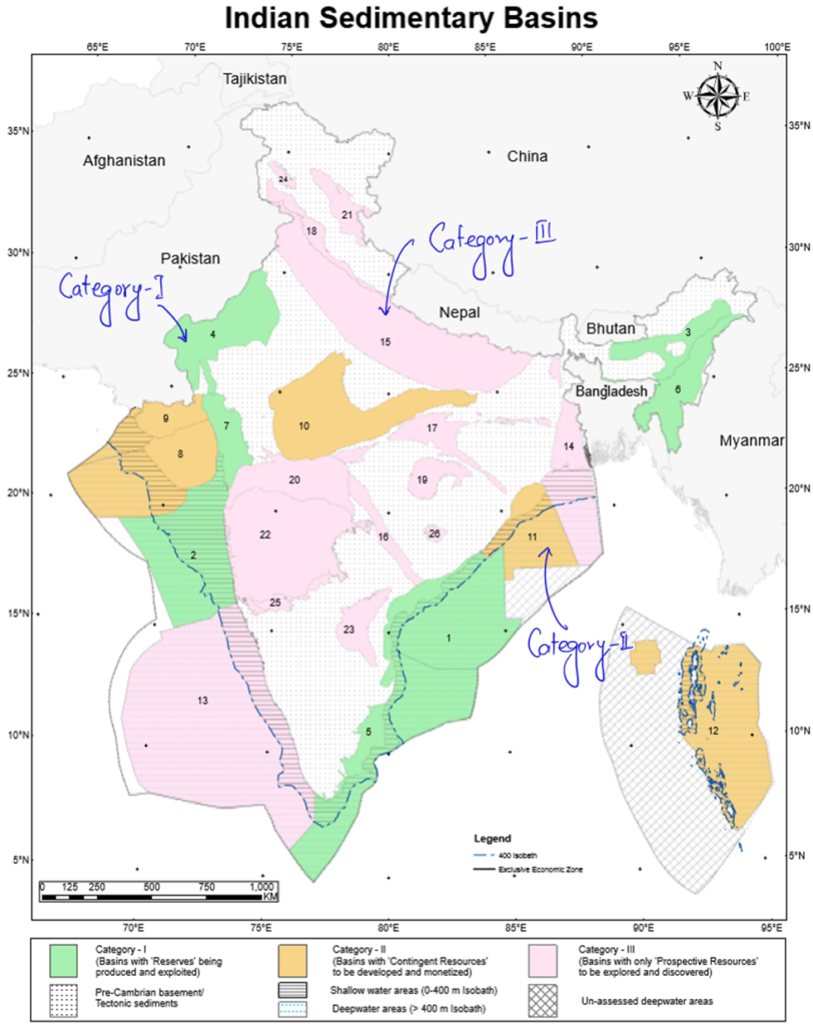
🥈 Category II: Discoveries Made, Yet to Begin Commercial Production
These basins have contingent resources—we know there’s oil, but production is not yet commercially viable. They cover ~7.8 lakh km² and include:
| Basin Name | Estimated Reserves (MMTOE) |
|---|---|
| Saurashtra | 1,325 |
| Kutch | 898 |
| Vindhyan | 632 |
| Mahanadi-North East Coast | 651 |
| Andaman-Nicobar | 371 |
| Total (Category II) | 3,877 MMTOE |
Think of these as “potential oil factories” waiting for investment, technology, and policy support.
🥉 Category III: Untapped, Prospective Areas
These are basins with geological potential, but no discoveries yet. They are unexplored but promising—like unopened treasure chests. They cover ~15.9 lakh km² and include:
| Basin Name | Estimated Reserves (MMTOE) |
|---|---|
| Kerala-Konkan (KK) | 1,245 |
| Bengal-Purnea | 828 |
| Ganga-Punjab | 128 |
| Pranhita-Godavari (PG) | 95 |
| Satpura–South Rewa–Damodar | 63 |
| Himalayan Foreland | 44 |
🧠 Analogy: Category III basins are like students with great potential but no exam scores yet—they still need exploration and discovery to prove their worth 😊
🎯 Let’s recap a bit now:
- Petroleum in India is largely found in Tertiary sedimentary rocks, especially in anticlines and fault traps.
- Offshore regions are the top producers of both crude oil and natural gas.
- India has 26 sedimentary basins, grouped into three categories based on their exploration status and commercial viability.
- The Mumbai Offshore and KG Basin are India’s largest contributors to petroleum reserves.
Offshore and Onshore Oil Production in India
Now that we understand where petroleum is found geologically, let’s see how it is extracted—both from land (onshore) and sea (offshore).
🌊 Offshore Oil Production in India
🧭 Western Coast: Arabian Sea
- India’s oil story at sea begins here, especially with Mumbai High, Bassein, and Aliabet (an island in the Gulf of Khambhat).
- Mumbai High—discovered in 1974, it sits on Miocene-aged rock strata—meaning it’s around 5 to 23 million years old.
- The Sagar Samrat, originally built as a jack-up drilling rig in 1973, was transformed into a Mobile Offshore Production Unit (MOPU) and began production in 2022.
🧭 Eastern Coast: Bay of Bengal
- Major offshore basins: Krishna-Godavari (K-G) and Cauvery.
- The Rawa Field in the K-G basin is especially important.
- These regions also show strong future potential for both oil and gas.
🧠 Takeaway: While Mumbai High is India’s past and present, the K-G and Cauvery basins may well shape its future offshore oil narrative.
🏞️ Onshore Oil Production in India
Let’s now shift from the seas to the mainland oilfields, spread across multiple states.
🛢️ Assam Oilfields: India’s First Oil State
- The 320 km stretch along the Brahmaputra Valley in Upper Assam is India’s oldest oil-bearing zone.
- The Digboi oilfield, located in Dibrugarh district, is India’s first and oldest oilfield—started in the 19th century.
- Other key fields: Naharkatiya and Moran-Hugrijan.
🚚 But there’s a challenge: Geographical remoteness. These fields are far from India’s major oil-consuming regions, which increases transport and logistics costs.
🛢️ Assam’s oil is refined within the state (at places like Noonamati, Digboi, Guwahati, Bongaigaon, Numaligarh) and even outside, like at Barauni in Bihar.
📊 Assam contributes around 15% of India’s total crude oil output, which accounts for nearly half of India’s onshore oil production.
🛢️ Gujarat Oilfields: A Legacy State
- Gujarat has a rich set of onshore fields: Ankleshwar, Khambhat, Ahmedabad, Barkol, and Sanand.
- Oil from these is sent to refineries at Trombay (Mumbai) and Koyali (near Vadodara).
📚 Interesting Fact: The Cambay Basin (Khambhat Gulf) is one of India’s oldest commercially explored sedimentary basins.
🛢️ Rajasthan Oilfields: The Desert Turns Liquid Gold
- Rajasthan is one of India’s largest onshore oil-producing state.
- The Barmer district gave India one of its biggest on-land oil finds.
- Key fields: Mangala, Bhagyam, Aishwariya—popularly known as the MBA fields.
- Other important discoveries: Sarswati and Rajeshwari.
📊 Rajasthan has turned from a desert state to a crude-rich state, largely due to smart exploration in the Thar desert region.
🛢️ Other Notable Oilfields
- Tamil Nadu – The Cauvery onshore basin is vital, especially around Narimanam and Kovilappal.
- Andhra Pradesh – A dual advantage state, with both onshore and offshore oil reserves.
🧭 Mapping India’s Oil Terrain, we can say:
- Offshore oil remains the major contributor, led by Mumbai High and emerging stars like the K-G basin.
- Onshore production is led by Rajasthan, Assam, and Gujarat—each with its distinct strengths.
- Assam gave India its first oil, Gujarat laid down early foundations, and Rajasthan is driving onshore growth today.
📊 State-wise Crude Oil Production Trends in India
To understand how much crude oil India produces, and from where, we need to look at onshore and offshore contributions.
Let’s examine the production data over three financial years (2022–2024):
🏞️ Onshore Production (Land-Based Fields)
| State | 2021-22 | 2022–23 | 2023–24 (P*) |
|---|---|---|---|
| Andhra Pradesh | 202 | 236 | 250 |
| Arunachal Pradesh | 48 | 47 | 52 |
| Assam | 3,988 | 4,164 | 4,359 |
| Gujarat | 4,627 | 4,850 | 4,950 |
| Rajasthan | 5,887 | 5,074 | 4,421 |
| Tamil Nadu | 367 | 324 | 294 |
| Total Onshore | 15122 | 14,699 | 14,329 |
*P: Provisional
All measurements in TMT (Thousand Metric Tonnes)
👉 Key Observations:
- Rajasthan is the top onshore producer for 2023-24.
- Gujarat and Assam follow closely, consistently producing significant volumes.
- Tamil Nadu, Andhra Pradesh, and Arunachal Pradesh contribute smaller shares.
🌊 Offshore Production (Sea-Based Fields)
| Category | 2021-22 | 2022–23 | 2023–24 (P) |
|---|---|---|---|
| Total Offshore | 14569 | 14480 | 15027 |
📌 Grand Total (Onshore + Offshore)
| Total Crude Production | 2021-22 | 2022–23 | 2023–24 (P) |
|---|---|---|---|
| India (Total) | 29691 | 29179 | 29356 |
🔍 Trend: production over these three years look similar. Now let’s talk about import of crude oil by India
🌍 India’s Oil Imports: Who Fuels India?
India is one of the largest crude oil importers in the world because our domestic production is not enough to meet the high demand for transportation, industry, and power.
🚢 Import Data (FY 2023-24 (P*))
- Crude oil imports: 2,34,262 TMT (thousand metric tonnes)
- Cost: ₹11.05 lakh crore (≈ $133.4 billion)
- Net oil & gas import bill (after accounting for exports): $122 billion
- India’s crude oil import dependence increased to 87.8% in 2023–24, with domestic production meeting less than 13% of the total demand.
💡 In short, while India earns some foreign exchange through refined product exports, it still pays a heavy bill for crude oil and gas.
🌐 Major Crude Oil Import Sources (2023)
| Country | % Share |
|---|---|
| Iraq | 19.4% |
| Saudi Arabia | 15.8% |
| UAE | 5.5% |
| United States | 4.3% |
| Nigeria | 3.0% |
| Russia | 39.1% |
🛣️ Pipelines in India: Lifelines of Energy Transport
🚛 Types of Pipelines
- Crude Oil Pipelines – Carry crude from ports or wells to refineries.
- Product Pipelines – Carry refined fuels (like petrol, diesel).
- Gas Pipelines – Transport natural gas and LPG.
🧭 Important Pipelines
✅ Crude Oil Pipelines
- Salaya-Mathura (SMPL)
- Paradip-Haldia-Barauni (PHBPL)
- Mundra-Panipat (MPPL)
✅ Product Pipelines
- Guwahati-Siliguri
- Koyali-Ahmedabad
- Barauni-Kanpur
- Panipat-Delhi
- Panipat-Rewari
- Chennai-Trichy-Madurai (CTMPL)
- Chennai–Bangalore
- Vijayawada–Vishakhapatnam
- Mangalore–Chennai
🛢️ Notable Mentions:
- Naharkatia-Nunmati-Barauni: First pipeline in India.
- HBJ (Hajira-Bijapur-Jagdishpur): World’s largest underground gas pipeline.
- Jamnagar–Loni LPG Pipeline: Longest LPG pipeline in the world.
- Kochi–Mangalore–Bangalore pipeline: For southern India energy needs.
✅ Advantages of Pipelines
- Ideal for liquid and gaseous transport.
- Can cross difficult terrain and underwater zones.
- Low maintenance, cost-effective, safe, and eco-friendly.
❌ Disadvantages of Pipelines
- Rigid – fixed routes only.
- Inflexible capacity – can’t be expanded after installation.
- Security challenges – vulnerable to sabotage and theft.
- Leak detection and repair – technically difficult.
- Accidents – Can lead to large-scale damage.
🧠 Final Perspective
India’s oil refining infrastructure reflects its strategic strength in energy security and export potential. While the private sector leads in scale, the public sector ensures access and stability. Pipelines, though invisible, are vital arteries of the economy—quietly transporting billions of litres of energy across the subcontinent.
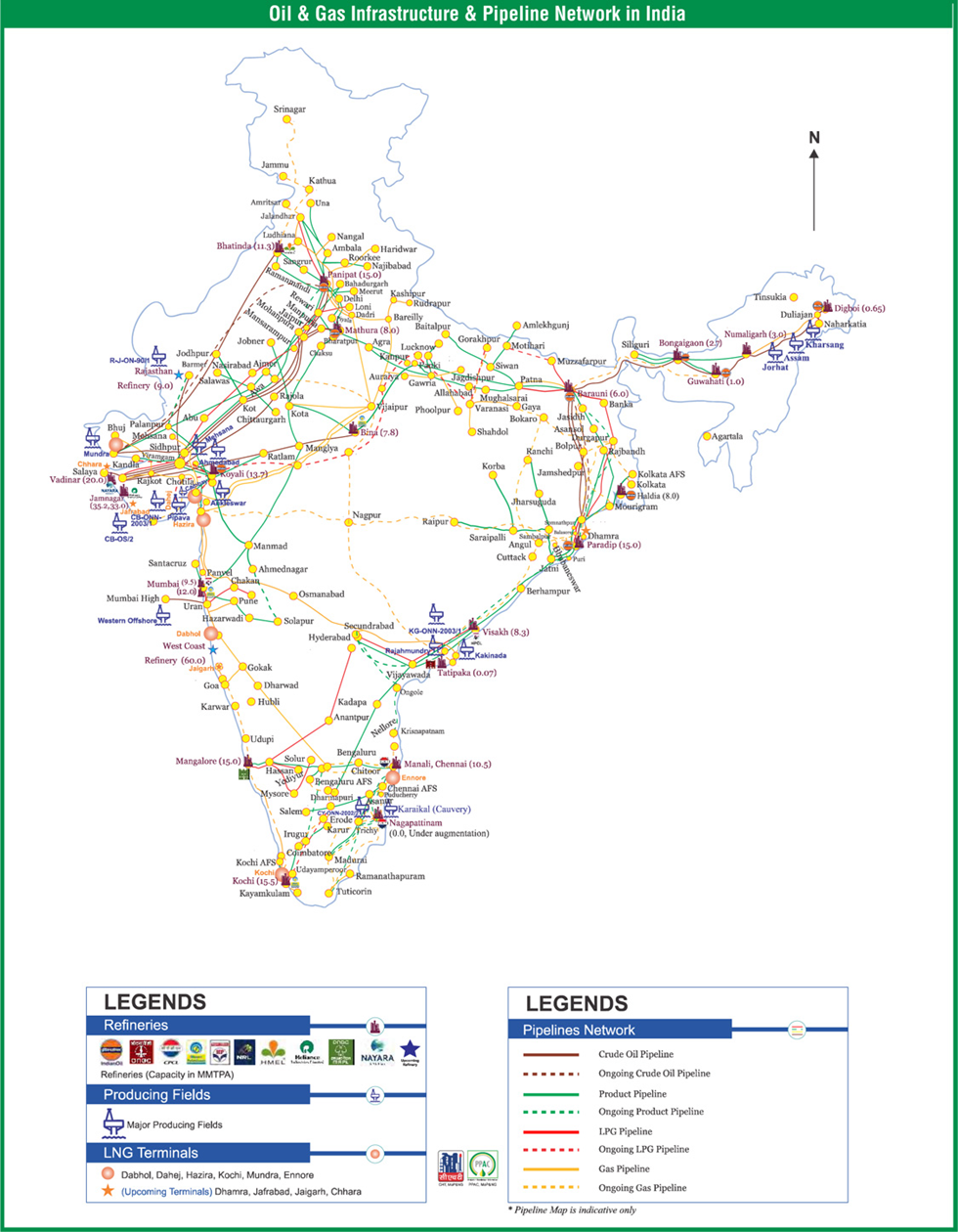
For HQ image of pipeline network, click here
🛢️ Indian Strategic Petroleum Reserve (ISPR)
📌 Why does India need a Strategic Petroleum Reserve?
Imagine fuel supply to India suddenly stops due to war or global crisis. How would we run our vehicles, power our industries, or even fly aircraft? To prevent such a crisis, India created strategic crude oil reserves—like a national emergency fuel tank.
🏢 ISPRL – The Organization
- Full Form: Indian Strategic Petroleum Reserve Limited
- It is a 100% government-owned company under the Oil Industry Development Board (OIDB).
- Operates under the Ministry of Petroleum & Natural Gas.
- Purpose: To build and manage India’s strategic crude oil storage infrastructure.
🏗️ Phase 1 – Existing Storage Facilities (Underground Rock Caverns)
| Location | State | Capacity (MMT) |
|---|---|---|
| Mangalore | Karnataka | 1.50 |
| Vishakhapatnam | Andhra Pradesh | 1.33 |
| Padur (near Udupi) | Karnataka | 2.50 |
| 🟢 Total | 5.33 MMT |
These are built underground in rock caverns for safety and security—hidden, strong, and shielded.
🛡️ Strategic Significance
- ISPRL’s capacity = 22 days of India’s oil consumption.
- Refiners’ own storage = 65 days.
- Total reserve = 87 days, which aligns with IEA (International Energy Agency) recommendations for emergency stockpiling.
🔁 Phase 2 – Expansion Plans
To strengthen long-term energy security, the GoI proposed:
- New locations:
- Chandikhole (Odisha)
- Bikaner (Rajasthan)
- Doubling Padur capacity.
- Post Phase 2, India’s strategic capacity will grow to 12.33 MMT.
🧠 How to Remember?
- 3 existing sites: “Vi-Ma-Pa” → Vishakhapatnam, Mangalore, Padur.
- 2 new sites: “Cha-Bi” → Chandikhole, Bikaner.
- Current total: 5.33 MMT → 22 days of buffer.
- Future total: 12.33 MMT → Over 40+ days, improving India’s resilience.
🌐 Global Context
- Developed nations (like the US) maintain strategic reserves for 90–120 days.
- India’s strategic reserves are a national insurance policy against oil shocks from:
- Wars
- Sanctions
- Supply chain disruptions
- Natural disasters
📍Conclusion
The Indian Strategic Petroleum Reserve isn’t just storage—it is geopolitical preparedness in liquid form. In a world where oil is power, these underground caverns quietly guard India’s energy future.