
Natural Gas
Introduction to Natural Gas – Understanding the Basics
Imagine nature’s own cooking gas, formed deep within the Earth—not in years, not in centuries, but over millions of years. This is Natural Gas—a non-renewable energy resource, meaning once it’s used, it’s gone forever (at least for the next few million years).
Now, what is it exactly?
- It is odourless, colourless, non-toxic, and flammable—a mix of hydrocarbon gases, primarily:
- Methane (CH₄) – the main ingredient.
- Ethane (C₂H₆) – the second most common.
- Along with traces of Propane, Butane, Pentane, and Hexane.
🔍 (Small analogy): Just like a fruit juice mix may have orange as the base, with apple, pineapple, and a hint of lemon, methane is the base of natural gas, with other hydrocarbons sprinkled in.
💡 Note: The commonly used LPG (Liquefied Petroleum Gas) is different—it mostly contains propane and butane, not methane.
How is Natural Gas Formed?
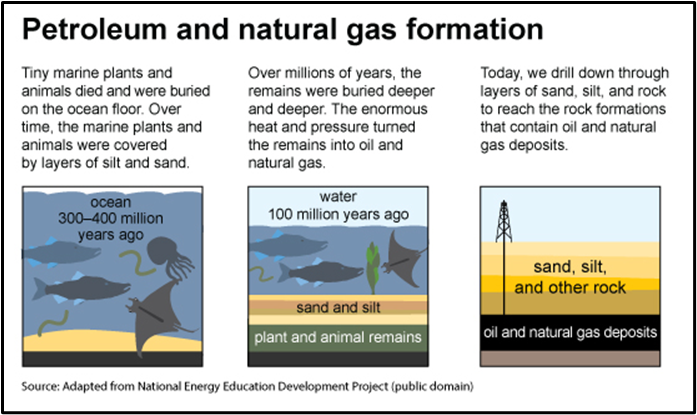
Natural gas is formed the same way petroleum is formed:
- Dead plants and marine organisms get buried under sediments.
- With heat, pressure, and millions of years, these turn into hydrocarbons—some become crude oil, and some, natural gas.
That’s why gas is often found:
- Dissolved in crude oil, or
- Floating as a gas cap above the oil reservoir—imagine a water bottle with a bit of air trapped at the top.
How is it Measured in the Market?
In the market, natural gas is not sold by kilograms or litres, but by its energy content, called calorific value. The unit is:
- MMBTU (Million British Thermal Units)
- Roughly, 1 MMBTU ≈ 1,000 cubic feet of natural gas
India’s Vision: A Gas-Based Economy
Right now, natural gas makes up about 5% of India’s energy basket. The Government of India plans to increase it to 15% by 2030, aiming for:
- Cleaner fuel alternatives
- Reduced oil imports
- Environmentally friendly urban transport systems
Types of Natural Gas
Based on Ease of Extraction
- Conventional (easy to reach): Associated Gas (found with crude oil) and Non-Associated Gas (found alone, high methane).
- Unconventional (needs advanced technology): Shale Gas (in shale rock, extracted by hydraulic fracturing / fracking); Tight Gas (low-permeability sandstone/limestone); Coal Bed Methane / CBM (from coal seams); Gas Hydrates / Methane Hydrates (methane trapped in ice-like structures on deep ocean floors and permafrost).
Classifying Based on Where & How It Occurs
Let’s classify natural gas based on how and where it is found:
| Type | Explanation |
|---|---|
| Wet Gas / Associated Gas | Found along with crude oil – like a bonus with the main oil deposit. |
| Dry Gas / Non-associated Gas | Found alone, without any crude oil. Just pure natural gas in the reservoir. |
| Coalbed Methane (CBM) | Found inside coal seams—methane gas trapped in coal layers. |
| Sour Gas | Contains harmful sulfur compounds like Hydrogen Sulfide (H₂S) – requires cleaning. |
| Sweet Gas | Lacks hydrogen sulfide – hence, safer and more environment-friendly. CBM is often sweet gas. |
| Shale Gas / Tight Gas | Found in shale rocks or tight sandstone—requires advanced techniques like hydraulic fracturing (fracking) to extract. |
📌 Think of these as types of mineral water—some are pure, some need filtering, and some are trapped inside rocks and need special treatment to be extracted.
Four Forms of Natural Gas – Based on How It’s Processed & Used
To make natural gas usable and transportable, it’s converted into different physical forms:
1. Liquefied Natural Gas (LNG)
- Gas is cooled to –160°C to turn it into a liquid.
- Makes transport over oceans in cryogenic tankers possible.
- Takes up 600 times less space than gas—like compressing a balloon into a marble 😊!
2. Regasified Liquefied Natural Gas (RLNG)
- Once LNG reaches the destination port, it’s converted back into gas.
- Then it flows through pipelines to reach power plants, factories, and homes.
3. Compressed Natural Gas (CNG)
- Gas is compressed to high pressure (200–250 kg/cm²).
- Used in vehicles—buses, autos, taxis—because it’s cleaner than diesel or petrol.
- A key player in reducing urban air pollution.
4. Piped Natural Gas (PNG)
- Supplied via pipelines directly to homes.
- Used for cooking, heating, and cooling.
- Comes with built-in safety valves to regulate pressure.
Comparison: LPG vs CNG vs PNG vs LNG
| Feature | LPG | CNG | PNG | LNG |
| Source | Refining / gas processing | Natural gas | Natural gas | Natural gas |
| Main composition | Propane + Butane | Methane | Methane | Methane |
| Form | Liquid (under pressure) | Compressed gas | Gas (pipeline) | Liquid (cryogenic) |
| Storage | Cylinders | High-pressure cylinders (200–250 bar) | Pipelines (no storage) | Cryogenic tanks (–162°C) |
| Volume reduction | Moderate | Compressed | N/A | ~600× reduced |
| Main use | Cooking, heating | Vehicles | Domestic & industrial | Transport, bulk storage |
| Calorific value | High | High | High | Very high |
| Pollution | Low | Very low | Very low | Very low |
| Safety | Heavier than air (accumulates) | Lighter than air (disperses) | Controlled supply | Cryogenic handling risk |
| Key advantage | Portable clean cooking fuel | Clean vehicle fuel | Continuous convenient supply | Efficient long-distance transport |
Issues with Natural Gas
- Non-renewable & finite; methane leakage (methane is a potent GHG); high infrastructure cost; import dependence (LNG); price volatility.
- Environmental risks from fracking (water contamination, induced seismicity); safety concerns (flammable); and — though cleaner — it still emits CO₂.
Applications – Where is Natural Gas Used?
Natural gas is truly a versatile energy source, used across sectors:
- Electric Power Generation – Modern power plants use it to generate electricity with lower emissions.
- Transportation Fuel – Vehicles (especially public transport) run on CNG.
- Fertiliser Production – Methane is used to make ammonia (NH₃), the building block of:
- Urea
- Nitric acid
- Other nitrogen-based fertilisers.
- Heating & Cooling – LNG is used in homes and commercial complexes for temperature control.
Formation of Natural Gas – A Journey from Life to Fuel
To understand how natural gas forms, think of it as a multi-million-year cooking process that nature carries out silently, deep beneath the Earth.
Let’s break it down step by step, are you ready? So let’s get started 😊
Step 1: Organic Matter Deposition
Millions of years ago, tiny marine organisms—plankton, algae, fish—died and settled at the bottom of seas and oceans. They mixed with mud, sand, and other sediments.
📌 Analogy: Just like food waste settles at the bottom of a compost pit, these remains got buried under layers of sediment.
Step 2: Compaction and Burial
As more and more layers accumulated above, the pressure increased, and so did the temperature.
- The deeper the burial, the hotter and more compact it became.
- No oxygen was present—so instead of rotting, the material got preserved and compacted under pressure.
Step 3: Kerogen Formation – The Waxy Intermediate
Under moderate heat and pressure, this organic matter transformed into a waxy substance called Kerogen.
🧴 Think of kerogen as the dough in the middle of the baking process—not raw, not fully ready 😊
Step 4: Catagenesis
As temperature crossed around 90–160°C, kerogen broke down into hydrocarbons—primarily methane (CH₄), which is natural gas.
- This stage is called catagenesis, meaning “breaking down by heat.”
- It’s the most crucial step—where the transformation to energy fuel happens.
📌 You can call this the “natural refinery” stage—where organic dough becomes the final edible cake: natural gas.
Step 5: Migration – The Gas Escapes and Moves
Once formed, natural gas doesn’t just sit quietly.
- It migrates upwards through the porous rocks (called carrier beds), looking for an exit—like steam escaping through holes in a lid.
Step 6: Trapping in Reservoir Rock – The Final Storage Locker
Eventually, this migrating gas hits a non-porous, impermeable rock layer—called a cap rock—and gets trapped.
- The area just below this cap rock, usually a porous reservoir rock, becomes a natural gas reservoir.
- This is where humans drill and extract gas from.
✅ Quick Summary of Formation Steps:
| Stage | Process |
|---|---|
| Deposition | Organic remains settle at seabed |
| Compaction | Buried under sediment, pressure & heat rise |
| Kerogen | Formation of waxy intermediate substance |
| Catagenesis | Kerogen breaks down into methane |
| Migration | Gas moves through rocks |
| Trapping | Gas gets trapped in reservoir under cap rock |
Natural Gas Storage – Keeping the Fuel Safe and Ready
India is working towards not just producing natural gas, but also storing it strategically—like stocking ration before the rainy season 😊.
Current Status:
- India has 5 million Tonnes (MT) of strategic petroleum reserves, but no strategic gas reserves yet.
- GAIL (Gas Authority of India Ltd.) plans to use depleted oil/gas wells as storage sites.
📌 A depleted well is like an empty water bottle—it already had gas/oil earlier, now it’s empty but still structurally usable.
Types of Natural Gas Storage
1. Underground Storage
Used for large-scale, long-term storage by repurposing geological structures:
- Depleted oil/gas fields – previously used, now empty.
- Salt caverns – underground spaces carved out in salt domes.
- Aquifers – porous rock layers that can store gas with pressure.
2. Above-Ground Storage – Tanks and Terminals
Used for short-term or limited storage, often near LNG terminals or industrial units.
- Think of these as big fuel tanks—used for daily or weekly operational needs.
Why Underground Storage is Beneficial
| Advantage | Explanation |
|---|---|
| Higher Energy Efficiency | Natural underground pressure keeps gas in a dense state, reducing energy loss. |
| Safety & Security | Deep geological formations reduce the risk of leaks or explosions. |
| Grid Reliability | Stored gas can be released during peak demand—ensuring electricity generation doesn’t stop. |
📌 Analogy: Just like keeping cold water in a clay pot helps maintain temperature naturally, underground storage keeps gas stable without extra energy input.
✅ Conclusion:
- Formation of natural gas is a slow geological process—from dead marine life to usable methane through heat, pressure, and time.
- Storage is essential for energy security, price stability, and emergency preparedness.
- India is now taking steps to create strategic gas reserves, using both underground and above-ground methods, led by GAIL.
Petroleum & Natural Gas Value Chain: Upstream, Midstream, Downstream
The oil & gas industry works like a relay race—each stage handing over the baton to the next. Let’s break it down:
⛏️ Upstream Sector – “Exploration and Production (E&P)”
🧭 What it involves:
- Searching for oil & gas in underground or underwater fields.
- Extracting it using rigs and drilling.
🔍 Key Functions:
- Exploration: Using seismic surveys, satellites, and data to locate hydrocarbon reserves.
- Drilling: Reaching the underground reserves and confirming presence.
- Production: Extracting crude oil or natural gas from discovered wells.
🏢 Key Players (India):
- ONGC, Oil India Ltd.
🧠 Mnemonic: “Explore → Drill → Extract”
🚛 Midstream Sector – “Transport & Handling”
🚚 What it involves:
- Moving the extracted crude oil/natural gas from fields to refineries or LNG terminals.
🔍 Key Functions:
- Pipelines: Huge underground/overland pipelines carry gas/oil across states or even countries.
- Shipping: Tankers and LNG ships move it globally.
- Storage & LNG Terminals: Re-gasification of LNG and storage facilities.
🏢 Key Players (India):
- GAIL, Petronet LNG, Indian Oil pipelines division
🧠 Mnemonic: “Pipe → Ship → Store”
🏭 Downstream Sector – “Refine & Deliver to End User”
🏪 What it involves:
- Refining crude oil into usable products like petrol, diesel, LPG, plastic etc.
- Distribution to industries and consumers.
🔍 Key Functions:
- Refineries: Break down crude oil into fuels.
- Petrochemicals: Make products like polymers, fertilizers, plastic, detergents.
- Retail distribution: Petrol pumps, LPG cylinders, etc.
🏢 Key Players (India):
- IOCL, BPCL, HPCL, Reliance
🧠 Mnemonic: “Refine → Convert → Supply”
Here is a very nice video on Natural Gas Extraction. If interested please watch:
How is natural gas extracted? Derrick tower – methane