
Coal Bed Methane (CBM)
Imagine coal not just as a solid fuel buried underground, but as a gas reservoir in disguise. Yes, inside coal seams—deep underground—lies a form of natural gas, and that gas is what we call Coal Bed Methane (CBM).
🔹 What is CBM?
- Coal Bed Methane is a natural gas that comes from coal seams.
- It is mostly methane (CH₄) — the same methane used in CNG — but it may also contain tiny amounts of ethane, propane, butane, and some non-hydrocarbon gases like carbon dioxide (CO₂), nitrogen (N₂), and hydrogen sulphide (H₂S).
Think of it like a soda bottle. The fizz you see is carbon dioxide gas dissolved in the liquid. Similarly, methane gas is trapped inside the coal — not dissolved in liquid but adsorbed (a technical term, meaning it sticks to the coal’s surface at a molecular level) and trapped within its tiny pores and fractures.
How is CBM Formed?
Let’s now understand the formation process.
Step 1: Coalification
- It all starts with plant material (dead trees, leaves, etc.) getting buried under soil layers.
- Over millions of years, due to heat and pressure, this organic matter turns into coal. This long process is called coalification.
- During coalification, methane gas is produced as a by-product of the chemical reactions involved in turning wood and plant matter into coal.
Step 2: Gas Gets Trapped
Now here’s the interesting part:
- Some of this methane becomes free gas — it flows into joints, cleats, and fractures (natural cracks) in the coal seam.
- But most of it is not free. It gets adsorbed onto the microscopic surfaces inside the coal—almost like how a sponge holds water in its tiny holes.
So, coal acts like a gas sponge.
How Do We Extract CBM?
To collect this methane, we don’t mine the coal. Instead, we drill wells into the coal seams and do the following:
Step 1: De-watering
- Coal seams are often saturated with water.
- First, we pump out the water. This reduces the pressure inside the coal seam.
Step 2: Gas Release
- When water is removed, the gas adsorbed on coal surfaces gets unstuck (de-adsorbed) and starts to flow toward the well.
This is how CBM is harvested.
⚠️ CBM and Coal Mines: A Dangerous Relationship
CBM isn’t new to miners. In fact, it has always been there — as a hazard.
- In underground coal mining, trapped methane can suddenly escape and cause explosions or fires.
- In fact, many fire accidents in coal mines are caused by CBM and, in some cases, by lignite deposits that spontaneously catch fire due to their chemical nature.
So, while CBM is now seen as a clean energy resource, in mining, it’s long been seen as a silent danger.
Coal Bed Methane (CBM): Global and Indian Perspective
🌍 Coal Bed Methane in the World
We know CBM is found in coal seams, but not all coal seams are the same. Their ability to produce methane depends on many geological factors like coal rank, depth, thickness, and permeability. That’s why the distribution of CBM is uneven across the globe.
🔹 Global Distribution of CBM Reserves
- Russia has the largest CBM reserves in the world.
- Other major countries include the USA, China, Canada, and Australia.
Following figure illustrates CBM reserves across the world
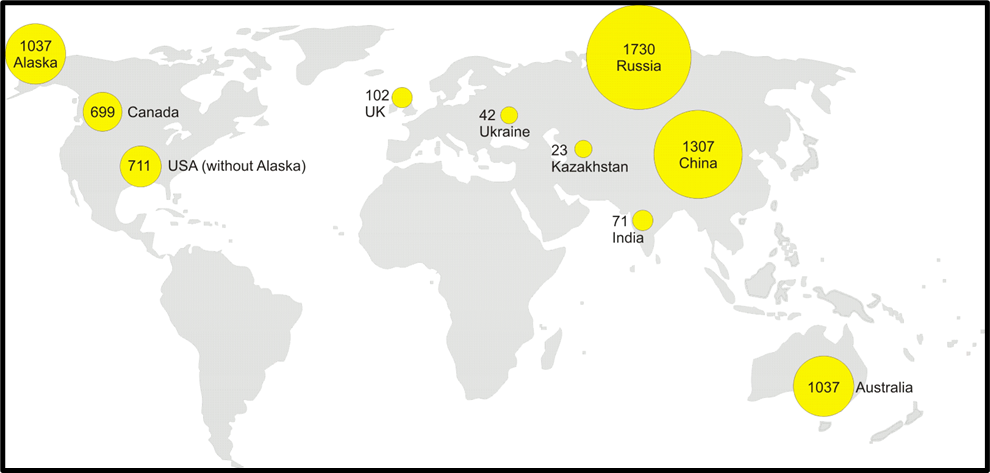
USA, China, Canada and Russia are leading producers of Coal Bed Methane in World.
🇮🇳 Coal Bed Methane in India
Now let’s focus on India’s CBM profile.
Resource Potential
- India has the 5th largest proven coal reserves in the world.
- That gives India tremendous potential for CBM exploration.
- As of FY 2019–20, India’s cumulative CBM production was 3.7 bcm, and rising.
Geographical Spread
- CBM resources are spread across 12 Indian states.
- However, the most productive regions are located in the Gondwana sedimentary basins — especially in eastern India.
- The Damodar Koel Valley and Son Valley are prime areas for CBM development.
Prime CBM Fields in India:
| State | Major CBM Coalfields |
|---|---|
| Jharkhand | Raniganj, Jharia, Bokaro |
| West Bengal | Raniganj |
| Madhya Pradesh | Sohagpur |
| Chhattisgarh | Sonhat |
These are known as virgin coal mines — meaning they haven’t been mined yet but are targeted for CBM production.
Other Emerging States
States like Gujarat, Rajasthan, and Odisha are actively being explored and developed for CBM production. This expansion aims to:
- Boost India’s energy security
- Reduce reliance on imported natural gas
⚠️ Current Drawback
One major issue India faces is this:
In many coal mines, Coal Mine Methane (CMM) is not captured. It is simply vented (released) into the atmosphere, leading to energy waste and increased greenhouse gas emissions.
So, India has both a great opportunity and a serious challenge here.
📊 State-wise CBM Resources in India (2022)
Let’s look at the official figures of CBM resources (in Billion Cubic Meters):
| State | CBM Resources (BCM) |
|---|---|
| Jharkhand | 722 |
| Rajasthan | 360 |
| Gujarat | 351 |
| Odisha | 243 |
| Chhattisgarh | 240 |
| Madhya Pradesh | 218 |
| West Bengal | 218 |
| Total | 2,600 BCM (≈ 91.8 TCF) |
🧠 Note: TCF = Trillion Cubic Feet, another common unit used in natural gas calculations.
✅ Benefits of Coal Bed Methane in India
Coal Bed Methane isn’t just a gas found in coal seams — it’s a multi-dimensional opportunity for India. Let’s understand its benefits by grouping them into strategic, environmental, economic, and social categories:
1. Strategic Importance
- Domestic Energy Source: CBM is an indigenous source of natural gas, meaning we don’t need to rely on volatile international markets. This reduces India’s energy vulnerability.
- Energy Security: Using CBM in power plants strengthens our grid and reduces the need for imported fuels like LNG or crude oil.
2. Environmental Benefits
- Cleaner Combustion: CBM burns more cleanly than coal or biomass, which means less soot, fewer pollutants, and lower greenhouse gas emissions.
- Methane Mitigation: If not captured, methane leaks from coal seams directly into the air — a potent greenhouse gas. CBM extraction helps capture and utilize this gas instead of letting it escape.
🧠 Reminder: Methane is 25 times more potent than CO₂ in trapping heat in the atmosphere over a 100-year period.
3. Economic Growth & Industrial Use
- Job Creation: CBM extraction projects bring employment, infrastructure, and economic activity to coal-rich but underdeveloped regions.
- Industrial Use: CBM serves as a cleaner fuel alternative for heavy industries like:
- Cement
- Fertilizers
- Steel
4. Social and Urban Benefits
- Cleaner Cooking Fuel: CBM can replace firewood or coal in households, offering healthier indoor air quality, especially in rural areas.
- Green Transport Fuel: When compressed (like CNG), CBM can power vehicles, leading to reduced urban air pollution.
⚠️ Challenges in CBM Exploration and Extraction in India
While the benefits are many, India is not tapping the full potential of CBM. Why? The hurdles are mainly institutional, legal, and technological. Let’s understand them one by one
1. Fragmented Ownership and Bureaucratic Hurdles
- Dual Ministry Conflict: CBM comes from coal seams, but two different ministries handle them:
- Ministry of Coal oversees coal mining.
- Ministry of Petroleum & Natural Gas governs CBM.
This creates a tug of war, resulting in overlapping jurisdiction and delays in decision-making.
🎯 Analogy: Imagine two parents trying to raise one child, but both follow different rulebooks. The child (in this case, CBM) suffers due to conflict and confusion 😊
2. Legal Restrictions on Contractors
- No Dual Rights: The same company cannot mine both coal and gas from a block due to bureaucratic restrictions.
- Private Players: Though public sector lacks technical efficiency, private companies are not given full exploration rights for unconventional gases like CBM.
3. Technological Limitations
- CBM extraction needs advanced drilling, dewatering, and gas separation technologies.
- Public sector companies often lack the organizational capacity to manage these efficiently.
4. Policy and Pricing Disincentives
- Even when private firms are willing to invest, they are discouraged due to:
- Restrictive laws
- Low market prices for CBM (making it financially unviable)
💡 Even a well-funded farmer won’t grow crops if the government fixes crop prices too low to cover his input costs. The same logic applies here.
📌 Conclusion: Way Forward
India has the resources, the industrial demand, and the environmental incentive to develop CBM. But without:
- Policy reforms
- Clear division of responsibilities
- Greater private sector participation
- Technological upgrades
…the sector may continue to underperform despite its massive potential.