
Tight Gas
Let’s begin with a real-life analogy.
Imagine you’re trying to extract honey from a sponge. If the sponge is soft and porous, honey flows out easily when you squeeze. But what if it’s a hard, tight sponge with almost no holes? Even if honey is inside, it won’t come out easily. You’ll need special techniques—maybe press harder or inject something to loosen it.
Now replace honey with natural gas, and sponge with rock. That’s the basic idea of tight gas.
🔍 Definition:
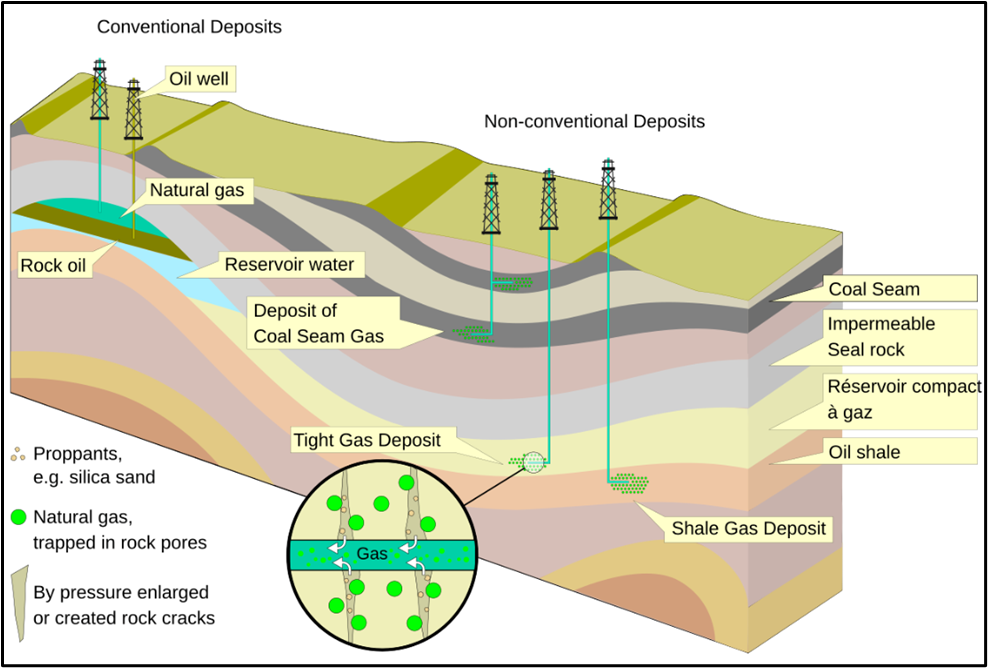
Tight gas is natural gas found in reservoir rocks that have very low permeability.
That means even though gas is present, the rock is so tight (compacted) that gas cannot move freely through it.
🔬 How is Tight Gas Extracted?
Now, since the gas doesn’t flow easily on its own, we need to forcefully create pathways.
This is done through Hydraulic Fracturing (also known as fracking).
Just like in shale gas extraction, a mixture of water, sand, and chemicals is injected under high pressure into the rock to create cracks—so gas can flow out through these cracks.
⚖️ Tight Gas vs Shale Gas — What’s the Difference?
They sound similar because both need fracking, but here’s the key difference:
| Feature | Tight Gas | Shale Gas |
|---|---|---|
| Trapped in | Sandstone or Limestone rocks | Shale rocks (a fine-grained sedimentary rock) |
| Permeability | Very low | Also very low |
| Extraction | Needs fracking | Also needs fracking |
So, the difference lies in the type of rock, not the technique.
🌍 Global Distribution of Tight Gas
Now let’s talk about where in the world tight gas is found.
- North America (especially the USA and Canada) has the largest tight gas reserves.
- Other major countries include:
- China
- Argentina
- Australia
- Poland
The USA alone contributes nearly half of the world’s total tight gas output.
🇮🇳 Tight Gas in India
- India’s tight gas production is very minimal.
- It contributes only a small fraction to India’s total natural gas output.
So, India has huge potential, but actual production is still at an early stage.
⚠️ Challenges in Extraction
Why hasn’t tight gas taken off in India and many parts of the world?
Let’s understand the key challenges:
1. 🧬 Complex Geology
- Tight gas is found in hard, compact rock layers.
- Extracting it requires advanced seismic surveys, horizontal drilling, and precision fracking.
- This demands high technical expertise and modern equipment.
2. 🌱 Environmental Concerns
- Fracking raises environmental issues like:
- Water contamination
- Earthquakes (induced seismicity)
- High water usage
- So, it needs strict regulations and careful execution.
3. 💰 High Cost
- Compared to conventional gas, tight gas is more expensive to extract.
- It needs more wells, more technology, and more investment.
- This makes it less economically viable, especially in countries with cheaper alternatives.
🧩 Conclusion
- Tight gas is a significant unconventional energy resource, trapped in low-permeability rocks like sandstone and limestone.
- Like shale gas, it needs hydraulic fracturing to be extracted.
- The USA leads globally, while India has potential but is still in the early phases.
- Extraction faces technical, environmental, and economic challenges, which must be addressed to scale up production.