
Mica
Let’s start with a fundamental definition.
Mica is a naturally occurring, non-metallic phyllosilicate mineral — that is, a silicate mineral which forms in layers (phyllo = leaf in Greek).
✅ It is one of 34 phyllosilicate minerals, but only a few — like Muscovite and Phlogopite — are economically significant.
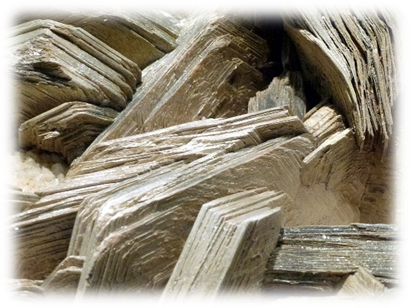
Now, what makes mica special?
Unique Properties of Mica
Here’s what makes mica stand out:
| Property | Explanation |
|---|---|
| Perfect Cleavage | It breaks into thin, flat sheets — these reflect light and can be split repeatedly. |
| Elasticity & Flexibility | Can bend without breaking — almost like a natural plastic. |
| Toughness | Despite being flaky, it has strong bonding within sheets. |
| High Dielectric Strength | Acts as a great electrical insulator, used in capacitors and electronics. |
| Heat Resistance | Doesn’t burn or melt easily — ideal for high-temperature applications. |
| Chemically Inert & Water-Resistant | Stable in harsh environments — doesn’t react or absorb moisture. |
👉 Dielectric Strength means the maximum electric field a material can withstand without losing insulation.
Types of Mica
Two types are commercially important:
| Type | Chemical Base | Appearance | Found In |
|---|---|---|---|
| Muscovite | Potash-based (K) | Silvery-white | Granitic pegmatites |
| Phlogopite | Magnesium-based (Mg) | Amber-brown | Metamorphosed sedimentary rocks mixed with granite pegmatites |
Formation of Mica
Mica has multiple origins depending on geological conditions:
Metamorphism:
- When igneous or sedimentary rocks like granite, shale, or schist undergo high temperature & pressure, mica forms.
Magmatic Crystallisation:
- During the cooling of magma, especially in granitic and pegmatitic intrusions, mica crystallises directly.
Weathering:
- When older mica-bearing rocks break down, mica flakes accumulate in soils or sedimentary layers.
So, mica can form both deep inside the Earth (plutonic settings) and on the surface through erosion.
Applications of Mica
Mica is a multi-purpose mineral — let’s break down its uses by sector.
🔌 Electrical & Electronic Uses
- Capacitors, transistors, heating elements
- Mica sheets used in toasters, hair dryers, and spacecraft insulation
💄 Cosmetic Industry
- Mica’s shiny, reflective quality gives a sparkle to eye shadows, nail polish, etc.
🧪 Scientific and Industrial Equipment
- Thin mica windows used in laboratory instruments due to transparency & heat resistance.
🏠 Construction
- Used as filler in wall compounds, asphalt, and roofing.
🎨 Paint and Pigments
- Mica is used to extend pigments, making paint lighter, more stable, and smoother.
✈️ Aerospace & Defence
- Special mica types are used in missiles and aircraft, thanks to their resilience to extreme environments.
Global Distribution of Mica
Let’s look at the world map of mica.
- Major Producers:
- India
- Brazil
- Madagascar
- USA (limited)
Historically, India was the global leader in mica sheet production and export.
But today, that monopoly has weakened due to:
- Shift towards synthetic/reconstituted mica
- Rise of mica substitutes in electrical industries
- Environmental concerns and better sourcing in other countries
Mica in India – Resources & Production
As of April 1, 2015, India had:
Total Reserves: 6,35,302 tonnes
State-wise Reserve Distribution:
| State | Share of Reserves |
| Andhra Pradesh | 41% |
| Rajasthan | 28% |
| Odisha | 17% |
| Maharashtra | 13% |
Also found in: Jharkhand, Telangana, Bihar, Gujarat, Kerala, Tamil Nadu, West Bengal, etc.
Production of Mica in India:
Rajasthan and Andhra Pradesh are major producers in India.