
Cobalt
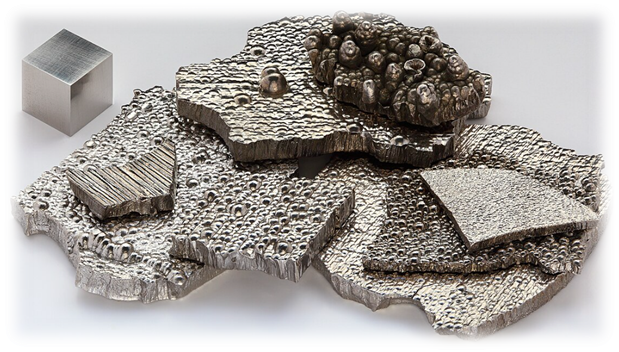
Imagine a shiny, silvery-blue metal — that’s Cobalt, known not just for its beauty but also for its magnetic power. It’s a ferromagnetic metal, meaning it can be magnetised and retains magnetism, making it invaluable in many industrial processes.
Where Do We Find Cobalt?
Cobalt doesn’t exist alone in nature. It is usually found in minerals like:
- Cobaltite
- Skutterudite
- Erythrite
But here’s the twist: cobalt is almost never mined directly. It’s extracted as a by-product during the mining of copper, nickel, zinc, and sometimes even precious metals. Think of it like a hidden treasure that comes bundled with others.
There’s also a fascinating fact — cobalt exists in manganese nodules at the bottom of the ocean. These nodules are like potato-sized lumps packed with valuable metals including cobalt, found scattered across the seabed.
Applications of Cobalt: Where Do We Use It?
Cobalt might be a small name, but its uses are mighty:
1. Industrial & Technological Uses
- Ferromagnetic alloys: It’s alloyed with aluminium and nickel to create strong magnets used in turbines and high-performance engines.
- Jet Turbines & Gas Generators: Cobalt’s ability to withstand high temperatures makes it essential here.
- Electroplating: Due to its shiny surface, hardness, and corrosion resistance, it’s used to coat objects.
2. Colouring & Radiation
- Ever seen that vibrant cobalt blue in pottery or glass? That’s thanks to cobalt salts.
- Cobalt-60, a radioactive isotope, is used in cancer treatment and to preserve food through radiation.
3. The Battery Revolution
- Cobalt is a key ingredient in Lithium-ion battery cathodes. These are the rechargeable batteries we use in:
- Mobile phones
- Laptops
- Electric vehicles (EVs)
👉 Note: The Rechargeable Battery Industry is now the largest consumer of cobalt globally.
Distribution of Cobalt in India
India has estimated cobalt ore reserves of ~44.91 million tonnes (as of April 2020). Here’s a snapshot:
| State | Reserves (MT) | Major Districts |
| Odisha | 31 MT (69%) | Kendujhar, Jajpur |
| Jharkhand | 9 MT (20%) | Singhbhum |
| Nagaland | 5 MT (11%) | Tuensang |
Other reported occurrences:
- Rajasthan (Jhunjhunu)
- Madhya Pradesh (Jhabua, Hoshangabad)
Sukinda in Odisha: Known for nickeliferous laterite, cobalt here is associated with nickel-rich ores.
Another unexpected source: Copper slags (waste from copper smelting) — especially those from Hindustan Copper Ltd (HCL).
Even India’s ocean floor nodules contain around 0.3% cobalt, making them a potential future source.
👉 But here’s the key concern:
India currently does NOT produce cobalt from primary sources. That means we depend on imports to meet domestic demand.
🔁 Recycling Focus: India is now exploring cobalt recovery from spent Li-ion batteries — a sustainable strategy for the future.
Global Scenario: Cobalt Reserves & Production
Let’s now step outside India and look at the world map.
Reserves (2024) – in Million Tonnes (MT)
| Country | Reserves |
| Congo (DRC) | 6 (54%) |
| Australia | 1.7 (15%) |
| Indonesia | 0.64 (6%) |
| World Total | 11 |
Production (2024) – in Thousand Tonnes (TT)
| Country | Production |
| Congo (DRC) | 220 (76%) |
| Indonesia | 28 (9.6%) |
| Australia | 3.6 |
| Total | 290 |
✅ Congo (Kinshasa) alone accounts for half the world’s cobalt reserves and more than 75 % of its production, making it the most dominant player globally.
Conclusion: Why Is Cobalt Critical?
- In the age of green energy and digital tech, Cobalt is indispensable.
- It’s not just a metal, it’s a strategic asset — powering electric vehicles, medical tech, and aerospace.
- For India, the challenge lies in moving from import-dependence to domestic production and recycling.
In simple words: Cobalt is the unsung hero powering the silent revolutions of tomorrow.