
Titanium
Imagine a metal that is so strong yet lightweight, can resist heat, doesn’t corrode easily, and is even safe inside the human body. That’s Titanium — a silver-grey metal that plays a powerful role in today’s industrial world.
But here’s something curious:
Titanium is never found in pure metallic form in nature. It always appears as an oxide — which means it’s combined with oxygen. Think of how iron rusts when it reacts with air — that’s also an oxide. Titanium prefers to stay bonded with oxygen in rocks, soils, plants, oceans — even in meteorites and stars!
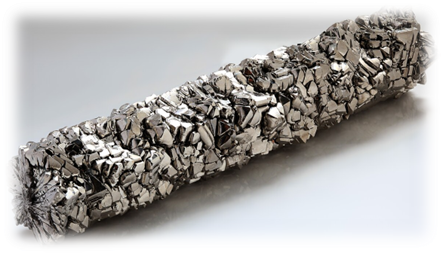
🛠️ Uses of Titanium
Because of its special properties — strong yet light, heat-resistant, corrosion-proof, and biocompatible — titanium is used in:
- Nuclear reactors and defence equipment (where both strength and heat resistance matter)
- Aerospace and marine industries (light but strong)
- Medical implants (doesn’t react with body tissues)
- High-performance alloys for construction
- Jewellery and electrical goods
🔍 Ores of Titanium
Titanium doesn’t come alone — we extract it from three major ores:
1. Ilmenite (Most Abundant)
- Appearance: Iron-black, heavy, metallic
- Composition: Iron + Titanium oxide
- Found in: Igneous rocks
2. Rutile
- Appearance: Reddish-brown
- Has higher titanium dioxide (TiO₂) than ilmenite — so more valuable
- Found in: Igneous and metamorphic rocks, often alongside ilmenite
3. Titanite (also called sphene)
- Appearance: Greenish to black
- Composition: Calcium titanium silicate
- Found in: Igneous and metamorphic rocks
🇮🇳 Titanium in India
Titanium-rich minerals like ilmenite and rutile are mostly found in beach sands — along India’s eastern and western coasts. Imagine the coastal strip stretching from Saurashtra (Gujarat) to Digha (West Bengal) — it hides these precious minerals.
Five key deposits in India are:
- Chavara (Kerala)
- MK Deposit (Kanyakumari, Tamil Nadu)
- OSCOM (Ganjam, Odisha)
- Brahmagiri (Puri, Odisha)
- Bhavanapadu (Srikakulam, Andhra Pradesh)
Indian Reserves & Production:
- Ilmenite reserves (as of 2020): 687.57 million tonnes
- Ilmenite production: 403 thousand tonnes (2022–23)
- Odisha (61%) > Kerala (30%) > Tamil Nadu (9%)
- Rutile production: 14 thousand tonnes
- Odisha (66%) > Kerala (20%) > Tamil Nadu (14%)
🌍 Titanium Globally
Now let’s step outside India.
Global Reserves of Ilmenite (2022):
- Total: 750 million tonnes (in terms of TiO₂ content)
- Top holders:
- China: 210 MT (28%)
- Australia: 180 MT (24%)
- India: 85 MT (11%)
Global Reserves of Rutile:
- Total: 55 million tonnes (TiO₂ content)
- Top holders:
- Australia: 35 MT (63%)
- India: 7.4 MT (13%)
- South Africa: 6.1 MT (11%)
Global Production (2022):
Ilmenite Concentrates – 13.2 million tonnes
- China: 5.1 MT (38%)
- Canada: 2.1 MT (13%)
Rutile Concentrates – 0.60 million tonnes
- Australia: 0.10 MT (16%)
- South Africa: 0.09 MT (15%)
🔁 Conclusion: Why is Titanium Important in Economic Geography?
- Titanium is a strategic metal — key for defence, aerospace, and high-tech industries.
- India holds significant reserves of both ilmenite and rutile but faces challenges in processing and production.
- Globally, China and Australia dominate both reserves and production.
- Understanding its ores, uses, and distribution connects physical geography (minerals and rocks) with economic geography (industrial and strategic utility).