
Conservation of Major Indian Wildlife Species
Conservation of Elephants
When we study elephant conservation, we must understand one thing clearly: unlike tigers, elephants are not vanishing suddenly; they are thinning slowly.
This is why experts say elephants face attrition, not extinction. Their numbers do not crash suddenly—but their habitats shrink, fragment, and get disturbed, which gradually weakens the population.
Status of Elephants in India and the World
Asian Elephants (Elephas maximus)
- India holds more than 60% of the global Asian elephant population.
- Listed under Wildlife Protection Act, Schedule I → highest legal protection.
- Their population trend is stable but under pressure.
Why pressure?
Because habitat loss, rail accidents, power lines, linear projects, agriculture expansion—all these slowly eat into elephant ranges.
African Elephants
There are two distinct species:
- African Savannah (Bush) Elephant
- African Forest Elephant
Why is poaching worse here?
👉 Because both male and female African elephants have tusks.
So, ivory poaching wipes out entire herds.
The Forest Elephant faces an additional challenge:
→ Gestation period ≈ 22 months (the longest among mammals)
→ This means population recovery is very slow.
African Elephant
African Savannah (Bush) Elephant
- Largest land animal on Earth.
- Lives in savannah grasslands (Sub-Saharan Africa).
- Tusks curve outward.
- Status: Endangered (IUCN)
African Forest Elephant
- Lives in dense tropical forests of Central & West Africa.
- Tusks point downward for navigating vegetation.
- Status: Critically Endangered (IUCN)
CITES and CMS Status for African Elephant
- CITES: Appendix I
- Bush Elephants of Botswana, Namibia, South Africa and Zimbabwe are included in Appendix II
- CMS: Appendix II
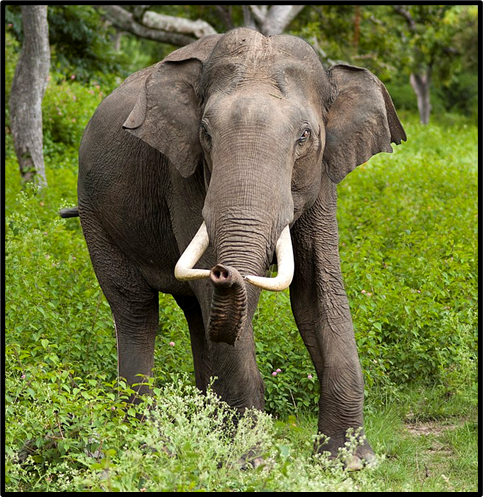
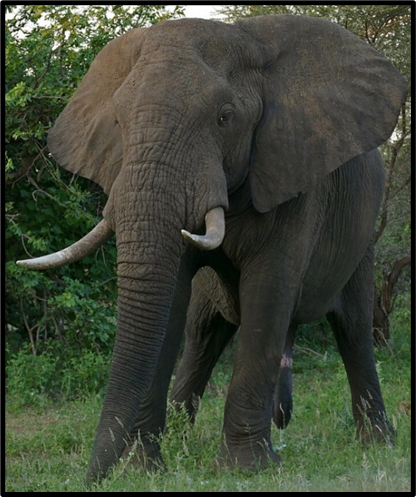
Asian Elephant vs African Elephant
| Feature | Asian Elephant (Elephas maximus) | African Elephant (Loxodonta africana & L. cyclotis) |
|---|---|---|
| Head Shape | Twin-domed head with a central indent | Single rounded dome |
| Ear Shape | Smaller, semi-circular ears | Much larger ears, shaped like the African continent |
| Size | Up to ~3.5 m tall | Largest terrestrial animal; up to ~4 m tall |
| Tusks | Only males have prominent tusks (females may have tushes) | Both males and females have tusks (larger than Asian elephants) |
| Trunk | One “finger” at trunk tip | Two “fingers” at trunk tip |
| Lifespan | Up to 48 years | Up to 70 years |
| IUCN Status | Endangered | Forest Elephant: CR; Savannah Elephant: Endangered |
| CITES | Appendix I | Appendix I (some Savannah populations in Appendix II) |
| Population | ~40,000–50,000 (India holds >60%) | ~4,15,000 (majority are bush elephants) |
| Region | South & Southeast Asia (India, Nepal, Sri Lanka, Myanmar, Thailand, etc.) | West, Central & Sub-Saharan Africa |
| Subspecies | Indian, Sumatran, Sri Lankan | Forest and Savannah species |
| Gestation | 18–22 months | ~22 months |
Ecological Importance — Why Elephants Are Keystone Species
In 2010, India declared the elephant as the National Heritage Animal.
Why? Because elephants shape ecosystems in multiple ways:
1. Landscape Architects
Their movement creates forest clearings, allowing new vegetation to regenerate.
2. Seed Dispersers
They eat fruits, walk long distances, and defecate seeds—spreading plant species across forests.
3. Soil and Nutrient Enhancers
Elephant dung is rich in nutrients and feeds fungi, insects, and even small mammals.
4. Water Providers
During droughts, elephants dig for water.
Their footprints store rainwater, becoming micro-pools for small creatures.
5. Food Chain Support
Tiger predation on calves + scavengers depending on elephant carcasses → elephants support trophic links.
In short:
Protecting elephants = protecting entire landscapes.
Elephant Corridors — The Backbone of Conservation
Elephants are highly mobile, requiring large home ranges.
But their paths are being blocked by:
→ Roads
→ Railways
→ Mining
→ Urban expansion
→ Electric fencing
To ensure free movement, we identify Elephant Corridors.
Definition:
Linear, narrow forest patches that connect two larger habitats, allowing elephants to migrate safely.
WTI’s “Right of Passage” study
Identified 101 corridors across India.
Distribution:
- Maximum → Northeast India
- Followed by: South India, Central India, North Bengal, North-west India
Threats to Elephant Corridors
1. Habitat Fragmentation
Mining (especially coal & iron ore) is the biggest threat in central & eastern India.
2. Linear Infrastructure
Railways, highways, transmission lines → increase accidental deaths.
3. Human–Elephant Conflict (HEC)
India witnesses:
→ ~400 human deaths per year
→ Crop loss
→ House destruction
→ Retaliatory killing of elephants
Why?
Because elephants need wide grazing areas, but Protected Areas are too small.
Mitigation Measures
1. Merge corridors with Protected Areas
So they receive legal protection.
2. Prevent further fragmentation
Strict control on encroachments.
3. Declare corridors as:
→ Ecologically Sensitive Areas (ESA)
→ Conservation Reserves
4. Community involvement
Voluntary relocation + awareness = coexistence.
Project Elephant (1992) — India’s flagship conservation scheme
Objectives:
- Assist states with wild elephant populations.
- Ensure long-term survival in natural habitats.
- Reduce human–elephant conflict.
- Strengthen scientific management.
- Control poaching and illegal ivory trade.
Other Major Initiatives
A. Haathi Mere Saathi (2011)
- Launched by MoEFCC + WTI during the Elephant-8 meeting.
- Goal: build positive human–elephant relationships via awareness.
E-8 countries: India, Botswana, Congo, Indonesia, Kenya, Sri Lanka, Tanzania, Thailand.
B. Project RE-HAB
By KVIC, first piloted in Kodagu (Karnataka).
Technique:
→ Using bee-box fences.
Why bees?
→ Elephants fear bee stings near eyes/trunk.
→ Even the buzzing sound irritates them.
A low-cost, non-violent mitigation solution.
To be expanded to all elephant-conflict states.
C. Asian Elephant Alliance
A coalition of 5 NGOs:
- Elephant Family
- IFAW
- IUCN
- WTI
- World Land Trust
Goal: Secure 96 of India’s 101 elephant corridors.
D. IUCN Asian Elephant Specialist Group (AsESG)
- Part of IUCN’s Species Survival Commission.
- Provides scientific data on population, distribution, status.
- Covers all 13 Asian elephant range states.
- Publishes the journal Gajah.
Conservation of the Great One-Horned Rhinoceros
To understand rhino conservation, we must begin with the global context: rhinos are not killed for meat or skin, but for their horn, which is nothing more than keratin—the same material as human hair and nails.
However, in Southeast Asian traditional medicine systems, the horn is considered “medicinal”, creating a massive illegal demand.
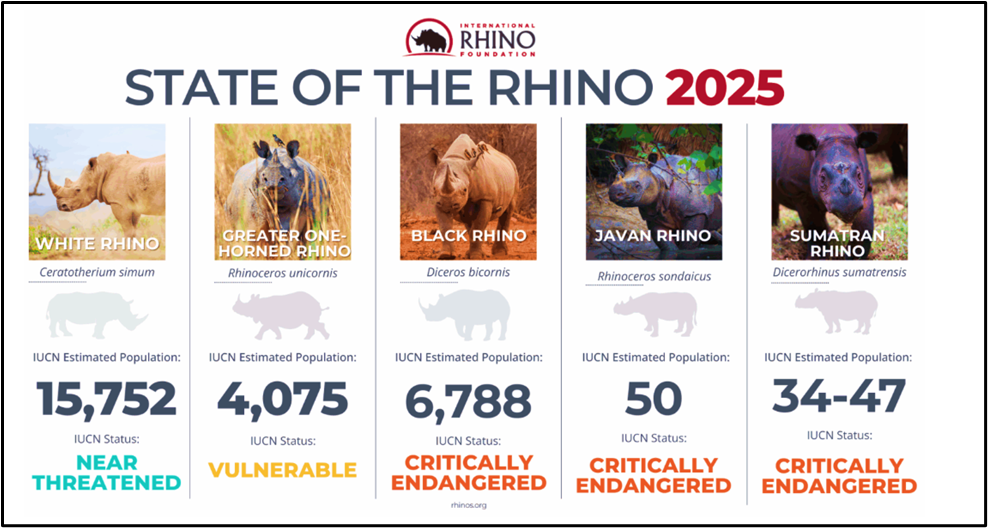
Rhino Species Across the World
Rhinos are found in Africa and Asia, and are grouped into five surviving species:
A. African Rhinos
- White Rhino
- Largest population among all rhino species today.
- Black Rhino
- Smaller than the white rhino.
- More threatened due to intense poaching.
B. Asian Rhinos
- Javan Rhino
- One of the rarest mammals on Earth; a few survive in Java and Vietnam.
- Sumatran Rhino
- Smallest rhino species, extremely endangered.
- Only 30–80 individuals remain, mainly on Sumatra.
- Great One-Horned Rhino (Indian Rhino)
- Found only in India and Nepal.
- Largest of all rhino species, except for the Asian Elephant.
- The only rhino species in India.
Horn Count Rule
- Two horns: African Rhinos + Sumatran Rhino
- One horn: Indian (Great One-Horned) Rhino + Javan Rhino
- In Indian rhinos, both males and females have horns.
Global Numbers
Out of ~27,000 rhinos left in the wild:
- 2/3rd are white rhinos
→ Shows how dramatically other species have declined.
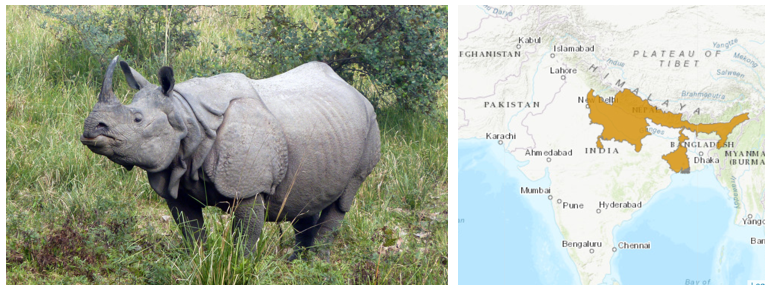
India’s Greater One-Horned Rhinoceros
Habitat
Tropical and subtropical savannas and shrublands, especially alluvial floodplain grasslands.
Distribution (Then vs Now)
- Historical range: Entire northern India, piedmont grasslands, even Pakistan and Bangladesh.
- Current range: Restricted to the Terai alluvial grasslands of India, Nepal, and Bhutan.
Major Populations in India
- Kaziranga National Park (largest population)
- Pobitora Wildlife Sanctuary (very high density)
- Manas National Park
Key Threats
- Poaching for horn
- Habitat loss and fragmentation
- Human–wildlife conflict
Protection Status
- IUCN: Vulnerable
- CITES: Appendix I (complete trade ban)
- WPA 1972: Schedule I
Major Conservation Measures
Indian Rhino Vision (IRV) 2020 – Assam’s Flagship Initiative
Started in 2005 by Assam Govt + WWF India + International Rhino Foundation.
Purpose:
Kaziranga held too many rhinos—putting them at risk from:
→ Floods
→ Disease
→ Poaching
→ Natural calamities
Vision:
➡️ 3,000 rhinos in Assam
➡️ Spread across 7 Protected Areas
Core Strategy: Translocation
Moving rhinos from dense populations (Kaziranga & Pobitora) → new or recovering sites:
➡️ Manas NP (first and most important site)
➡️ Dibru-Saikhowa WLS
➡️ Laokhowa–Bura Chapori WLS
Outcome:
IRV 2020 concluded with rhinos moved to Manas NP.
New Delhi Declaration on Asian Rhinos (2019)
Signed by five range nations:
India, Nepal, Bhutan, Indonesia, Malaysia
→ For coordinated conservation, anti-poaching, habitat protection.
DNA Profiling of Rhinos
Government of India launched a project to create a genetic database of every rhino.
Helps in:
- Crime investigation
- Tracking movement
- Strengthening prosecution in poaching cases
RhoDIS–India (Rhino DNA Database)
- By 2023, nearly all rhino-bearing states have completed DNA sample collection.
- Used in forensic tracking of seized horns (PIB 2023).
National Rhino Conservation Strategy (2019)
A national-level blueprint for long-term protection and population recovery of the Great One-Horned Rhino.
Evaluation of IRV 2020 — What Worked, What Didn’t?
Successes:
- Assam achieved ~3,000 rhinos, meeting the target.
- Manas NP regained its UNESCO World Heritage Site status, partly due to rhino revival.
- Poaching significantly reduced due to coordinated enforcement efforts.
Shortcomings:
- The plan to expand rhinos to 7 protected areas failed.
- Only Kaziranga, Orang, and Pobitora hold strong populations.
- Translocation to other sites suffered because:
- High poaching threats
- Weak security
- Poor health monitoring
- Unregulated tourism
- Road construction near Indo-Bhutan border
Way Forward — What Should Assam Do Now?
The report suggests diversification of rhino habitats:
✔ Focus on new viable areas:
→ Pobitora WLS surroundings
→ Amchang WLS
✔ Develop the Brahmaputra river channel (Kaziranga → Orang) as a natural rhino landscape.
This approach reduces concentration risk and expands the species’ ecological footprint.
Conservation of Indian Dolphins
When we discuss dolphin conservation in India, we are essentially studying freshwater ecosystem health.
Dolphins act as indicator species—their presence immediately reflects the quality of the river.
India has three key dolphin species, of which the South Asian River Dolphin (Ganges + Indus Dolphin) is the most important for UPSC.
South Asian River Dolphin (Platanista gangetica)
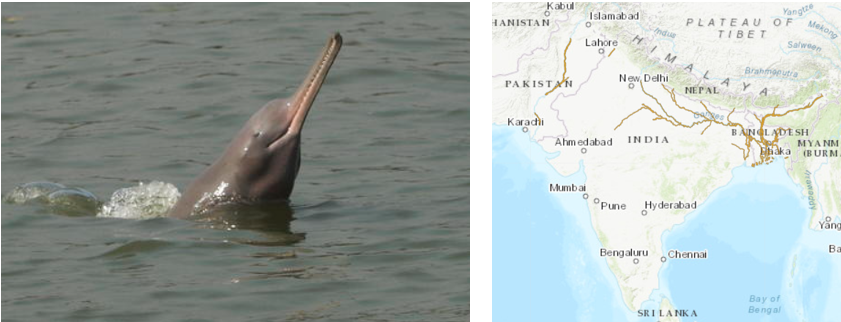
This is the only freshwater dolphin species found in the Indian subcontinent, and it has two subspecies:
(A) Ganges River Dolphin (P. g. gangetica)
(B) Indus River Dolphin (P. g. minor)
These dolphins are found across:
→ India
→ Nepal
→ Bangladesh
→ Pakistan
Threats to River Dolphins
Freshwater dolphins face far more risks than marine dolphins because rivers are heavily altered.
Major threats include:
1. Accidental entanglement in fishing nets
They drown when caught in gillnets.
2. Habitat disruption due to water development projects
- Barrages
- Dams
- Embankments
These fragment their habitats and cut off movement pathways.
3. Pollution
Industrial discharge, pesticides, and untreated municipal sewage degrade water quality.
4. Noise pollution
Vessel noise interferes with their echolocation.
Protection Status
- IUCN: Endangered
- CITES: Appendix I
- CMS: Appendix I
- WPA 1972: Schedule I
This reflects the highest category of global and national protection.
Ganges River Dolphin – “Susu”
✔ India’s National Aquatic Animal (since 2009)
Also, the State Aquatic Animal of Assam.
✔ Reason for the name “Susu”
The dolphin makes a susu-like sound while breathing at the surface.
✔ Ecological Indicator
It indicates the health of the Ganga River System.
✔ Key Characteristics
- Completely freshwater species
- Functionally blind (eyes only detect light)
- Hunts using ultrasonic echolocation
✔ Distribution
Ganga–Brahmaputra–Meghna river basins.
✔ CMS Status
Only the Ganges Dolphin is currently listed under CMS (Convention on Migratory Species).
Indus River Dolphin
✔ State Aquatic Animal of Punjab
✔ Distribution
- Primarily in Indus River (Pakistan)
- Small population in Beas River (India) — the only habitat of the Indus Dolphin in India
- Historically ranged in Sutlej as well.
This species is one of the world’s rarest river dolphins.
Irrawaddy Dolphin (Orcaella brevirostris)
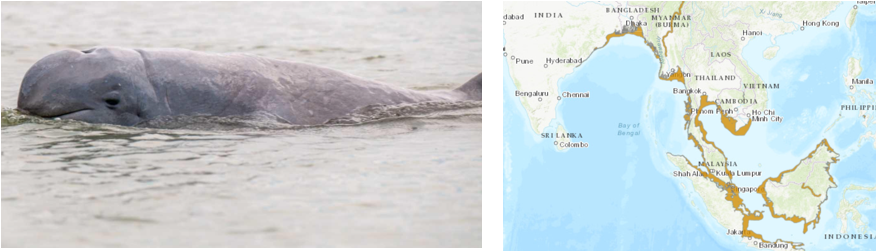
Unlike the previous two, the Irrawaddy dolphin uses:
✔ Brackish water, estuaries, and river mouths, and
✔ Freshwater rivers (Ganga, Mekong, Irrawaddy)
In India
- A significant population lives in Chilika Lake (Odisha)
→ This makes Chilika globally important.
Threats
- Human conflict
- Accidental capture in gillnets
- Boat strikes
Protection Status
- IUCN: Endangered
- CITES: Appendix I
- CMS: Appendix I
- WPA: Schedule I
Conservation Measures for Ganges River Dolphin
India’s conservation efforts revolve around improving river health and reducing anthropogenic disturbances.
1. Ganga Action Plan (1985)
Included Gangetic dolphins under Schedule I of WPA → highest protection.
2. National Ganga Council
Coordinates protection of dolphins along the Ganga basin.
3. Vikramshila Gangetic Dolphin Sanctuary (Bihar)
India’s only dedicated dolphin sanctuary.
4. Project Dolphin (Announced 2020)
Announced by PM Modi.
Covers both river and marine dolphins.
Similar model to Project Tiger / Project Elephant.
5. Conservation Action Plan for Gangetic Dolphin (2010–2020)
Identified threats such as:
- River traffic
- Irrigation canals
- Prey depletion
- Habitat fragmentation
6. Integrated Development of Wildlife Habitat
Ganges River Dolphin included among 21 priority species.
7. National Aquatic Animal Status (2009)
Declared during the first meeting of National Ganga River Basin Authority.
8. National Ganga River Dolphin Day — 5 October
Celebrated by NMCG (Namami Gange) to increase public awareness.
Conservation of Indian Crocodile
When we study crocodile conservation, it is important to understand that India has three native crocodilian species, each with distinct habitats, behaviours, and conservation concerns. Their survival depends on river health, wetland protection, and human–wildlife conflict management.
Before diving into Indian species, let’s understand the basic difference between crocodiles, alligators, and gharials.
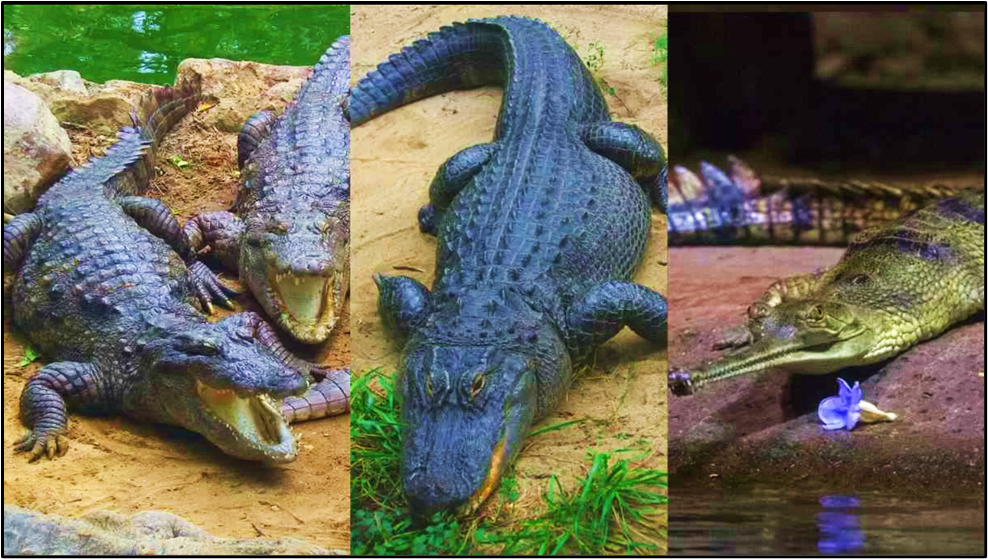
Crocodile vs Alligator vs Gharial
This is a classic UPSC question. Always remember the three key identifiers:
Family – Habitat – Snout Shape
| Aspect | Crocodiles | Alligators | Gharials |
|---|---|---|---|
| Family | Crocodylidae | Alligatoridae | Gavialidae |
| Habitat | Saltwater + freshwater | Freshwater | Freshwater |
| Distribution | Throughout tropics | US, Mexico, China | Ganges, Indus; False gharial in Indonesia |
| Snout Shape | V-shaped, pointed | U-shaped, broad | Very long, thin snout |
| Behaviour | Aggressive | Less aggressive | Extremely shy |
| Size | Large | Smaller | Medium |
| Bite Force | High | Medium | Low |
| Diet | Opportunistic | Opportunistic | Fish specialists |
| Species Count | 13 | 8 | 2 |
Thus, India does NOT have alligators. We have:
✔ Gharial
✔ Mugger
✔ Saltwater Crocodile
Indian Crocodile Species (All three native species)
A. Gharial (CR) — The Most Threatened
The gharial is evolutionarily distinct and highly specialized.
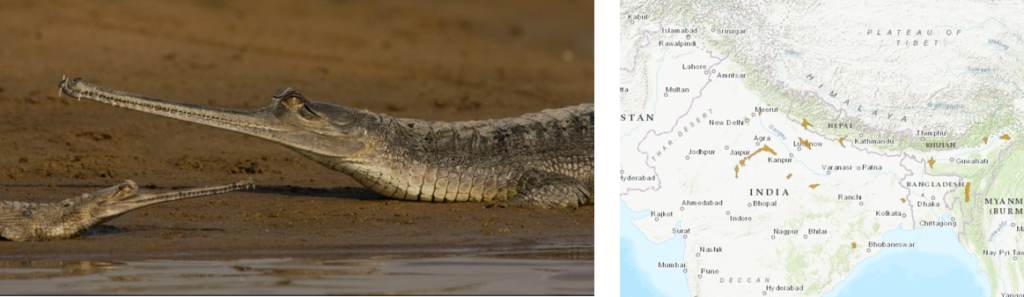
🔹 Key Features
- Fish-eating freshwater crocodile
- Very long and narrow snout
- Among the longest crocodilians in the world
- Cannot walk on land like crocodiles — their limbs are weak
- Extremely shy, non-aggressive
🔹 Former & Present Distribution
Historically:
➡️ Major rivers of the Indian subcontinent.
Today:
➡️ Only viable population remains in the
National Chambal Sanctuary (UP, MP, Rajasthan)
Small, non-breeding populations survive in:
→ Son
→ Gandak
→ Hooghly
→ Ghagra
→ Satkosia (Odisha)
🔹 Habitat
Clean, deep rivers with sandy banks for basking and nesting.
🔹 Threats
- Dams & barrages
- River channel modification
- Sand mining
- Pollution
- Agriculture along riparian zones
- Livestock intrusion
🔹 Protection Status
- IUCN: Critically Endangered
- CITES: Appendix I
- CMS: Appendix I
- WPA: Schedule I
B. Mugger / Marsh Crocodile (VU)
This is India’s most widespread crocodile.
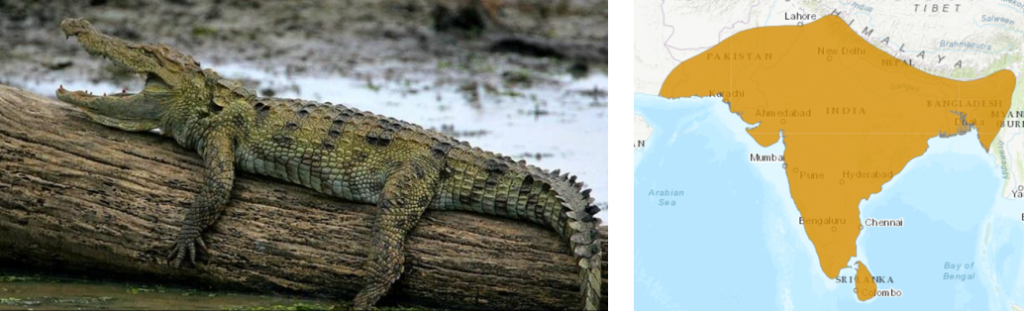
🔹 Key Features
- Freshwater species
- Broad snout (“broad-snouted crocodile”)
- Tolerant of human-dominated landscapes
- Most commonly seen in India
🔹 Habitat
- Freshwater lakes
- Rivers
- Marshes
- Reservoirs
- Slow-moving shallow waters
🔹 Distribution
- Throughout India
- Extinct in Bhutan
🔹 Threats
- Wetland destruction
- Agricultural conversion
- Industrial expansion
- Superstitious killing
- Used as aphrodisiacs in some regions
🔹 Protection Status
- IUCN: Vulnerable
- CITES: Appendix I
- WPA: Schedule I
C. Saltwater Crocodile (LC)
This is the world’s largest living reptile.
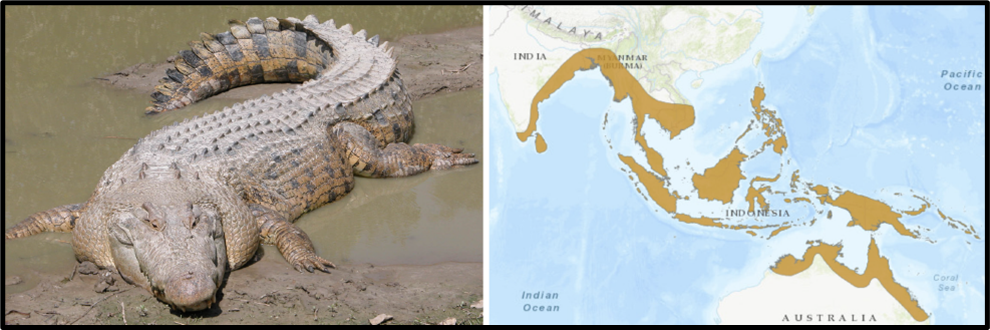
🔹 Habitat
- Mangroves
- Estuaries
- Brackish wetlands
- Coastal swamps
🔹 Distribution in India
- Bhitarkanika Wildlife Sanctuary (Odisha) — India’s largest population
- Andaman & Nicobar Islands
- Sundarbans
Also found across Southeast Asia and northern Australia.
🔹 Threats
- Illegal hunting for skin
- Habitat loss (mangrove clearing)
- Human–crocodile conflict
🔹 Protection
- IUCN: Least Concern
- CITES: Appendix I
- WPA: Schedule I
Comparative Table
Here is a short comparative table for you to analyse all the three types of crocodiles:
| Feature | Gharial | Mugger / Marsh Crocodile | Saltwater Crocodile |
|---|---|---|---|
| IUCN Status | CR (Critically Endangered) | VU (Vulnerable) | LC (Least Concern) |
| Snout Shape | Very long, narrow (fish-eater) | Broad, U-shaped | Wide, robust (V-shaped) |
| Habitat | Freshwater rivers with deep water, sandy banks | Freshwater lakes, rivers, marshes, reservoirs | Brackish & saltwater: mangroves, estuaries, coastal swamps |
| Distribution (India) | Chambal (viable); small non-breeding populations in Son, Gandak, Hooghly, Ghagra, Satkosia | Widespread across India; extinct in Bhutan | Bhitarkanika (largest), A&N Islands, Sundarbans |
| Behaviour | Very shy; non-aggressive; weak limbs (can’t walk well on land) | Tolerant of human areas; commonly sighted | Strong swimmer; territorial; can show aggression |
| Diet | Fish specialist | Opportunistic (fish, birds, mammals) | Opportunistic (fish, crustaceans, mammals) |
| Threats | Dams, barrages, sand mining, pollution, river alteration | Wetland loss, agriculture, superstition-based killing | Mangrove loss, hunting (historical), human conflict |
| Legal Protection | WPA Schedule I, CITES I, CMS I | WPA Schedule I, CITES I | WPA Schedule I, CITES I |
| Special Notes | Most evolutionarily distinct crocodilian; population extremely low | Most widespread crocodilian in India | World’s largest reptile; only crocodile adapted to marine water |
Indian Crocodile Conservation Project
This project is one of India’s most successful wildlife recovery programmes.
🎯 Objectives
✔ Protect remaining crocodile populations via sanctuaries
✔ Rebuild numbers through grow-and-release / rear-and-release techniques
✔ Promote captive breeding to revive endangered species
What is “grow and release”?
Crocodile eggs or juveniles are collected → raised safely in captivity → released into the wild once strong enough.
This helped gharials and muggers bounce back significantly.
Madras Crocodile Bank Trust (MCBT)
A globally renowned conservation institution.
Location
Outskirts of Chennai (Tamil Nadu)
Founded by
Romulus Whitaker — a legendary herpetologist.
Significance
- One of the world’s largest crocodile & alligator research centres
- Captive breeding for
- Mugger (VU)
- Saltwater Crocodile (LC)
- Gharial (CR)
- Also provides nesting sites for Olive Ridley Turtles (VU)
This institution has played a key role in scientific conservation, awareness, and rescue work.
Conservation of Indian Turtles
Turtles are among the most ancient vertebrates on Earth, but today they face some of the highest extinction risks.
In India, their threats include:
- Poaching (meat, pets, traditional medicine)
- Illegal trade
- Habitat loss (river pollution, sand mining)
- Light pollution affecting hatchlings (sea turtles)
Before we discuss individual species, let’s understand the basic difference between tortoise, turtle, and terrapin.
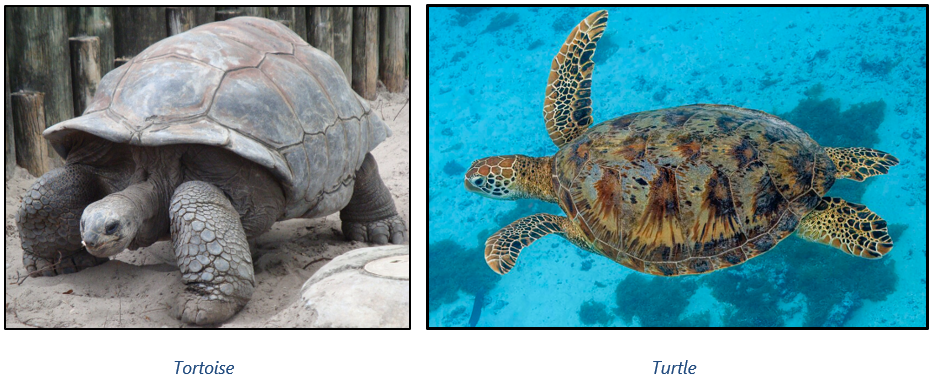
Tortoise vs Turtle vs Terrapin
| Feature | Tortoise | Turtle |
|---|---|---|
| Habitat | Land-dwelling | Water-dwelling (sea, river, ponds) |
| Water Behavior | Poor swimmers | Excellent swimmers (paddle-shaped limbs) |
| Diet | Herbivores | Omnivores (except Green Turtle → herbivore) |
| Reproduction | Everything on land | Come to land only to lay eggs |
| Size / Lifespan | Larger; long-lived (80–120 years) | Smaller; shorter lifespan (20–40 years) |
| Head withdrawal | Complete withdrawal | Partial withdrawal |
✔ All tortoises are turtles
Because both belong to the order Testudines (Chelonia).
But not all turtles are tortoises.
✔ Terrapins
Intermediate form → live both in water and land.
✔ Exception
The Green Sea Turtle is mostly herbivorous.
Major Turtle/Terrapin Species Groups in India
To simplify, turtles can be organised into two main groups:
- Batagur species (riverine turtles)
- Nilssonia species (softshell turtles)
We will cover both.
Batagur Turtle Species (All extremely threatened)
- Batagur = large river turtles of South & Southeast Asia.
- All Batagur species are Critically Endangered.
- Only two are CITES Appendix I → Southern River Terrapin & Northern River Terrapin.
- India’s focus species: Northern River Terrapin, Three-Striped Roofed Turtle, Red-Crowned Roofed Turtle.
| Species (Batagur Genus) | Distribution | Habitat Notes | IUCN Status | CITES | WPA Schedule |
|---|---|---|---|---|---|
| Southern River Terrapin (Batagur affinis) | SE Asian rivers (Malaysia, Cambodia, Indonesia) | Large river systems, nesting on sandbanks | CR | Appendix I | Schedule I |
| Northern River Terrapin (Batagur baska) | SE Asia river deltas + Sundarbans | Estuarine & tidal river systems | CR | Appendix I | Schedule I |
| Painted Terrapin (Batagur borneoensis) | SE Asian rainforests (Malaysia, Indonesia, Brunei) | Nesting on coastal/riverine sand beaches | CR | Appendix II | Schedule I |
| Three-Striped Roofed Turtle (Batagur dhongoka) | Ganga plains – India, Nepal, Bangladesh | Nests on sandbanks of large rivers | CR | Appendix II | Schedule I |
| Red-Crowned (Bengal) Roofed Turtle (Batagur kachuga) | Ganga–Brahmaputra basins; viable population only in National Chambal Sanctuary | Riverine; males much smaller than females | CR | Appendix II | Schedule I |
| Burmese Roofed Turtle (Batagur trivittata) | Irrawaddy River, Myanmar | Large rivers; critically reduced wild population | CR | Appendix II | Schedule I (not native to India but protected internationally) |
Note: Guys, you can read in further detail about these species in the IUCN page links provided in the IUCN Status column
Nilssonia Softshell Turtles (Freshwater)
Nilssonia → softshell freshwater turtles of South Asia; majority are CR, high conservation priority.
| Species | Distribution | Habitat Notes | IUCN | CITES | WPA Schedule |
|---|---|---|---|---|---|
| Burmese Peacock Softshell Turtle (Nilssonia formosa) | Myanmar; Karbi Anglong (Assam) | Large rivers | CR | Appendix II | Schedule I (India) |
| Leith’s Softshell Turtle (Nilssonia leithii) | Peninsular Indian rivers | Riverine; threatened by habitat loss | CR | Appendix I | Schedule IV |
| Black Softshell Turtle (Nilssonia nigricans) | Lower Brahmaputra; ponds in Chittagong & temple ponds in NE India | Freshwater ponds, slow rivers | CR | Appendix I | N/A |
| Indian (Ganges) Softshell Turtle (Nilssonia gangetica) | Ganges, Indus, Mahanadi | Flattened shell; riverine | EN | Appendix I | Schedule I |
| Indian Peacock Softshell Turtle (Nilssonia hurum) | Indus, Ganges, Brahmaputra | Rivers, lakes, ponds with muddy/sandy bottoms | EN | Appendix I | Schedule I |
| Indian Narrow / Small-Headed Softshell Turtle (Chitra indica) ❌ Nilssonia | Sutlej, Indus, Ganges, Brahmaputra, Godavari, Mahanadi, Padma | One of the largest freshwater turtles; buries in sand to ambush prey | EN | Appendix II | Schedule IV |
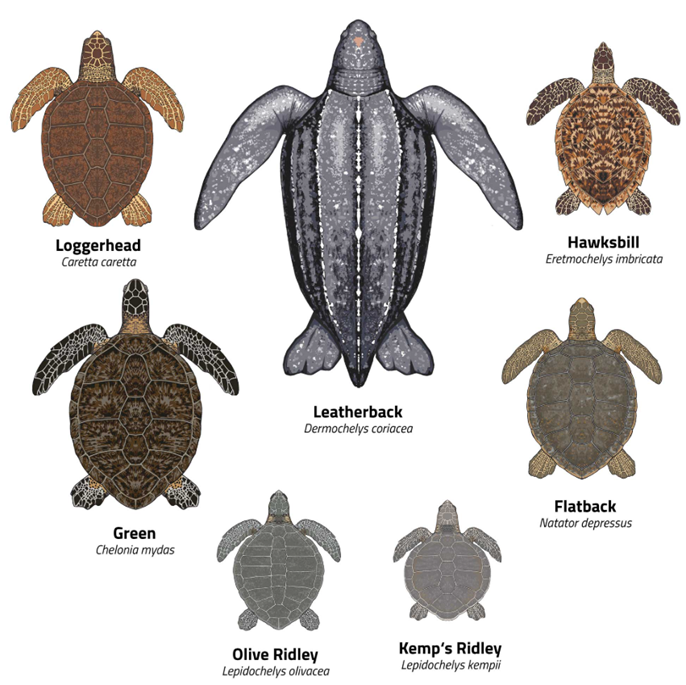
Sea Turtles of the World
There are 7 sea turtle species globally.
Decreasing order of their size:
Leatherback > Green > Loggerhead > Hawksbill > Flatback (Australia only) > Olive Ridley > Kemp’s Ridley
India has 5 of these (all except Flatback and Kemp’s Ridley, which is rare here).
| Sea Turtle Species | Distribution | Habitat / Ecological Notes | IUCN | CITES | CMS | WPA Schedule |
|---|---|---|---|---|---|---|
| Hawksbill Sea Turtle (Eretmochelys imbricata) | India: A&N Islands, Tamil Nadu, Odisha; tropical reefs worldwide | Migratory; nests on insular sandy beaches; associated with coral reefs | CR | Appendix I | Appendix I | Schedule I |
| Kemp’s (Atlantic) Ridley Sea Turtle (Lepidochelys kempii) | Subtropical–temperate North Atlantic; not common in India | World’s rarest & smallest sea turtle; known for arribada (with Olive Ridley) | CR | Appendix I | Appendix I | Not listed |
| Green Sea Turtle (Chelonia mydas) | Tropical & subtropical seas; rare in India | Only herbivorous sea turtle; feeds on seagrass | LC | Appendix I | Appendix I | Schedule I |
| Leatherback Sea Turtle (Dermochelys coriacea) | Global: tropical & temperate oceans | Largest sea turtle (250–700 kg); artificial light disorients hatchlings | VU | Appendix I | Appendix I | Schedule I |
| Loggerhead Sea Turtle (Caretta caretta) | Tropical & temperate oceans | Long-distance migrations; moderate-sized species | VU | Appendix I | Appendix I | Schedule I |
| Olive Ridley Sea Turtle (Lepidochelys olivacea) | Warm tropical oceans; India’s east coast (Odisha) major nesting site | Famous for arribada; nests at Gahirmatha & Rushikulya; heavy anthropogenic threats | VU | Appendix I | Appendix I | Schedule I |
| Flatback Sea Turtle (Natator depressus) | Endemic to northern Australia & nearby seas | Named for its distinctly flat shell; does not undertake long oceanic migrations unlike other species | DD | Not listed (Australia restricts export) | Not listed | N/A |
Sea Turtle Conservation Project (1999)
By MoEF + UNDP + Wildlife Institute of India (WII)
Objectives
- Conserve Olive Ridley and other marine turtles
- Identify nesting sites
- Map breeding habitats
- Track migratory routes via satellite telemetry
Major Achievement
- Promotion of Turtle Exclusion Device (TED) in trawlers
→ Helps turtles escape nets → reduces bycatch mortality
Conservation of Indian Vultures
India once had the world’s largest vulture populations, especially in the Gangetic plains. The reason was simple:
- Hindus do not eat cattle,
- Dead cattle were left in open fields,
- Vultures consumed them, keeping the environment naturally clean.
Thus, India was among the best habitats globally for vultures.
But within a decade (1990s–2000s), India witnessed the world’s fastest collapse of a bird population — a true ecological disaster.
The Diclofenac Crisis — What Happened?
✔ What is Diclofenac?
- A veterinary NSAID (non-steroidal anti-inflammatory drug)
- Used to treat pain, fever, swelling in livestock
✔ Why is it deadly for vultures?
Vultures lack an enzyme to break down diclofenac.
When they feed on cattle treated with the drug:
➡️ Diclofenac accumulates in their body
➡️ Causes renal failure
➡️ Leads to visceral gout (uric acid crystals deposit in organs)
➡️ Vulture dies within days
✔ Decline in Gyps species (the most affected group)
- White-Rumped Vulture: ↓ 99.7% (1993–2002)
- Indian (Long-Billed) Vulture: ↓ 97.4%
- Slender-Billed Vulture: ↓ 97.4%
✔ Why were Himalayan Vulture & Eurasian Griffon less affected?
- They migrate to India only in winters
- Live mostly in mountains
- Less exposure to contaminated carcasses
Ecological Consequences of Vulture Decline
Vultures are nature’s sanitation workers. Their disappearance caused:
1. Carcasses left to rot
→ Pollutes water & soil
2. Explosion of wild dogs and rats
These animals now feed on carcasses and multiply.
3. Spread of diseases
Dogs and rats are carriers of pathogens from rotting meat.
Vultures are NOT carriers — their metabolism kills pathogens.
Diseases that increased due to depopulation include:
→ Rabies
→ Anthrax
→ Plague
This has public health and economic consequences.
Indian Vulture Species
All are Old World Vultures, belonging to Accipitridae family.
| Vulture Species | Distribution (India / Region) | IUCN | CMS | WPA |
|---|---|---|---|---|
| White-Rumped Vulture (Gyps bengalensis) | Gangetic plains (once abundant) | CR | App I | Sch I |
| Red-Headed Vulture (Sarcogyps calvus) | Indian subcontinent; plains & forests | CR | App I | Sch IV |
| Indian (Long-Billed) Vulture (Gyps indicus) | India, Pakistan, Nepal | CR | App I | Sch I |
| Slender-Billed Vulture (Gyps tenuirostris) | Sub-Himalayan region & SE Asia | CR | App I | Sch I |
| Egyptian Vulture (Neophron percnopterus) | Widely distributed; common near human habitation | EN | App I | Sch IV |
| Himalayan (Griffon) Vulture (Gyps himalayensis) | Himalayas & Tibetan Plateau | NT | App II | Sch IV |
| Bearded Vulture (Lammergeier) (Gypaetus barbatus) | High-altitude mountains | NT | App II | Sch IV |
| Cinereous Vulture (Aegypius monachus) | Central & West Asia; winter visitor to India | NT | App II | Sch IV |
| Eurasian Griffon Vulture (Gyps fulvus) | Europe, W & Central Asia; wintering in India | LC | App II | Sch IV |
Major Non-Indian Vulture Species:
| Vulture Species | Distribution (Global) | IUCN | CMS | WPA Schedule |
|---|---|---|---|---|
| White-Backed Vulture (Gyps africanus) | Sub-Saharan Africa (savannas & open woodlands) | CR | App I | Sch IV |
| Rüppell’s (Griffon) Vulture (Gyps rueppelli) | Sahel region & East Africa; known for high-altitude flight | CR | App I | Sch IV |
Government Steps for Vulture Conservation
India has implemented multiple strategies at both species and landscape levels.
1. Species Recovery Programme under IDWH
Many vulture species are included under the Integrated Development of Wildlife Habitats.
2. Upgrading Legal Protection
Three Gyps vultures were upgraded from WPA Schedule IV → Schedule I:
→ White-Rumped
→ Long-Billed
→ Slender-Billed
Others remain in Schedule IV.
3. Vulture Restaurants
- Started in Maharashtra & Punjab
- Safe food (diclofenac-free carcasses) is provided on raised platforms
This helps vultures recover in monitored environments.
4. Vulture Conservation Breeding Programme
Led by:
- Central Zoo Authority (CZA)
- Bombay Natural History Society (BNHS)
Extremely successful in captive breeding of critical species.
5. Vulture Safe Zones (VSZs)
Created within a 150 km radius around vulture colonies.
Purpose:
- Ensure no diclofenac or toxic NSAIDs enter the food chain
- Prepare areas for reintroduction of captive-bred vultures
Nepal has also established VSZs along the Indian border.
6. Bans on Toxic NSAIDs
India has banned multiple drugs:
| Drug | Status |
| Diclofenac (2006) | Banned for veterinary use |
| Aceclofenac & Ketoprofen (recent) | Banned for veterinary use |
✔ Meloxicam
- Safe alternative for vultures
- Works for cattle; does not harm vultures
Action Plan for Vulture Conservation (2020–25)
This is India’s most important policy document for vultures.
Key Objectives:
1️⃣ Strict regulation of all veterinary NSAIDs
2️⃣ Safety testing of new drugs before allowing veterinary use
3️⃣ Ban all vulture-toxic drugs (not only diclofenac)
4️⃣ Cover all 9 Indian species under the plan
5️⃣ Establish at least one Vulture Safe Zone in every state
6️⃣ Strengthen rescue, rehabilitation, and reintroduction efforts
For chapter-wise Environment preparation for UPSC Prelims and Mains, refer to the complete Environment UPSC notes page.