
Demographic Transition Model (DTM)
Let’s begin with the core idea. The Demographic Transition Model (DTM) tries to explain how population patterns change over time as a society progresses—from being poor, rural, and illiterate to becoming rich, urban, and educated.
It was put forward by W.S. Thompson and Frank Notestein, who closely studied the population trends of Europe, Latin America, and Australia.
The Core Hypothesis of the Model
There are three important assumptions or hypotheses that the model is built on:
- Mortality declines before fertility – In simple terms, people start living longer before they start having fewer children.
- Eventually, fertility also declines – Families begin to prefer fewer children as conditions improve.
- Socio-economic change happens alongside demographic change – As societies industrialize and modernize, their population structure changes too.
The Underlying Reason: Biological vs Cultural Nature of Humans
Here, the scholar Trewartha offers an interesting observation. He says that:
- Biologically, all human beings are the same—we reproduce.
- But culturally, we are very different.
→ Example: In one society, having 6 children is normal. In another, even 2 is considered a lot.
So, culture explains why different regions move through demographic transition at different speeds.
The Five Stages of Demographic Transition
Let’s now understand this model stage by stage, like the journey of a country as it evolves socially and economically.
Stage 1: High Stationary Stage
“Imagine a time when people were living in villages, farming, and had no hospitals or vaccines.”
- Birth Rate: Very High (families had many children to help in work)
- Death Rate: Also Very High (due to disease, famines, poor hygiene)
- Population Growth: Low or stagnant
- Life: Short and uncertain. High infant mortality.
- Gender Inequality: Prominent
- Examples Today: Few African countries are still in this stage.
🔍 Analogy: Like a leaking bucket—you keep pouring water (births), but most of it leaks out (deaths).
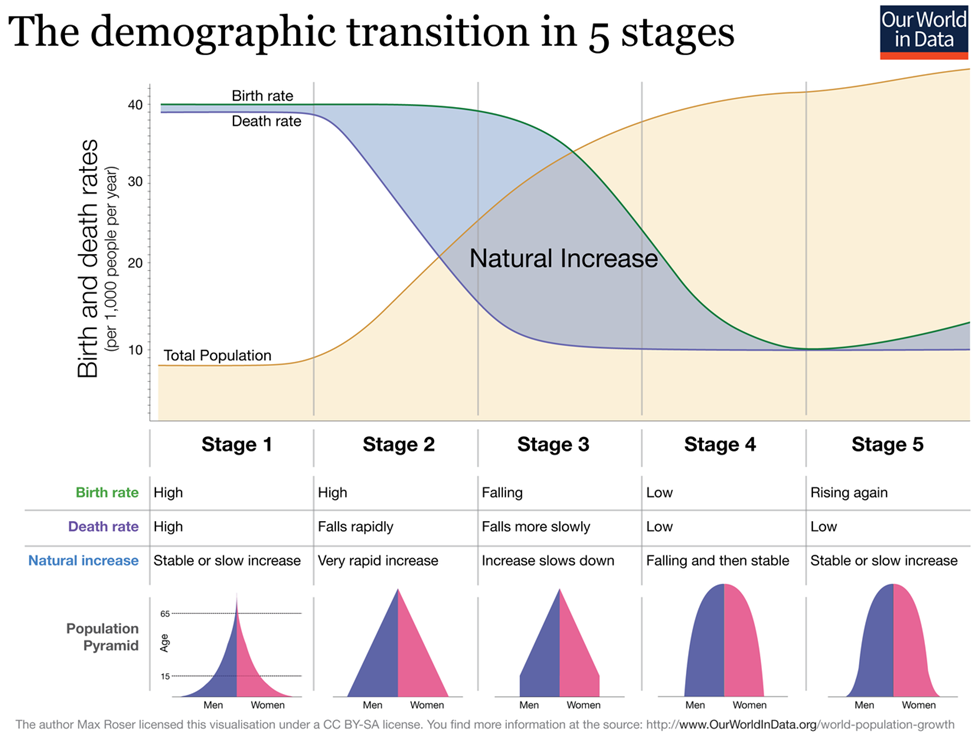
Stage 2: Early Expanding Stage
“Now picture a village where a new clinic opens, vaccines arrive, but people are still having many children.”
- Death Rate: Starts falling (thanks to medical progress)
- Birth Rate: Remains high (cultural habits continue)
- Population Growth: Explodes! (this is the population explosion stage)
- Urbanization and Industrialization: Begin
- Problems: Overcrowding, unemployment, resource strain
- Gender Gap: Still persists
- India’s Position: India was in this stage until around 2001
🔍 Analogy: The leaking bucket is now patched (fewer deaths), but we’re still pouring the same amount of water in (many births). So the bucket starts overflowing—population booms!
Stage 3: Late Expanding Stage
“Now, the same village becomes a town. People move to cities, women get educated, family planning becomes common.”
- Birth Rate: Starts to fall (due to education, contraception, shift in mindset)
- Death Rate: Already low
- Population Growth: Slows down
- Age-Sex Pyramid: Starts taking a barrel shape—more middle-aged people due to increasing life expectancy
- India’s Current Position: India is in Stage 3 today.
🔍 Real-life Example: Urban middle-class Indian families today typically have 1 or 2 children—this is Stage 3 in action.
Stage 4: Low Stationary Stage
“Now think of countries like Germany, Canada or Sweden.”
- Birth Rate and Death Rate: Both are low and balanced
- Population: Stable and low
- Society: Highly urbanized, industrial, literate, with good health care
- Gender Equality: High
- Workforce: Dominated by secondary (industries) and tertiary (services) sectors
🔍 Analogy: Now the bucket is full, but water is added and removed slowly and equally—no overflow, no shortage.
Stage 5: Declining Stage (Recently Added)
“Now imagine Japan today—many elderly, fewer babies.”
- Birth Rate: Falls below the death rate
- Death Rate: Still low, but aging population causes higher deaths
- Population: Starts shrinking
- Major Concern: Ageing population, labour shortage, economic strain
- Example: Japan is in this stage
🔍 Analogy: Less water is added than what evaporates—so the bucket slowly starts emptying.
Criticisms of the Demographic Transition Model
While this model is useful, it is not without flaws. Let’s understand the major criticisms:
- Western-Centric: It is based only on the experience of Europe, America, and Australia.
- Not Predictive: It doesn’t tell us when a country will move from one stage to another.
- Ignores Innovation: Underestimates the impact of technology, especially in medicine, in reducing mortality.
- Doesn’t Fully Explain Fertility Decline: It doesn’t identify all the reasons or variables that lead to smaller families.
- Not Applicable to All: Many developing countries have shown unexpected patterns, like a sudden drop in death rates due to external aid or global medical advancements.
Conclusion: Is it Still Useful?
Despite criticisms, the Demographic Transition Theory remains a powerful framework to understand how population evolves with development. It gives a macro-level generalization—not perfect, but still helpful.
- Think of it as a broad map, not a precise GPS.
- It gives direction but not exact timing.
- Especially for UPSC aspirants, it helps categorize countries, understand population policies, and analyze developmental challenges.