
State of Food Security and Nutrition in the World (SOFI 2024) Report
Published by five global agencies — FAO, IFAD, UNICEF, WFP, and WHO, the SOFI 2024 report is the global barometer for food security and nutrition. It tells us how many are hungry, why they are hungry, and what we can do about it.
Let’s understand it in 4 parts:
- Key Global Findings
- India-Specific Data
- Underlying Issues
- Key Recommendations
Key Global Findings: The World is Still Hungry
Despite some improvement, the world is off-track to meet SDG 2 – Zero Hunger by 2030.
| Indicator | Key Data |
|---|---|
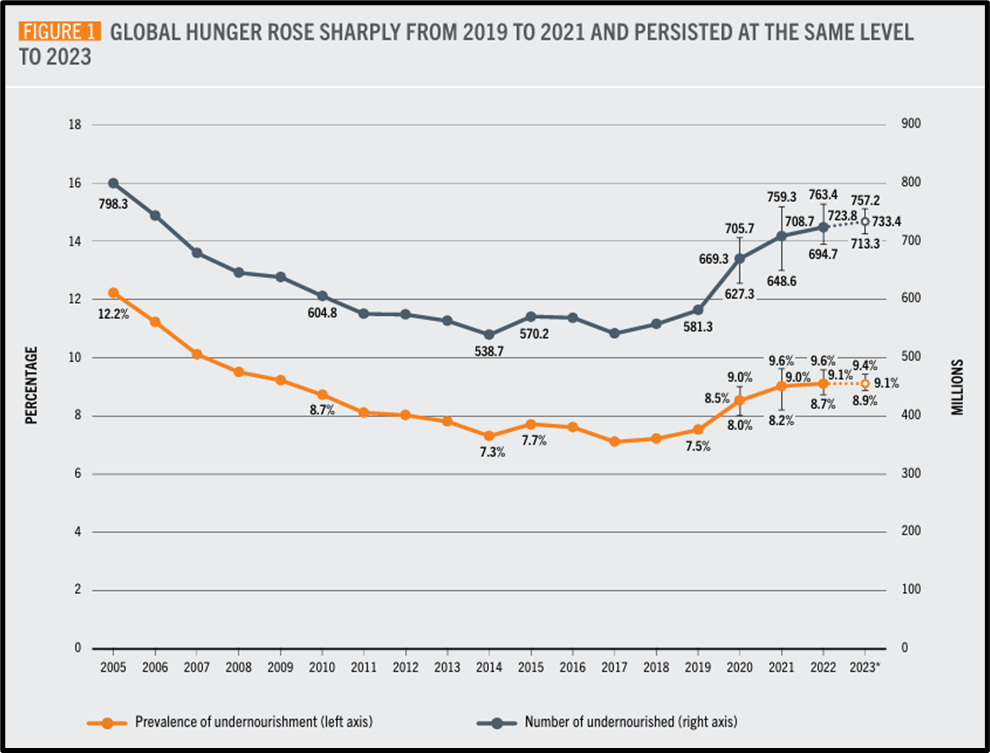
| 🔴 Undernourishment | 713–757 million people were hungry in 2023. That’s 1 in 11 people globally, and 1 in 5 in Africa. |
| 🔴 Food Insecurity | 2.33 billion people faced moderate or severe food insecurity. Severe cases: 864 million. |
| ⚠️ Cost of Healthy Diet | Rose to $3.96 (PPP/day/person) in 2022. Still, 2.83 billion people cannot afford it. |
| ⚠️ Nutrition Imbalance | Both undernutrition and obesity rising. Obesity is a growing global epidemic. |
| ⚠️ Anaemia in Women (15–49 yrs) | On the rise globally, linked to poor diet and women’s health neglect. |
| ⚠️ Public Financing | Still inadequate, especially in low-income nations. Private investment is hard to track. |
🧠 Conceptual insight: Food insecurity today is no longer just about “no food”, but also about “wrong food, unaffordable food, and poor-quality food.” It’s a triple burden: undernourishment, micronutrient deficiency, and obesity — co-existing.
India-Specific Highlights: Hunger amidst Plenty
India’s picture is paradoxical: food grain surplus country, yet large-scale hunger.
| Issue | Data |
|---|---|
| 🍽️ Undernourished Population | 194.6 million — highest in the world (but improved from 240 million in 2004–06). |
| 💰 Affordability of Healthy Diet | 55.6% (≈790 million people) cannot afford a healthy diet. |
| ⏳ Chronic Undernourishment | Affects 13% of the population — long-term issue. |
| 📊 GHI (Global Hunger Index) Rank 2023 | 111th — poor food security indicators. |
| 🧒 Child Malnutrition | Wasting: 18.7%, Stunting: 31.7% — both very high. |
| 👶 Low Birth Weight | 27.4% — highest in the world, indicates maternal malnutrition. |
| 👩 Anaemia in Women (15–49 yrs) | 53% — highest in South Asia. |
| ⚖️ Obesity Rising | 2.8% in children <5 years, 7.3% in adults. |
| 🍔 Diet Quality | Ultra-processed foods on the rise. WHO classifies most packaged foods as unhealthy. |
🧠 Critical insight: India faces a double burden — hunger and obesity, both fueled by poor-quality diets, socio-economic inequality, and flawed food systems.
Note: Incorporating data from the above tables into your mains answer writing will enhance the depth and quality of your responses.
Underlying Structural Issues
The report identifies the root causes behind the crisis — both global and India-specific:
- Rising food costs and inflation
- Inadequate social protection for vulnerable groups
- Climate shocks and weather disruptions (e.g., heatwaves, erratic monsoon)
- Pandemic aftershocks (loss of livelihoods, disrupted supply chains)
- Lack of investment in nutrition-sensitive agriculture
- Ineffective public spending (need better targeting and governance)
🧠 Analogy: Think of food insecurity like a sinking boat. Some people are sinking due to holes (poverty, hunger), while others are overloaded with junk (obesity, ultra-processed diets) — the solution is not just more food, but better distribution, quality, and equity.
Key Recommendations: The Road Ahead
SOFI 2024 is not just diagnostic — it is prescriptive.
1. Increase Public Investment
- More spending on nutrition-sensitive schemes (e.g., ICDS, Mid-Day Meals).
- Local communities should be involved in design → ownership = effectiveness.
2. Mobilize Private Investment
- Use social/green/sustainability bonds to attract funds.
- Encourage public-private partnerships in nutrition, food tech, and agri-infrastructure.
3. Promote Climate-Resilient Agriculture
- Invest in drought-resistant crops, crop diversification, and agro-ecology.
- Build early warning systems and climate-smart supply chains.
4. Improve Agrifood Systems
- Strengthen logistics, cold chains, storage, and market access.
- Reduce post-harvest losses and food wastage.
5. Implement Comprehensive Nutrition Programs
- Address both undernutrition and overnutrition.
- Promote balanced diets, nutrition education, and physical activity.
6. Focus on Vulnerable Populations
- Special focus on women, children, small farmers, and tribal communities.
- Encourage exclusive breastfeeding, and address maternal nutrition gaps.
7. Strengthen Data Systems
- More robust, real-time data to track nutrition trends.
- Integration with national databases for targeted policymaking.
🔚 Conclusion: The Hunger Paradox
The world produces enough food to feed everyone, yet millions go hungry — this is not a food shortage issue, but a failure of equity, governance, and policy priorities.
SOFI 2024 reminds us that ending hunger is not about charity, but about justice, smart investment, and inclusive governance.