
Human Development Index
Understanding the Human Development Index (HDI)
Growth vs. Development: The Basic Difference
Earlier, growth and development were used as if they meant the same thing. But gradually, scholars realized they are different:
- Growth: It is quantitative—meaning it talks about numbers (like GDP increasing or decreasing). It can be positive or negative. Example: If India’s GDP falls by 2%, that’s negative growth.
- Development: It is qualitative—it talks about improvement in the quality of life, and it is always positive. Example: Better education, healthcare, and dignity for people.
👉 Analogy: Think of growth as gaining more weight (which could be good or bad), but development is like becoming healthier and fitter (always a positive thing).
Before 1990: Economic Progress Meant Development?
- Earlier, a country’s development was judged only by its economic growth.
- But this was misleading. Even if GDP grew, common people might still be poor, sick, or uneducated.
- Real development should improve quality of life, opportunities, and freedom.
👉 Realization: Development isn’t just about richer governments—it’s about happier, healthier citizens.
1970s: The First Step Towards Broader Understanding – PQLI
- David Morris introduced PQLI (Physical Quality of Life Index) in the 1970s.
- It measured:
- Health
- Life Expectancy
- Literacy Rate
👉 This was the first time social factors, not just economic ones, were used to measure development.
Late 1980s and 1990s: Human Development Concept Emerges
- Dr. Mahbub-ul-Haq and Dr. Amartya Sen revolutionized thinking.
- Mahbub-ul-Haq (1990) created the Human Development Index (HDI).
- He said:
- Development = Enlarging people’s choices for living long, healthy, meaningful lives with dignity.
- A meaningful life = Health + Talent Development + Social Participation + Freedom.
- Amartya Sen added emphasis on freedom—freedom to make choices and shape one’s life.
👉 Analogy: Just earning money isn’t enough. True success is when you are healthy, educated, empowered, and free to live the way you want.
Key Aspects of Human Development
HDI focuses on:
- Health (Leading a long and healthy life): measured by life expectancy at birth (SDG-3)
- Education (Gaining knowledge and skills): assessed through mean years of schooling for adults (SDG-4.4) and expected years of schooling for children (SDG-4.3).
- Standard of living (Having resources and employment): evaluated using Gross National Income (GNI) per capita (SDG-8.5), adjusted for income distribution.
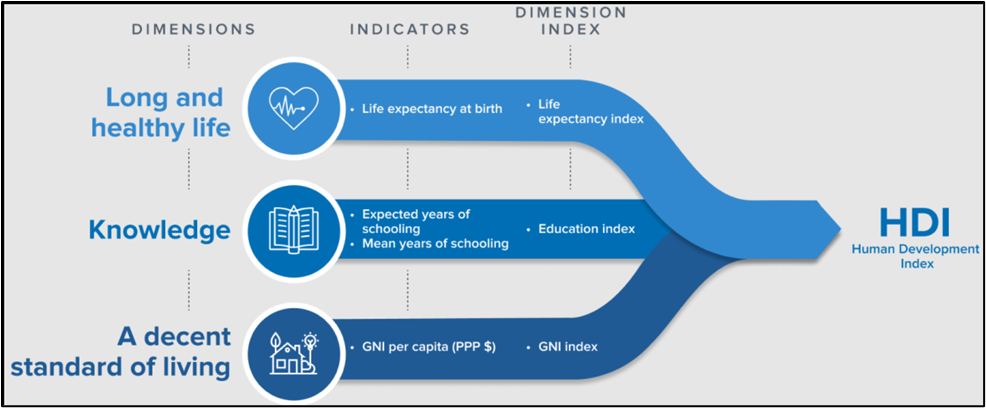
HDI categorizes countries into four development levels based on their HDI values:
- Low Human Development: HDI value below 0.550
- Medium Human Development: HDI value between 0.550 and 0.699
- High Human Development: HDI value between 0.700 and 0.799
- Very High Human Development: HDI value 0.800 and above
Different Faces of Development: Western vs. Post-Colonial View
- Western countries often define development as modernization, leisure, and comfort.
- Postcolonial countries like India have different challenges:
- Colonization, social discrimination, regional disparities—these issues distort the development process.
In India, poverty is worsened by:
- Social Capability Loss: Displacement breaks social ties.
- Environmental Capability Loss: Pollution harms living conditions.
- Personal Capability Loss: Diseases and accidents increase vulnerability.
👉 Lesson: Development isn’t “one-size-fits-all.” Context matters.
Why Focus on Human Development?
According to Paul Streeten, Human Development is important because it:
- Improves human living conditions and enlarges choices.
- Boosts productivity.
- Helps reduce population growth.
- Protects the environment.
- Builds healthy civil society, strengthens democracy, and improves political stability.
👉 Analogy: Investing in people is like watering the roots of a tree—you get stronger fruits (economy, society) later.
Indicators of Human Development
The United Nations Development Programme (UNDP) created the HDI, measuring:
- Longevity (Life Expectancy)
- Knowledge (Education levels)
- Decent Standard of Living (Income)
In India, for Human Development Reports (HDRs), indicators are:
- Core Composite Indices (general human development)
- Gender Equality Index (how equally men and women develop)
- Human Poverty Index (measuring deprivation)
Other indicators:
- Health: Birth rate, death rate, Infant Mortality Rate (IMR), nutrition.
- Education: Literacy rate (especially female literacy), enrollment, dropouts, pupil-teacher ratio.
- Economy: Wages, income, employment, per capita GDP, poverty rate.
Approaches to Human Development
- Income Approach: Freedom increases with income.
- Welfare Approach: Humans are beneficiaries of development projects.
- Minimum Needs Approach: Focuses on basic services like health, education, housing.
- Capabilities Approach (Amartya Sen’s idea): Building people’s capabilities is the real development.
👉 Simple way to understand: Instead of giving a fish (welfare), teach them how to fish (capability building).
Limitations of HDI
HDI is a big step forward but not perfect. Limitations include:
- Doesn’t differentiate much among developed countries: Once income and literacy are high, differences are tiny.
- Excludes political and civil freedom: HDI focuses mostly on socio-economic aspects.
- Ignores inequalities: Inside countries, between rich and poor, men and women.
- Data problems:
- Developing countries often have incomplete or incorrect data (example: wrong GNP figures, estimated under-5 death rates).
- Literacy definitions differ between countries; some countries haven’t updated data since 1970.
- Conceptual Weakness: HDI tries to capture very complex realities into simple numbers—leading to oversimplifications.
👉 Conclusion: HDI is good as a broad indicator but should not be used blindly for policy-making.
To address these gaps, UNDP provides additional indices, including:
- Inequality-adjusted HDI (IHDI)
- Gender Inequality Index (GII)
- Multidimensional Poverty Index (MPI)
Final Thought
Human Development Index shifted the world’s focus from “how rich a country is” to “how well its people live.”
But, just like a student’s report card cannot fully capture his creativity, emotions, or social skills, HDI too cannot capture everything about human life.
It’s an important start, but not the final answer.