
Classification of Rural Settlements
The rural landscape of India—and indeed the world—is not uniform. If you travel across villages from Punjab to Odisha, or from the hills of Meghalaya to the plains of West Bengal, you’ll notice a variety in the way houses are arranged, how far apart they are, and how the community is structured.
This diversity in rural settlements can be classified using several criteria:
- Size of the settlement
- Distribution of houses
- Layout (how the settlement is organized)
- Function (economic or cultural role)
- Type and pattern/design (how it looks spatially)
But for practical and conceptual clarity, we broadly classify rural settlements into four main types:
1. Compact / Nucleated / Clustered Settlements
Think of this as a tightly packed neighborhood.
Houses are close to one another—like clusters of grapes—usually centered around a common facility like a well, temple, or chowk.
Key Features:
- Farming-based economy.
- Common in fertile alluvial plains such as:
- Indo-Gangetic Plain
- Hwang Ho Valley (China)
- Nile Valley (Egypt)
In India, these are prominent in:
- Northern Plains – From Punjab to West Bengal
- Coastal Odisha
- Maidan region of Karnataka
- Rayalaseema (Andhra Pradesh)
Social Structure:
- Often shows segregation of castes:
- Upper castes occupy the central or elevated core.
- Lower castes live on the periphery.
- This differentiation is particularly visible in Sutlej-Ganga plains.
Why do they develop this way?
- Fertile soil → people want to live near fields.
- Need for protection from wild animals or enemies.
- Mutual cooperation and shared resources.
- Cultural practices reinforce social clustering.
🧠 Analogy: Imagine a medieval fort town where everyone lives within walls for safety, and the center has temples, shops, and water. Compact settlements function similarly—close-knit and interdependent.
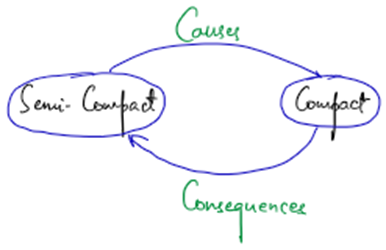
2. Semi-Compact / Semi-Nucleated / Semi-Clustered Settlements
This is a transitional form—halfway between compact and dispersed.
Why does this form emerge?
- When compact villages expand, more houses are added but not tightly clustered.
- Happens due to:
- Semi-arid climate
- Less fertile or marginal land
- Social taboos (e.g., untouchability) leading to spatial segregation
- Population growth forcing outward expansion
- Adoption of new technology (e.g., tractors need space)
Where in India?
- North-west Ganga-Yamuna Doab
- Khadar plains (fertile river belts)
- Rajasthan
- Hilly areas like:
- Madhya Pradesh
- Meghalaya, Manipur, Mizoram
- Tripura, Sikkim, etc.
🧠 Analogy: Think of a town that started small but slowly sprawled out. It’s no longer compact, but not entirely spread out either.
3. Hamleted Settlements
These are scattered fragments of a single village.
- Technically, if the number of hamlets is double the number of villages, it’s called a hamleted settlement.
- These hamlets are separated by intervening agricultural fields.
- A central or dominant village may be weak or even non-existent.
Why do they develop?
- Uneven topography (hills and valleys)
- Diffused arable land (land suitable for cultivation is scattered)
- Dense forests
- Poor communication
- Social divisions (e.g., lower castes living away from the main group)
Where in India?
- West Bengal
- Eastern Uttar Pradesh
- Madhya Pradesh
- Ganga-Ghagra Doab
- Kashmir Valley
- Doon Valley
- The Vindhya Range
🧠 Analogy: Think of a school where students are split into different rooms with no clear center—each group exists in isolation, with a weak connection to the rest.
4. Dispersed / Sprinkled Settlements
These are the most scattered type—houses are far apart, often isolated.
Where do they occur?
- Hills, plateaus, grasslands
- Forested or tribal regions
- Where farmers live directly on their land
This pattern often arises when:
- Overpopulation forces people to settle away from the core village.
- A group splits from the main village and starts living independently.
- It suits regions where grazing or shifting cultivation is practiced.
Historical Note:
- In India, dispersed settlements started becoming common in the medieval period.
- Present today in:
- Khadar belt
- Grasslands like Steppe region (Kazakhstan)
🧠 Analogy: Think of stars in the sky—each shining alone, far from others. That’s how dispersed settlements are—isolated, self-reliant, and scattered.
Conclusion: A Summary of Rural Settlement Types
| Type | Arrangement | Where Found | Why It Forms |
|---|---|---|---|
| Compact/Nucleated | Clustered, dense | Indo-Gangetic Plain, Nile Valley | Fertile soil, safety, cooperation |
| Semi-Compact | Partially clustered | Ganga-Yamuna Doab, Rajasthan | Expansion, marginal land, tech use |
| Hamleted | Scattered hamlets | Doon Valley, Vindhyas | Terrain, social division, poor access |
| Dispersed | Widely scattered | Hills, Plateaus | Grazing, overpopulation, self-reliance |