
Patterns of Rural Settlements
The pattern of a rural settlement refers to the spatial arrangement of houses, roads, and other structures in a village. It’s essentially the answer to this question: “How are the buildings in a rural settlement positioned in relation to each other?”
Think of it as looking at a village from above—like reading a large-scale map, such as a Survey of India topographical sheet. You’ll notice shapes: some look like lines, some like circles, triangles, or stars. These shapes are not random—they emerge from centuries of adaptation to the environment and social structure.
Now, let’s understand these patterns:
1. Rectangular Pattern
This is the most common pattern globally. Imagine neat blocks of houses and straight roads, just like a grid layout in urban areas, but on a village scale.
Key Features:
- Straight lanes intersecting at right angles.
- Houses and farms arranged in a geometric grid.
- Found in productive alluvial plains and wide valleys.
Examples:
- Sutlej-Ganga plains in India.
- Planned settlements in Germany, Russia, China, France, etc.

2. Linear Pattern
In a linear settlement, homes stretch along a line—usually a road, river, canal, or even the edge of a valley.
Why does it form?
- To remain close to water or transport routes.
- In mountains, to avoid flood-prone valley floors but still stay connected.
Geographical Distribution:
- Himalayas, Alps, Rockies, Andes, Zagros, Elburz.
- Along roads in Ganga-Yamuna plains.

3. Circular and Semi-Circular Pattern
This occurs when people settle around a central water body—like a lake or ox-bow lake—or along the coastline.
Typical Occupations:
- Fishing, salt production, or water-based livelihoods.
- Also include services for tourism and recreation.
Formation Areas:
- Around crater lakes, salt lakes, ox-bow levees, and sea coasts.

4. Star-like Pattern
This pattern forms at places where multiple roads converge. Settlements fan out along these roads in all directions—like rays from a central point.
Key Features:
- Central hub with radial expansion along roads.
- Results from new development and transport importance.
Examples:
- North-West Europe, Punjab (Pakistan), Sutlej-Yamuna plains.

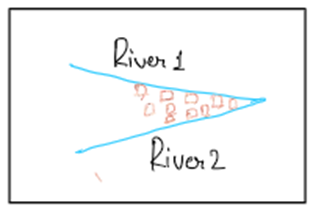
5. Triangular Pattern
This pattern is limited in occurrence, but unique.
Where does it form?
- At the confluence of two rivers.
- Since expansion is limited by water on multiple sides, the layout naturally becomes triangular.
6. Nebular Pattern
This pattern looks like a circular web, with roads radiating out and returning to a central point or nucleus—like a mosque, temple, church, or the house of a dominant landlord.
Key Traits:
- Small in size, socially or religiously centralized.
- Reflects feudal or caste-based control over land.
Common In:
- Ganga-Yamuna Doab region.

7. Terraced Pattern
Found in hilly or mountainous regions where people have to carve out land for cultivation.
Formation:
- Terracing the hill slope for agriculture.
- People build homes on their terraced fields, resulting in a step-like settlement pattern.
Locations:
- Himalayan belt, Western Ghats, North-East India, etc.
✅ Summary Table of Rural Settlement Patterns
| Pattern | Key Feature | Location Examples |
|---|---|---|
| Rectangular | Grid-like layout with right-angle roads | Sutlej-Ganga Plains, Europe, East Asia |
| Linear | Settlement along roads, rivers, or valleys | Himalayas, Alps, Ganga-Yamuna roads |
| Circular/Semi-Circular | Around lakes, salt pans, or coastlines | Crater lakes, salt lakes, coastal areas |
| Star-like | Spread along converging roads | NW Europe, Sutlej-Yamuna plains |
| Triangular | At river confluences | Limited; triangular due to water constraints |
| Nebular | Central core with circular roads | Ganga-Yamuna Doab |
| Terraced | On hill slopes, with step-like formation | Himalayan and hilly areas of India |
Closing Thought
The pattern of a rural settlement is a reflection of geography, history, economy, and culture—all working together over centuries. From rectangular grids in fertile plains to circular clusters around water, each pattern tells a story of how humans adapt to and shape their physical and social world.