
Watershed Management
Let’s start with the most fundamental idea.
A watershed is not a body of water. It is the entire land area that drains water — from rainfall or snowmelt — into a particular water body like:
- A river
- A stream
- A lake
- A pond
- Even an estuary
🧭 In Hindi, we might call it जलग्रहण क्षेत्र — the area that “catches” or “collects” water.
Think of it like a large funnel where every drop of water eventually flows into a common outlet.
What is Watershed Management?
Now that we understand what a watershed is, let’s define watershed management:
It is the comprehensive planning and implementation of land use and water resource practices to:
- Protect water quality
- Conserve soil and vegetation
- Improve the overall ecological health of the watershed
In essence:
🛠️ It’s “managing the land to protect the water.”
This involves everything from controlling pollution, to land development planning, to community partnerships.
Why is Watershed Management Needed?
Let’s now explore why managing watersheds is not a luxury, but a necessity in today’s context.
A. Watersheds Carry Everything Downstream
As rain or snowmelt runs down a watershed:
- It carries with it sediments, pesticides, fertilizers, oil, and other pollutants
- These pollutants accumulate in lakes, rivers, and aquifers
🚨 This results in:
- Water pollution
- Algal blooms
- Loss of aquatic biodiversity
- Contamination of drinking water sources
B. Human Activities Within Watersheds Matter
Everyday activities within the watershed affect its health:
| Activity | Impact |
|---|---|
| Construction | Increases runoff and soil erosion |
| Agriculture | Adds fertilizers, pesticides to water |
| Septic systems | Can leak waste into groundwater |
| Lawn/garden care | Excess nutrients pollute water |
| Car washing/oil leaks | Lead to toxic runoff |
So, even individual households unknowingly become part of the watershed problem — or the solution.
C. Watershed Boundaries ≠ Political Boundaries
This is a very exam-relevant point:
- Watershed boundaries are based on topography, not political borders.
- So, a village or municipality upstream can significantly impact water quality downstream.
🧠 This creates a governance challenge — how do you manage a natural system that cuts across multiple states, districts, and departments?
➡️ The answer is cooperative and participatory planning.
Goals and Benefits of Watershed Management
Let’s list the core objectives of watershed management
✅ Primary Objectives:
- Protect Water Quality
- Reduce pollution and sedimentation in water bodies
- Manage Land Use
- Promote sustainable agricultural and construction practices
- Control Runoff
- Prevent soil erosion, floods, and water logging
- Promote Biodiversity
- Conserve forests and local ecosystems within the watershed
- Foster Community Partnerships
- Engage all stakeholders — local bodies, farmers, NGOs, and governments
- Ensure Efficient Resource Allocation
- Especially important when financial or technical resources are limited
Watershed Management Planning: A Blueprint for Action
The process of watershed management doesn’t happen overnight. It involves systematic steps:
📘 Key Elements of Watershed Planning:
- Assess the Watershed
- Understand topography, land use, soil type, rainfall, and pollution sources
- Identify Problems
- For example: erosion hotspots, contaminated wells, deforested slopes
- Stakeholder Involvement
- Include every affected party — even if they are in another district or state
- Propose Solutions
- Reforestation, check dams, drainage channels, contour ploughing, etc.
- Implement and Monitor
- Build structures, train locals, monitor water quality
- Adaptive Management
- Keep updating the plan based on outcomes and feedback
🧠 A Strategic Insight: Why Watershed Management Matters for India
For India, watershed management is especially important because:
- 80% of annual rainfall is concentrated in 4 months → high runoff & erosion
- Rainfed agriculture dominates over 60% of cultivated area
- Soil erosion and groundwater depletion are threatening long-term food security
- Watershed-based planning offers integrated, decentralised, and eco-sensitive solutions
🤝 Participatory Approach: The Key to Success
Watershed management cannot succeed top-down. It thrives when:
- Local Panchayats, NGOs, farmers, and state departments collaborate
- Solutions are context-specific and community-owned
This aligns perfectly with the bottom-up ethos of Panchayati Raj, Decentralised Planning, and Sustainable Development Goals.
Watershed Management Practices & Their Socioeconomic Impact
🧱 Two Categories of Watershed Practices: Structural and Non-Structural
A. Structural Practices
These involve physical interventions — i.e., actual modification of the landscape or ecosystems to:
- Prevent degradation,
- Mitigate current land-use impacts, or
- Restore damaged environments.
Examples include:
- Afforestation and revegetation
- Erosion control structures (gabions, check dams, bunds)
- Terracing and land leveling
- Controlled or rotational grazing
- Agroforestry systems
These practices stabilize slopes, regulate streamflow, and reduce sedimentation — thereby maintaining both soil and water quality.
B. Non-Structural Practices
These are behavioral or institutional — rather than physical.
They aim to change human interaction with land and water, often through awareness, training, or incentives.
Examples include:
- Farmer sensitization programmes
- Community participation frameworks
- Capacity building through local NGOs or SHGs
- Awareness campaigns on water-saving practices
Purpose of These Practices — Why They Matter
These practices are not abstract. They have very tangible biophysical and social benefits, such as:
| Objective | How It’s Achieved |
|---|---|
| 1. Soil Stabilization | Through terracing, vegetative barriers, and afforestation on steep slopes |
| 2. Streamflow Regulation | Managing runoff using percolation tanks, check dams |
| 3. Water Quality Improvement | Preventing pesticide and fertilizer runoff; promoting bio-filters through vegetation |
| 4. Agriculture Support | Improving water retention and microclimate around farms |
| 5. Social Impact | Employment generation, livelihood support, women empowerment via SHGs |
The effects of these various actions translate into direct and indirect economic benefits to society, as shown in the given figure:
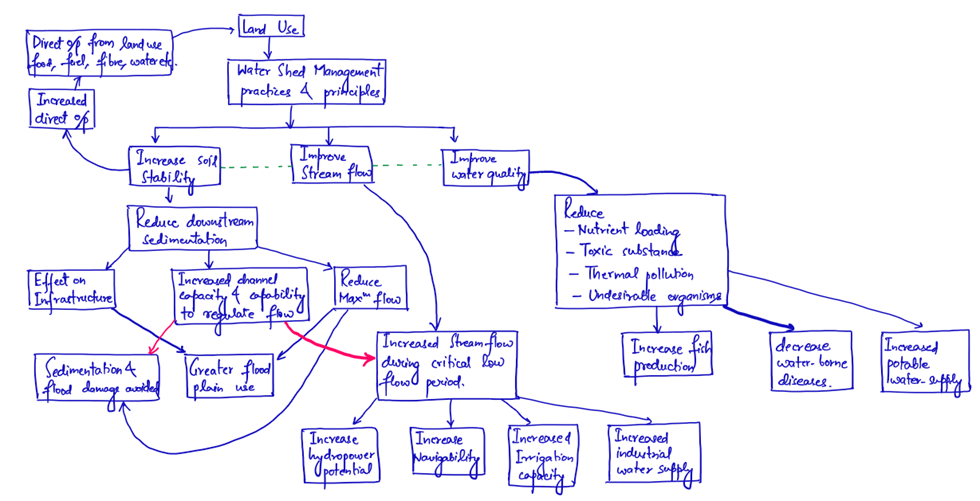
- These are the benefits that link the on-the-ground practice of watershed management to economic development and justify the integration of a watershed management framework into economic development programs.
- Furthermore, indirect benefits of environmental quality also are realized in biological diversity, wildlife habitat, fishery, habitat and in water quality.
- Note that agricultural, forestry and other land use, and engineering practices commonly are combined to accomplish watershed management objectives.
Institutional Mechanisms
Let’s decode the word ‘Institution’ first.
✅ An institution is not just a building or organization — it is a system where things work regularly and predictably, according to shared rules and values.
In watershed management, institutions are crucial because the practices must be accepted, internalized, and enforced by diverse actors:
- Farmers
- Local communities
- Power companies
- Local/State governments
- NGOs
- Project authorities
A. Types of Institutional Mechanisms
Let’s classify this clearly into three pillars:
| Mechanism Type | How It Works | Examples |
|---|---|---|
| 1. Direct Public Investment | Government executes the intervention | Tree planting, check dams, desilting tanks |
| 2. Regulatory Mechanisms | Government regulates private actors | Forest clearance rules, land use zoning, grazing bans |
| 3. Incentive-Based Mechanisms | Govt rewards or compensates certain behavior | Paying upstream communities for rainwater harvesting that benefits downstream |
This is where Payments for Ecosystem Services (PES) model comes in — a cutting-edge model increasingly relevant in environmental governance.
Barriers to Watershed Management
Let’s now take a critical lens — important for a well-rounded GS or optional answer.
⚠️ A. Misalignment of Natural and Political Boundaries
Watersheds don’t follow administrative borders.
For example, a river catchment might span two districts and three gram panchayats — but there is no institutional authority that manages it as a whole.
Thus:
- Upstream users (e.g., farmers cutting trees) have no incentive to reduce erosion
- Downstream users (e.g., towns facing siltation) suffer, but can’t enforce accountability
⚠️ B. Lack of Incentives for Upstream Communities
The classic dilemma:
“Why should we (upstream villagers) invest time and money in watershed protection if the benefits go to them (downstream towns)?”
Unless there are compensation mechanisms, adoption remains low.
⚠️ C. Weak Awareness Among Stakeholders
- Many development professionals don’t fully understand how hydrology and human geography interact
- Technical experts often fail to communicate in a language accessible to administrators and villagers
- Local communities are not aware of the long-term benefits of such investments
This leads to a gap between technical design and on-ground adoption.
The Watershed Model & Sustainable Development
Now comes the most philosophically powerful idea:
Watershed Management = Localized Sustainable Development Framework
🌱 Why?
Because:
- It balances ecology (natural capacity of soil and water)
- With economy (livelihood, productivity, poverty alleviation)
- Through equity (multi-stakeholder partnerships)
This is why modern environmental policy — from PMKSY to MGNREGA’s natural resource works — often adopts watershed-based units as the foundation of planning.
🔚 Conclusion
Watershed management is not just a technical method — it is a governance philosophy that teaches us:
“When geography crosses boundaries, governance must learn to cooperate.“
In UPSC terms, this becomes a model framework for writing essays, GS-III answers, or case study inputs in Geography Optional.