
Case Study – Damodar Valley Corporation (DVC)
Imagine a river so destructive that people called it the “Sorrow of Bengal.” The Damodar River, once known for its annual devastating floods, is not just a river—it became a symbol of what unchecked nature and under-planning can do.
But from this sorrow was born a vision—a multi-purpose river valley project, inspired by the Tennessee Valley Authority (TVA) in the U.S., that aimed not just to tame the river, but to transform a whole region.
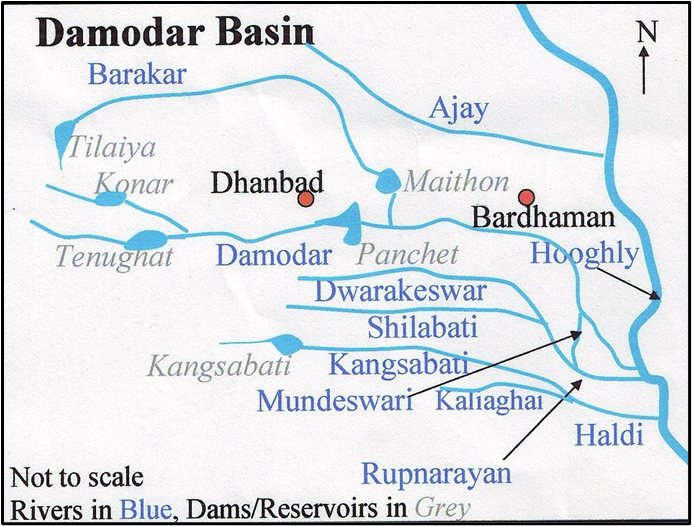
Geographical Context: Damodar River and Its Basin
- Damodar River is a tributary of the Hooghly River, flowing west to east through Jharkhand and West Bengal.
- Total length: 541 km
- ~50% in Jharkhand, 50% in West Bengal
- Important tributaries: Bokaro, Barakar, Konar
- The basin covers an area of 24,235 sq. km
At Bardhaman, it takes a southern turn, finally joining the Hooghly, 50 km upstream from Kolkata.
The Problem: A River That Brought Sorrow
- Frequent floods devastated large parts of Bengal annually.
- These floods also led to sedimentation in the Hooghly River, which posed a major threat to Kolkata port, a key economic hub.
- The poor drainage, combined with stagnant water, further led to malaria outbreaks, waterlogging, and agricultural destruction.
The Damodar River was, quite literally, turning potential into poverty.
The Solution: Establishment of DVC (1948)
In 1948, the Damodar Valley Corporation (DVC) was launched—India’s first multi-purpose river valley project—with support from the Central Government, and the states of West Bengal and then Bihar (now Jharkhand).
Inspired by the TVA, DVC aimed to bring integrated development through:
- Flood control
- Irrigation
- Hydropower
- Navigation
- Public health
- Regional industrialisation
Planned vs Actual Infrastructure
Initially, 7 major dams were proposed:
- Damodar River: Aiyar & Panchet Hill Dam
- Barakar River: Tilaiya, Maithan, Belpahari
- Konar River: Konar Dam
- Bokaro River: Bokaro Dam
But only 4 dams were constructed:
- Tilaiya, Maithan, Konar, and Panchet
Additionally, Durgapur Barrage was built to store irrigation water, 23 km from Raniganj, receiving regulated release from the four dams.
Achievements of the DVC Project
- Flood Control in parts of Jharkhand and West Bengal
- Irrigation to 5.15 lakh hectares of land
- Hydropower generation: Installed capacity of 2,60,000 kW
- Soil erosion control through regulated river flow
- Land reclamation for agriculture
- Navigation facilitated in lower reaches
- Health improvements: Malaria and stagnant water reduced
- Fisheries and tourism promoted via reservoirs
- Industrial boost due to coal and iron availability
- 6 thermal power stations
- 4 major steel plants
- 14 coal washeries
DVC created the base for India’s industrial corridor between Bokaro, Dhanbad, Asansol, and Durgapur.
Challenges and Criticisms
Despite many positives, DVC faced serious limitations:
| Issue | Explanation |
|---|---|
| Flood control not fully achieved | Major floods occurred even after DVC (1959, 1970, 1978) |
| Only 4 of 7 dams built | Limited capacity for integrated basin control |
| Siltation increased | Over-exploitation of forests and poor afforestation efforts |
| Hydropower underperforming | Floods disrupt electricity generation |
| Environmental degradation | Forest loss and displacement of farmers |
| Socio-economic exclusion | Local people remained poor despite resource richness |
| Rise of Coal Mafias | Informal economy and political-criminal nexus flourished |
DVC is often called a case of “Rich land, poor people” — development occurred, but benefits bypassed the common man.
✅ Conclusion: DVC – A Mixed Legacy
The Damodar Valley Project stands as a pioneering model of integrated planning, but it also reminds us that development is not just infrastructure, it must be:
- Participatory
- Ecologically sensitive
- Equitably distributed
Dams and power plants can build a region, but only inclusive planning can build a just society.