
Air Transport
– Shrinking Time, Expanding Reach
Air travel overcomes the biggest limitation of land and sea: time. In mountainous regions like the Himalayas, where landslides, avalanches, and snow block roads, airways become the only access mode.
✈️ “No place in the world is more than 35 hours away today.”
This reflects time-space compression, a key concept in geography.
🌎 Inter-Continental Air Routes – Sky Highways
🗺 Concentrated mainly in the Northern Hemisphere (due to higher population and economic activity), especially:
- Eastern U.S.A.
- Western Europe
- Southeast Asia
🧠 The U.S.A. alone accounts for 60% of the global airways.
📍 Major Air Route Nodes:
- North America: New York, Chicago, San Francisco, Los Angeles
- Europe: London, Paris, Frankfurt, Rome, Amsterdam, Moscow
- Asia: New Delhi, Mumbai, Karachi, Singapore, Tokyo, Bangkok
🚫 Limited connectivity in:
- Africa
- Asian Russia
- South America
Because of sparse population, underdeveloped economy, and less demand.
✈️ Example of Longest Flight:
- New York to Singapore – 15,300 km
- Takes around 18.5 hours
🛠️ Challenges:
- Requires hangars, refuelling stations, maintenance hubs
- Costly → found mostly in developed, industrialised countries
🇮🇳 Air Transport in India
Air transport in India plays a critical role in overcoming physical barriers and ensuring rapid connectivity—especially in remote, hilly, or strategic regions.
“Air transport is not just a mode, it’s a bridge over inaccessibility.”
🌐 Characteristics of Air Transport in India
- Fastest mode of transport over long distances
- Suitable for emergency services, disaster relief, and strategic military logistics
- Essential in Northeast India, Ladakh, Jammu & Kashmir, Andaman & Nicobar Islands
- Air connectivity enables economic integration, tourism, and regional development
🛫 Evolution of Civil Aviation in India
| Year | Milestone/Event |
|---|---|
| 1911 | First commercial flight in India (Allahabad to Naini) |
| 1953 | Nationalisation of airlines; creation of Air India and Indian Airlines |
| 1994 | Opening to private players |
| 2003 | Launch of low-cost carriers like Air Deccan |
| 2015 | Launch of UDAN Scheme (Ude Desh ka Aam Nagrik) to promote regional connectivity |
🛬 Types of Airports in India
| Category | Description |
|---|---|
| International Airports | Handle global flights; customs & immigration present |
| Domestic Airports | Operate within Indian territory |
| Custom Airports | Handle limited international cargo or charters with customs facility |
| Defence Airports | Controlled by Indian Air Force, some dual-use (e.g., Srinagar, Tezpur) |
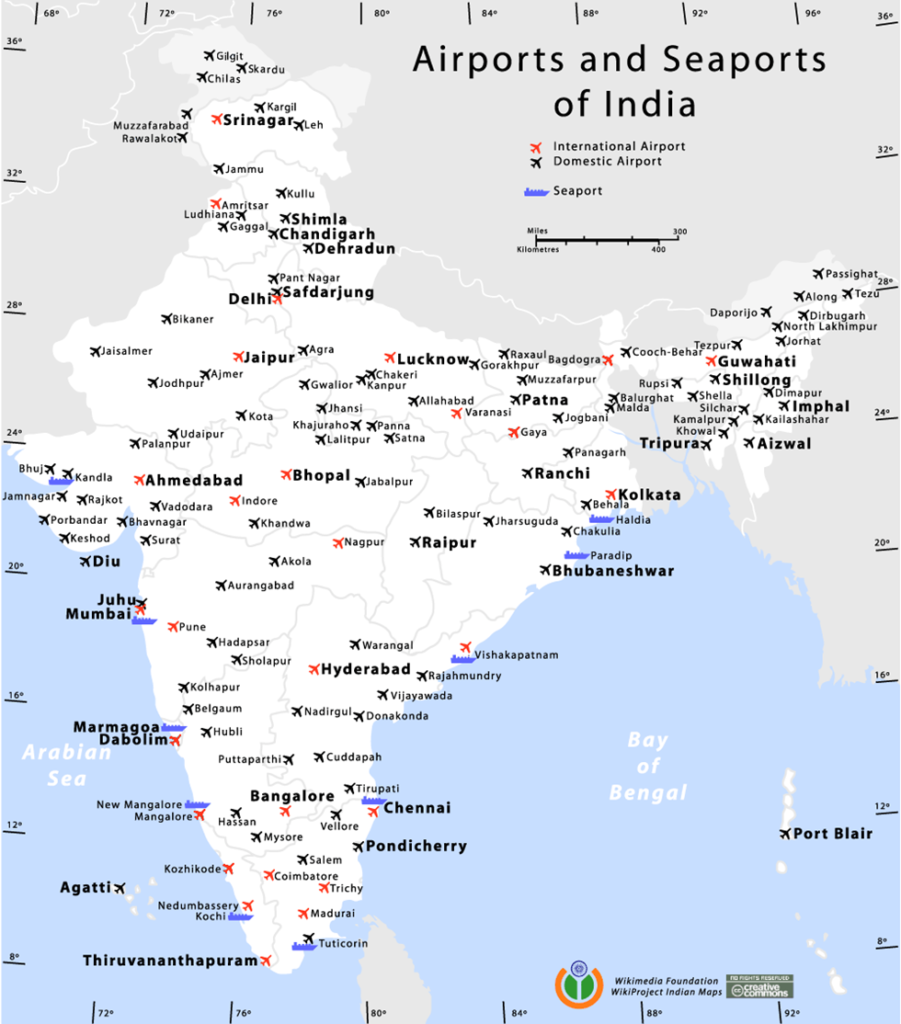
🗺️ Major International Airports (Selected)
| City | Airport Name |
|---|---|
| Delhi | Indira Gandhi International Airport |
| Mumbai | Chhatrapati Shivaji Maharaj International Airport |
| Bengaluru | Kempegowda International Airport |
| Hyderabad | Rajiv Gandhi International Airport |
| Chennai | Chennai International Airport |
| Kolkata | Netaji Subhash Chandra Bose International Airport |
| Kochi | Cochin International Airport (World’s first solar-powered airport) |
| Guwahati | Lokpriya Gopinath Bordoloi International Airport |
🌍 National Air Routes – Structure and Pattern
- Radial Pattern with Delhi, Mumbai, Chennai, Kolkata as major nodes
- Hub-and-spoke model increasingly adopted for operational efficiency
- Special importance to Northeast, J&K, and island regions via subsidised flights
💡 Government Initiatives and Policies
✈️ UDAN (Ude Desh ka Aam Nagrik) Scheme – 2016
- Aim: Enhance regional air connectivity at affordable costs
- Features:
- Financial support to airlines for unserved/underserved airports
- Viability Gap Funding provided by MoCA (Ministry of Civil Aviation)
- Capped airfares for short routes (e.g., ₹2,500 for a 1-hour flight)
- Status:
- 500+ routes awarded under various rounds
- Focus areas: Northeast, J&K, tier-2 and tier-3 cities
🛰️ GAGAN System (GPS Aided GEO Augmented Navigation)
- Jointly developed by ISRO + Airports Authority of India
- Improves air navigation safety and accuracy
- One of only 4 such systems in the world
🛠️ National Civil Aviation Policy (NCAP) – 2016
- Focus on:
- Regional connectivity
- MRO (Maintenance, Repair, and Overhaul) services
- Liberalisation of air cargo and drone policies
🪖 Strategic Importance
- Indian Air Force bases also function as emergency civilian airstrips
- Remote areas like Leh, Kargil, Tawang, Port Blair are connected via air
- Key to disaster response (earthquakes, floods) and medical evacuations
📈 Growth Trends and Challenges
| Strengths | Challenges |
|---|---|
| Rising domestic air traffic | Infrastructure bottlenecks at Tier-1 airports |
| Low-cost carriers and digital ticketing | High operational costs and ATF prices |
| Expanding regional connectivity | Air pollution and environmental sustainability |
| Increasing private participation (PPP) | Uneven accessibility in remote regions |
✅ Conclusion
Air transport in India has transformed from elite connectivity to essential regional service. With rising affordability and government push through UDAN and infrastructure development, it is emerging as a key enabler of inclusive spatial development.
“What railways were to the 19th century, airways are to the 21st century.”