
Environmental Impact Assessment
What is Environmental Impact Assessment (EIA)?
At its core, EIA is a decision-support tool.
👉 Simple idea:
Before we say “Yes, go ahead” to a development project, we must first ask:
- What damage can it cause to the environment?
- Can that damage be reduced or managed?
Formally, EIA predicts the likely environmental impacts of proposed developmental activities and:
- Assesses risks
- Suggests mitigation strategies
- Ensures environmental management and monitoring
📌 UPSC takeaway:
EIA does not stop development; it guides development towards sustainability.
Evolution of EIA in India
(a) Early Phase (1976–1994)
- Introduced in 1976–77, initially only for river valley projects
- Gradually extended to other sectors
- Till 1994, environmental clearance (EC) was merely an administrative decision and had no legislative backing
This meant weak enforcement.
(b) Legal Backing in 1994
In 1994, under the Environment (Protection) Act, the Ministry of Environment and Forests made Environmental Clearance mandatory through an EIA Notification.
- EC became compulsory for ® New projects, Expansion, Modernisation
👉 This was a paradigm shift: environment moved from advisory to mandatory compliance.
Current Status of EIA in India
- EIA is mandatory for around 30 categories of projects
- EC is granted only after ® EIA study, Public consultation, Expert appraisal
The final “go-ahead” is given by the Impact Assessment Agency within the Ministry of Environment, Forest and Climate Change (MoEFCC).
Core Components of EIA
It can be explained as three pillars:
- Risk Assessment
- Environmental Management
- Post-project Monitoring
EIA is not a one-time document, but a continuous cycle.
Classification of Projects Requiring EIA
To ensure scientific and multidisciplinary appraisal, expert committees are formed for sectors like:
- Mining Projects
- Industrial Projects
- Thermal Power Projects
- River Valley, Multipurpose, Irrigation & Hydroelectric Projects
- Infrastructure & Miscellaneous Projects
- Nuclear Power Projects
📌 Each sector has specialised experts, because environmental impacts differ across sectors.
EIA Process and Procedures
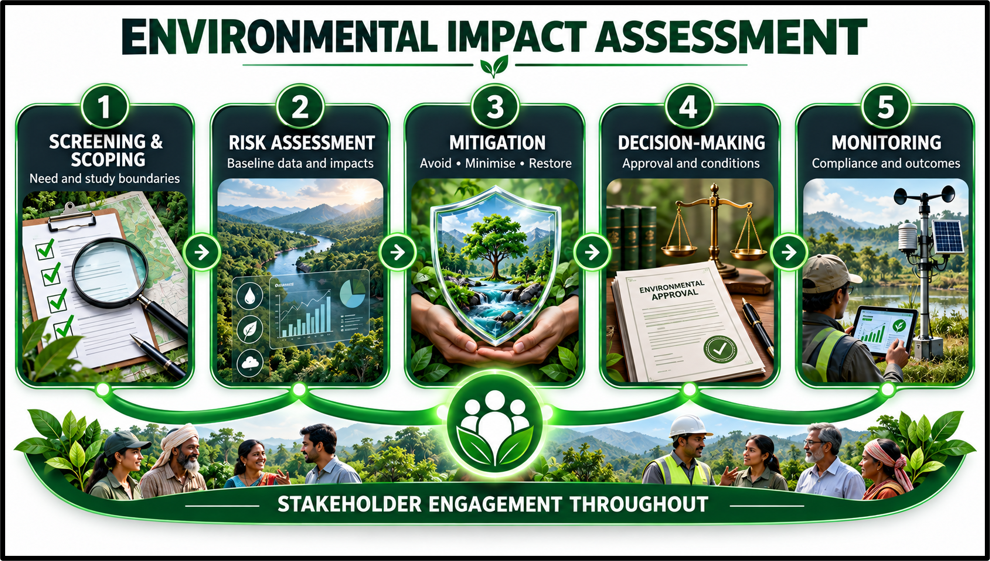
The EIA process is cyclical, not linear. Let us understand this:
(1) Screening
- Determines whether a project needs EIA based on Size, Location, Investment, Type of activity
(2) Scoping
- Identifies Key impacts, Impact zones, Monitoring needs
- Decides what to study and what to ignore
(3) Collection of Baseline Data
- Baseline data = existing environmental status
- Covers Air, Water, Soil, Biodiversity and Socio-economic conditions
📌 Without baseline data, impact prediction is meaningless.
(4) Impact Prediction
Impacts are assessed as: Positive / Negative · Reversible / Irreversible · Temporary / Permanent
(5) Mitigation Measures
- Measures to → Prevent, Minimise, Compensate for Environment Impacts.
(6) Public Hearing
- Local communities and environmental groups are consulted
- Reflects democratic environmental governance
(7) Decision-Making
- Appraisal Authority evaluates EIA report, Environmental Management Plan (EMP)
- Decision normally within 90 days, if data is complete
(8) Monitoring & EMP Implementation
- Ensures conditions of clearance are actually followed
(9) Risk Assessment
- Includes Hazard identification, Probability analysis, Accident preparedness
Environment Management Plan (EMP)
EMP is the action-oriented part of EIA. It includes Pollution control measures, Waste management, Rehabilitation & resettlement (R&R) and Monitoring framework
👉 Think of EIA as diagnosis, EMP as treatment.
Environmental Appraisal
- Conducted by MoEFCC Appraisal Committees
- Inputs may be taken from ® Experts, Investors, Technical agencies
EC is conditional, not unconditional.
Special Case: EIA of Coastal Areas
- Coastal States/UTs prepare Coastal Zone Management Plans (CZMPs)
- Prepared under CRZ Notifications
- Approved by MoEFCC
Single Window Clearance
If a project needs Environmental Clearance (EC) and Forest Clearance under Forest (Conservation) Act, 1980, both are processed simultaneously, not sequentially.
📌 Single Window = EC + Forestry Clearance
Main Participants in the EIA Process
- Project Proponent
- Environmental Consultants
- SPCBs / PCCs
- Public
- Impact Assessment Agency
EIA is thus multi-stakeholder governance, not bureaucratic monopoly.
Benefits of EIA
- Integrates environment with development
- Cost-effective in reducing long-term damage
- Promotes ® Mitigation, Sustainable resource use, Ecosystem resilience
Shortcomings of EIA (Critical Analysis)
- Applicability Issues: Many impactful projects escape EIA due to ® Threshold limits and Exemptions
- Weak Expert Committees: Lack of ® Ecologists, Wildlife experts, Anthropologists and Social scientists
- Public Hearing Problems: Conducted too late; Exemptions for many projects; Poor access to documents; Indigenous knowledge ignored
- Poor Quality of EIA Reports: Single-season data; Incomplete or false data; Overly technical language
- Conflict of Interest: Project proponent funds EIA; Consultants lack independent accreditation
Recommendations to Improve EIA
- Independent EIA Authority
- Sector-wide EIAs
- Full transparency
- Universal applicability
- Strong public participation
- Independent consultants
- Expert-driven appraisal committees
- Automatic clearance withdrawal for violations
EIA Notification 2006: Key Changes
The EIA Notification decentralised EC.
Project Categories:
- Category A – National-level appraisal
- Category B – State-level appraisal
Category B further divided into:
- B1 → EIA mandatory
- B2 → No EIA / EC
Four Stages after 2006: 1. Screening, 2. Scoping, 3. Public Hearing, 4. Appraisal
Controversial Amendments
(a) COVID-era Amendment (Bulk Drugs)
- Bulk drugs downgraded to B2
- Exempted from ® EIA, Public consultation
(b) Oil & Gas Exploration (2019)
- Onshore & offshore exploration moved to B2
- Criticism ® Marine ecosystem damage, Seismic survey impacts, Oil spill risks
Prior EC vs Ex Post Facto EC — Vanashakti v. Union of India (2026)
Under the EIA Notification, 2006, environmental clearance is ordinarily required before construction or commencement of a listed project. In Vanashakti v. Union of India (2026), the Supreme Court reaffirmed that prior EC is the general rule.
- The Court quashed the 2021 Office Memorandum prospectively because an administrative instruction cannot override or substantially alter the statutory EIA Notification.
- However, the Court upheld the 2017 Notification as a narrow, time-bound one-time exception, issued through valid delegated legislation under the Environment (Protection) Act.
- Existing ECs granted under the 2017 Notification/2021 OM remain valid unless individually challenged; no fresh applications can be entertained under those instruments.
- The government cannot create a permanent ex post facto clearance regime through executive orders, though a narrowly tailored statutory notification may be possible in exceptional public-interest circumstances.
- The Supreme Court retains its Article 142 power to grant appropriate relief in exceptional cases.
Draft EIA 2020 Notification (Expired but Influential)
Proposed:
- Prior EC vs Environmental Permission (EP)
- Ex-post facto clearances
- Massive exemptions from EC & public consultation
Key Issues:
- Post-facto clearance (against SC rulings)
- Reduced public participation
- Extended EC validity (up to 50 years for mining)
Rules Similar to Draft EIA 2020 (Through Notifications)
Even after expiry:
- Border highway projects exempted from EC
- Fast-tracked forest clearances in Maoist & border areas
- EC validity extended ® 13 yrs (hydropower), 15 yrs (nuclear), 50 yrs (mining)
- Appraisal powers delegated to states
- Move towards single-window clearance
Conclusion
👉 EIA is the battleground between development and environment.
- Strong EIA = Sustainable development
- Weak EIA = Irreversible ecological loss
UPSC does not expect emotional answers, but balanced, constitutional, and analytical responses — exactly what this topic offers.
This topic is part of the complete Environment Notes for UPSC. Explore the full subject coverage here.