
Biofuels
| Definition: Biofuels are fuels derived from biological sources — plants, algae, animal waste — through biological and chemical processes such as fermentation, transesterification, and anaerobic digestion. |
The central promise of a biofuel: the CO₂ released when we burn it is partly offset by the CO₂ the plant absorbed while growing. This near-closed carbon loop is what makes biofuels cleaner than fossil fuels, at least in principle.
The Four Generations of Biofuels
Biofuels are classified into generations based on feedstock, technology, and sustainability. Think of it as an evolutionary ladder — each generation fixes the weakness of the one before it. Follow this story and the section becomes effortless.
First Generation (1G) — the “Conventional” Biofuels
1G biofuels are produced from food-based biomass using simple, conventional technologies. This is where the story begins — and where the famous “food vs fuel” debate is born.
- Feedstock: sugar-rich crops (sugarcane, sugar beet, molasses); starch-rich crops (maize, wheat, cassava); oil-rich crops (soybean, palm, mustard, groundnut); animal fats & used cooking oil.
- Examples: Bioethanol (fermentation), Biodiesel (transesterification of edible oils/animal fats), Biogas (anaerobic digestion), Bio-butanol (fermentation using Clostridium bacteria).
| Advantages of 1G | Disadvantages of 1G |
| Mature, commercially proven technology | Food vs fuel debate — competes with food crops |
| Improves energy security by cutting crude imports | Environmental cost — deforestation, monoculture, soil/water stress |
| Boosts rural economy — extra income for farmers | Limited net carbon savings once life-cycle emissions counted |
| Cleaner than fossil fuels (lower CO₂, SOx, particulates) | Modest energy density (ethanol ~65–70% of petrol’s energy) |
| Compatible with existing engines (E10, E20, B20) | Blend-wall limit — higher blends need engine modification |
Second Generation (2G) — the “Advanced” Biofuels
The obvious criticism of 1G was: “Why burn food?” So 2G answers back — it uses non-food biomass, specifically lignocellulosic feedstock (the tough, fibrous parts of plants). Crop residues once burnt in fields become valuable fuel.
- Feedstock: agricultural residues (paddy straw, bagasse, cotton stalks); forestry residues; energy crops (switchgrass, miscanthus); non-edible oilseeds (jatropha, pongamia, karanja); industrial/municipal waste.
- Examples: Cellulosic ethanol, Fischer–Tropsch (FT) diesel, Bio-butanol, Bio-syngas, Biohydrogen, Bio-CNG, biodiesel from non-edible oilseeds.
| Advantages of 2G | Disadvantages of 2G |
| No food vs fuel conflict — uses non-food biomass | High production cost — complex pretreatment & enzymes |
| Uses crop residues → curbs stubble burning | Technology still evolving (hydrolysis, gasification, FT) |
| Greater GHG reduction; aids Net-Zero-by-2070 | Supply-chain hurdles — biomass bulky, scattered, seasonal |
| Promotes circular economy — waste into energy | Limited commercialisation — India’s plants still nascent |
| Energy security & farmer income from residues | Infrastructure gaps in biorefineries, storage, blending |
Third Generation (3G) — the “Algal” Biofuels
Now the imagination expands. Why use land at all? 3G biofuels come from algae — using advanced cultivation and conversion. Algae grow astonishingly fast, need no farmland, and can even feed on wastewater.
- Feedstock: microalgae (Chlorella, Spirulina); macroalgae/seaweeds (Laminaria, Sargassum); cyanobacteria; wastewater-grown algae.
- Examples: algal biodiesel, algal bioethanol, biogas, biohydrogen.
| Advantages of 3G | Disadvantages of 3G |
| Very high yield — ~10–30× more oil per acre than oil crops | High production cost — capital-intensive cultivation |
| No food vs fuel issue — algae is not a food crop | Energy-intensive to maintain light, CO₂, nutrients |
| Grows on non-arable land & in saline/wastewater | Harvesting & lipid extraction are difficult & costly |
| Strong carbon capture — absorbs CO₂, even flue gases | Large-scale commercial plants not yet viable |
| Versatile & very fast growth | Biosafety concerns if engineered algae escape |
Fourth Generation (4G) — the “Carbon-negative” Frontier
And finally, the cutting edge. 4G biofuels combine genetically engineered feedstocks (crops or microbes) with Carbon Capture and Storage/Utilisation (CCS/CCU).
The audacious goal: fuels that are carbon-neutral or even carbon-negative — removing more CO₂ than they emit. Largely still in the laboratory, but exactly the forward-looking point that elevates an answer.
- Feedstock: genetically engineered energy crops; GM algae; synthetic microorganisms; waste biomass with carbon capture.
- Examples: photobiological solar fuels, electrofuels (e-fuels), synthetic drop-in hydrocarbons, advanced biohydrogen, BECCS-based fuels (Bioenergy with Carbon Capture & Storage).
| Advantages of 4G | Disadvantages of 4G |
| Carbon-negative potential via CCS/CCU | Technological immaturity — mostly experimental |
| High productivity through synthetic biology | Very high R&D and production costs |
| No food vs fuel conflict — engineered non-food sources | Energy-intensive; net benefit uncertain |
| Versatile — suits aviation & shipping | Biosafety, regulatory & ethical (GMO) concerns |
| Strong alignment with net-zero & Paris goals | Scalability & commercial viability unproven |
The Four Generations — One Master Table
If you remember nothing else from this section, remember this table — the single most reliable revision tool for biofuels.
| Generation | Feedstock | Examples | Key Advantage | Key Drawback |
| 1G (Conventional) | Food crops, animal fats, used cooking oil | Bioethanol, Biodiesel, Biogas | Mature & commercial; engine-compatible | Food vs fuel; high land/water demand |
| 2G (Advanced) | Non-food biomass — crop/forestry residues, MSW | Cellulosic ethanol, FT diesel, Bio-CNG | Avoids food conflict; curbs stubble burning | High cost; supply-chain & commercialisation hurdles |
| 3G (Algal) | Microalgae, seaweed, cyanobacteria, wastewater algae | Algal biodiesel, bioethanol, biohydrogen | Very high yield; great CO₂ capture | Costly & energy-intensive; not yet viable |
| 4G (Synthetic) | GM crops/algae/microbes + CCS/CCU | Electrofuels, photobiological & synthetic fuels | Potentially carbon-negative; drop-in fuels | Still R&D; costly; biosafety concerns |
Biofuels & India — Importance and Challenges
Why Are Biofuels So Important for India?
It’s an important concept to understand, because it links technology to the nation’s biggest anxieties — our oil import bill, our farmers’ incomes, our polluted air. Each reason below is anchored with the kind of concrete fact that lifts an answer from ordinary to impressive.
- Renewable & sustainable: biomass replenishes annually, unlike finite fossil reserves.
- Cuts import dependence: India imports ~85% of its crude oil, a huge forex burden. The Ethanol Blended Petrol (EBP) programme alone saves roughly ₹30,000 crore annually — advancing Atmanirbhar Bharat.
- Climate change mitigation: ethanol blending has cumulatively cut CO₂ emissions by ~69.8 million tonnes since 2014.
- Waste management & pollution control: uses crop residues and reduces stubble burning; 2G ethanol plants at Panipat and Bathinda run on rice straw.
- Rural economy & farmer income: creates a market for agricultural surplus and residues, supporting Doubling Farmers’ Income.
- Strategic stability: reduces reliance on volatile crude markets; strengthens India’s role in the Global Biofuels Alliance (GBA) and ISA.
- Industrial growth: 12 commercial-scale 2G ethanol plants under PM JI-VAN Yojana; research in algal & waste-to-energy fuels.
- Versatile applications: transport, cooking, electricity — Bio-CNG and biogas replace LPG/wood; E20 reduces petrol use.
- Biodegradable & safe: biodiesel and ethanol break down readily, lowering spill risks.
- Supports climate & SDG goals: helps meet Paris Agreement & Net-Zero-2070; advances SDG-7, SDG-12, SDG-13.
Challenges of Biofuels in India
Let us be balanced — the examiner rewards the candidate who sees the other side too.
- Food vs fuel debate: 1G biofuels divert food crops, risking food insecurity and price rises.
- Land & water conflicts: water-guzzling feedstocks like sugarcane strain groundwater (e.g., drought-prone Maharashtra).
- Feedstock supply constraints: seasonal, region-specific, monsoon-dependent; bulky biomass is hard to collect, store, transport.
- High production costs: advanced (2G/3G) plants are capital- and energy-intensive; often need Viability Gap Funding (VGF).
- Low energy yield: ethanol and biogas carry less energy than petrol/diesel, reducing mileage.
- Technology & R&D gaps: reliance on imported enzymes, microbes and patents limits scalability.
- Infrastructure constraints: too few refineries and blending depots, concentrated in sugar states — a regional imbalance.
- Market & pricing challenges: government-controlled prices deter private investment; biodiesel blending is below 1% vs a 5% target.
- Emission uncertainty: life-cycle emissions may not be carbon-neutral once fertiliser use & processing are counted.
- Policy & regulatory barriers: overlapping mandates across ministries slow clearances.
Advantages and Disadvantages of Biofuels
Advantages of Biofuels
Increases the Life of the Vehicle Engine
- Biofuels are adaptable to current engine designs and perform very well in most conditions.
- They have higher cetane and better lubricating properties — this keeps the engine running longer, requires less maintenance, and brings down overall pollution.
Less Carbon Emissions
- Biofuel is made from renewable resources and is relatively less flammable compared to fossil diesel.
- It causes less harmful carbon emissions than standard diesel.
- Studies suggest biofuels reduce greenhouse gases by up to 65 per cent.
Easy to Source
- Biofuels are made from many different renewable sources such as manure, crop waste, corn, switchgrass, soybeans, algae, and plants grown specifically for fuel.
Economic Security
- Wider shifting to biofuels lets a country reduce its dependence on fossil fuels.
- Fuelling homes, businesses and vehicles with biofuels is less expensive than fossil fuels.
- A growing biofuel industry creates more jobs, keeping the economy secure.
Lower Levels of Pollution
- Biofuels are biodegradable, reducing the possibility of soil and underground-water contamination during transportation, storage or use.
Cost-Benefit
- Biofuels currently cost about the same as gasoline, but their overall cost-benefit is much higher — being cleaner fuels, they produce fewer emissions when burnt. With rising demand, they also have the potential to become cheaper in future.
Disadvantages of Biofuels
High Cost of Production and Future Price
- Biofuels are quite expensive to produce in the current market, and the interest and capital investment going into biofuel production is fairly low.
- Constantly rising prices may make biofuels as harsh on the economy as rising gas prices.
Industrial Pollution
- The carbon footprint of biofuels is lower than traditional fuels when burnt — but the process by which they are produced makes up for that.
- Large-scale biofuel industries emit large amounts of emissions and cause small-scale water pollution too.
- Unless more efficient production methods are adopted, overall carbon emission is not reduced much; it also increases NOx.
Changes in Land Use and Pollution
Biofuel production can encourage monoculture. If land is used to grow a biofuel feedstock, it must be cleared of native vegetation, leading to ecological damage in three ways:
- First, damage from destroying local habitat and reducing the health of the region’s natural resources. Native forest is almost always better at removing CO₂ from the atmosphere than a biofuel feedstock — partly because that CO₂ stays trapped and is never released by burning, as it is with fuel stock.
- Secondly, damage from the carbon debt created. Estimates show that deforesting native land can produce a carbon debt that takes up to 500 years to repay.
- Finally, converting land to agricultural status almost always means fertilisers are used for maximum yield — causing runoff and agricultural pollution. Creating more farmland thus damages waterways, and the energy used in treatment plants and other mitigation adds an even larger carbon debt.
Less Suitable for Use in Low Temperatures
- Biofuel is more likely to attract moisture than fossil diesel, creating problems in cold weather.
- It also increases microbial growth in the engine, which clogs the engine filters.
Government Initiatives for Biofuels
India’s first National Biofuel Policy came in 2009 (MNRE). It was superseded by the National Policy on Biofuels, 2018 (Ministry of Petroleum & Natural Gas), which was further amended in 2022.
Evolution of Biofuels in India (Chronological Understanding)
- 1975 – India begins studying ethanol–petrol blending
- 2002 – 5% ethanol blending mandated in select states
- 2004 – Programme suspended due to molasses shortage
- 2005 – Revival after increased sugar and molasses production
- 2006 – Biodiesel Purchase Policy announced
- 2007 – Biofuels Mission launched (jatropha, pongamia)
- 2009 – National Biofuel Policy 2009
- 2018 – National Policy on Biofuels 2018 launched (revised policy)
Now, let us take the key instruments one by one.
National Policy on Biofuels, 2018
| Objective: To promote biofuels as renewable, eco-friendly substitutes for fossil fuels — ensuring energy security, meeting climate goals, improving waste management, and generating rural income. |
Key Features
- Blending targets: Ethanol 20% (E20) in petrol by 2030 (advanced to 2025-26 in the 2022 amendment); Biodiesel 5% in diesel by 2030.
- Categorisation: Basic biofuels (1G — bioethanol, biodiesel from food crops) and Advanced biofuels (2G from non-food sources, 3G from algae, drop-in fuels from MSW, Bio-CNG) — designed for targeted incentives.
- Feedstock diversification: 1G (sugarcane juice, starch crops, damaged grains), 2G (agri/forestry residues, MSW), 3G/4G (algae, industrial gases). The 2022 amendment added maize and surplus FCI rice.
- Financial incentives: Viability Gap Funding (VGF) for 2G biorefineries (via PM JI-VAN Yojana); tax incentives and accelerated depreciation.
- Differential pricing: higher purchase prices for advanced biofuels (2G, Bio-CNG) than basic ones, to encourage advanced production.
- Waste-to-energy focus: ethanol from MSW, used cooking oil (UCO), and industrial waste — broadening non-food sources.
- Export (2022 amendment): permitted in specific cases for SEZ/EOU units under “Make in India”, provided domestic demand is met.
Notable Achievements
- Ethanol blending rose from 1.53% (2013-14) to 12.06% (2022-23); E10 achieved in 2022 (5 months early); E20 advanced from 2030 to 2025-26 and met by March 2025.
- PM JI-VAN Yojana (2019) launched with ₹1,969 crore support for 2G ethanol (IOCL Panipat and others).
- SATAT (2018) introduced to promote 5,000 CBG plants with a 15 MMT annual target.
- India co-launched the Global Biofuels Alliance (2023) with the USA and Brazil at the G20 Delhi Summit.
- ~₹23,000 crore forex savings in 2021-22; ~12.4 million tonnes CO₂ reduced in 2022-23; ~5 lakh rural jobs projected by 2025.
Ethanol Blending Programme (EBP)
Launched in 2003 by MoPNG and scaled up under the 2018 Policy. Aim: blend ethanol with petrol to cut crude imports, lower emissions, and support farmers.
Other Key Schemes at a Glance
| Scheme (Year) | Launched by | Core Aim |
| SATAT (2018) | MoPNG | Promote Compressed Bio-Gas (CBG) as transport fuel; 5,000 CBG plants & 15 MMT/yr target; assured OMC offtake |
| GOBAR-DHAN (2018) | Dept. of Drinking Water & Sanitation, Min. of Jal Shakti (under SBM-Grameen) | Convert cattle dung & organic waste into biogas, Bio-CNG & compost; waste-to-wealth for villages |
| GOBARdhan – National Unified Scheme for CBG (2026) | MoPNG | ₹23,731 crore (FY27–FY36); CBG Obligation on CGD 3% → 5%; administered CBG price; capital, pipeline and credit-guarantee support |
| RUCO (2018) | FSSAI | Collect Used Cooking Oil (UCO) and convert it into biodiesel; keep unsafe (high-TPC) oil out of the food chain |
| PM JI-VAN Yojana (2019) | MNRE / MoPNG | Viability Gap Funding for 2G ethanol biorefineries (₹1,969 crore) |
| National Bio-Energy Programme (2022) | MNRE | Waste-to-Energy, Biomass (briquettes/pellets) & Biogas programmes; income from surplus rural biomass |
| SATAT explained simply: SATAT = Sustainable Alternative Towards Affordable Transportation. It targets over 62 million tonnes of waste generated annually, converting it into CBG (Bio-CNG). It aligns with the Swachh Bharat Mission and is expected to create ~75,000 direct jobs. |
| RUCO explained simply: Repeatedly-heated cooking oil accumulates harmful Total Polar Compounds (TPC). FSSAI caps re-use at 3 cycles / 25% TPC; oil beyond that must exit the food chain. RUCO’s “EEE Strategy” — Education, Enforcement, Ecosystem — channels this UCO into biodiesel. (1 litre of UCO yields ~0.9 litre biodiesel.) |
Important Biofuels
Finally, let us meet the three biofuels the examiner cares about most, one by one — their chemistry, how they are made, and where they are used.
Ethanol (C₂H₅OH)
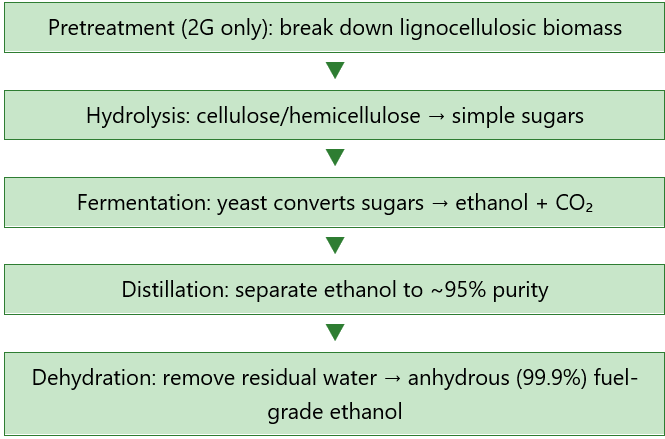
Ethanol — also called ethyl alcohol or grain alcohol — is a volatile, flammable, colourless liquid alcohol, produced by the fermentation of sugars/starches (biological route) or by the hydration of ethylene (petrochemical route). It serves as a biofuel, solvent, disinfectant, and the base of alcoholic beverages.
Key Properties
- Density ~0.789 g/cm³ (less dense than water); miscible with water in all proportions.
- Highly flammable — burns with a clean blue flame; calorific value ~7,000 kcal/kg (lower than petrol).
- High octane number (~108.5 vs petrol’s ~84.4) — excellent knock resistance for high-compression engines.
- Mild oxidation → acetaldehyde; strong oxidation → acetic acid.
Production (Fermentation Route)
Uses
- Fuel: blended with petrol (E5, E10, E20, E85); research on aviation-fuel blends.
- Industrial: solvent in paints, perfumes, cosmetics, pharma; raw material for acetic acid & ethyl acetate.
- Medical: antiseptic/disinfectant (60–70% is most effective); solvent in cough syrups & tinctures.
- Beverage & household: alcoholic drinks; cooking gels, spirit lamps, cleaning agents.
Biogas & Compressed Biogas (CBG)
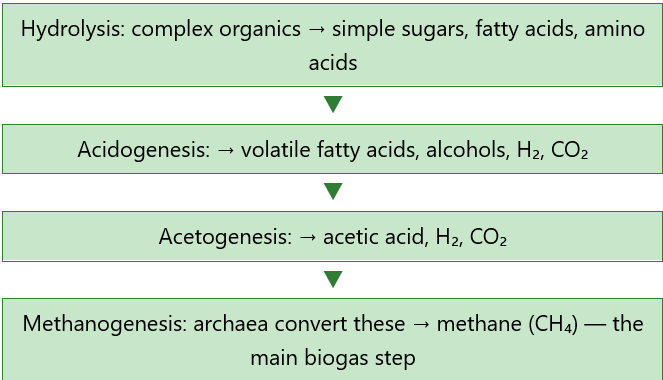
Biogas is a renewable fuel produced by the anaerobic digestion (decomposition without oxygen) of organic matter — cattle dung, agricultural residues, sewage, MSW, food waste. It is mainly methane (CH₄, 50–70%) and carbon dioxide (CO₂, 30–40%), with traces of H₂S, N₂ and water vapour.
The Four Stages of Anaerobic Digestion
Compressed Biogas (CBG / Bio-CNG) is purified biogas enriched in methane (~90–95%) and compressed to 200–250 bar as a substitute for CNG. Purification means removing CO₂, H₂S and water vapour. Its calorific value (~52,000 kJ/kg) is comparable to CNG.
| Real-world model — Indore’s GOBAR-DHAN Bio-CNG Plant: Commissioned by Indore Municipal Corporation (inaugurated 2022), it is Asia’s largest MSW-based Bio-CNG plant. It processes segregated organic waste to produce 17,000 kg of Bio-CNG daily, plus 100+ tonnes of compost, cutting ~130,000 tonnes of CO₂ a year. A textbook example of the circular economy. |
Biodiesel
Biodiesel is a renewable, biodegradable fuel made by transesterification of vegetable oils, animal fats, or waste cooking oil with an alcohol (usually methanol/ethanol). Chemically, it is a mixture of Fatty Acid Methyl Esters (FAMEs), usable in diesel engines pure (B100) or blended (B5, B10, B20).
- Key properties: density ~0.86–0.90 g/cm³; calorific value ~37–40 MJ/kg (slightly below fossil diesel); high cetane number (46–65); negligible sulphur (near-zero SO₂); higher flash point (~130°C) means safer handling; hygroscopic (absorbs water).
- Advantages: cleaner combustion (less CO, SO₂, PM); near carbon-neutral; biodegradable; uses waste oils; good lubricity; rural employment.
- Disadvantages: ~10–12% lower calorific value; cold-flow problems (thickens in cold); higher cost without subsidy; food-vs-fuel if edible oils used; slightly higher NOx; storage/oxidation issues; infrastructure gaps.
Comparison — Petrol, Diesel & the Biofuels
If a question asks you to compare conventional fuels with biofuels, this is your answer skeleton. Read it slowly, row by row.
| Feature | Petrol | Diesel | Ethanol | Biogas | CBG | Biodiesel |
| Nature | Fossil fuel | Fossil fuel | Biofuel | Biofuel | Purified biogas | Biofuel |
| Main component | Hydrocarbons | Hydrocarbons | Ethanol (C₂H₅OH) | CH₄ 50–70%, CO₂ 30–40% | CH₄ ~90–95% | FAMEs |
| Calorific value | ~10,500 kcal/kg | ~10,800 kcal/kg | ~7,000 kcal/kg | ~20–25 MJ/m³ | ~52,000 kJ/kg | ~37–40 MJ/kg |
| Use in transport | SI engines | CI engines | Blended (E10, E20, E85) | Limited (small engines) | CNG substitute | Blended (B5, B10, B20) |
| Renewable? | No | No | Yes | Yes | Yes | Yes |
| India policy | Imports | Imports | EBP → E20 by 2025-26 | GOBAR-DHAN, NBMMP | SATAT (5,000 plants) | 5% by 2030, RUCO |
| Status in India | Widespread | Widespread | E20 met (Mar 2025) | Widely used rurally | ~40+ plants (vs 5,000) | <1% (vs 5% target) |
This article forms part of the broader Environment syllabus for UPSC preparation.