
Economic Theories of Fertility
Economic theories of population are rooted in one core idea:
People are rational agents who weigh the costs and benefits of having children, just like they would evaluate any investment or expenditure.
Therefore, reproductive decisions are not just emotional or biological, but economic—involving deliberate calculation.
These theories belong to the microeconomic framework of decision-making and gained prominence in the second half of the 20th century, when population economists began to formally model fertility behavior.
We’ll focus on two major theorists:
- Harvey Leibenstein (1953),
- J.C. Caldwell (Wealth Flow Theory).
Harvey Leibenstein’s Cost-Benefit Theory of Fertility (1953)
🔍 Core Proposition:
Fertility decisions are based on utility vs disutility (benefit vs cost) of having an additional child.
This is very similar to how an individual might evaluate whether to buy a new car or invest in a business:
- Is the pleasure or utility worth the cost?
✅ Three Types of Utility (i.e., Why People Might Want a Child):
- Consumption Utility – The child as a source of joy and emotional satisfaction (just like a luxury item gives happiness).
- Productive Utility – The child contributes to household income, helps in farming, or family business.
- Security Utility – The child is expected to take care of parents in old age—a form of economic insurance.
❌ Types of Disutility (Cost):
- Direct Costs – Food, education, healthcare, housing, etc.
- Indirect Costs – Foregone opportunities like:
- Mother’s employment,
- Lifestyle reduction,
- Career delays.
📈 The Development Link: What Changes with Economic Growth?
Leibenstein presents a powerful insight:
| With Rising Income/Economic Development | Effect on Utility/Cost of Child |
|---|---|
| Consumption Utility | Stays the same |
| Productive Utility | Declines – Children no longer work |
| Security Utility | Declines – Social security and pensions replace children |
| Cost (Direct + Indirect) | Increases – More is spent on each child |
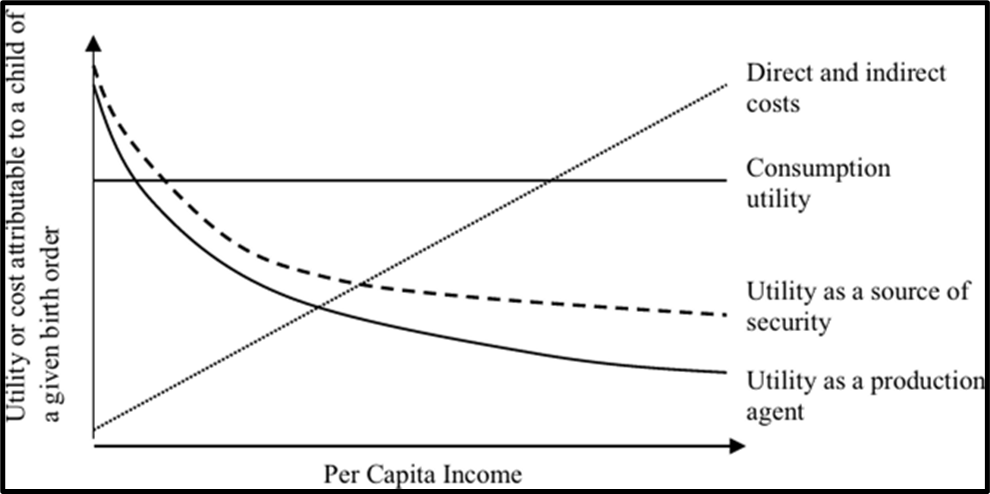
🧩 Conclusion:
As societies develop, the benefits of children shrink, while costs go up → Resulting in lower fertility rates, especially for third, fourth or higher-order births.
It explains why high-income families in developed countries often stop at one or two children.
J.C. Caldwell’s Intergenerational Wealth Flow Theory
Caldwell introduced a culturally sensitive yet economically framed theory, which explains why fertility is high in traditional societies and low in modern ones.
🔍 Core Proposition:
The direction of wealth flow between generations determines fertility levels.
🧭 Two Scenarios:
| Society Type | Flow of Wealth | Fertility Outcome |
|---|---|---|
| Traditional/Primitive Societies | From children → parents | High fertility (economically rational) |
| Modern/Urban Societies | From parents → children | Low fertility (children are economic burden) |
📌 Explanation:
- In traditional settings, children:
- Work in farms or family businesses,
- Marry early and support parents,
- Are considered assets.
- ➤ Thus, more children = more wealth.
- In modern societies:
- Children depend on parents for longer (education, healthcare, etc.),
- Enter workforce late,
- Often move away and become independent,
- ➤ Thus, more children = more cost.
🔄 Reversal in Wealth Flow – A Precondition for Fertility Decline
Caldwell states:
A decline in birth rate will only occur when the direction of wealth flow reverses—from child → parent to parent → child.
This requires:
- Emotional nucleation of family (less joint-family obligation),
- Economic nucleation (individual earning and independence),
- Westernisation and modern education.
He observed that in many developing countries, this transition had already begun due to urbanisation, media exposure, and changes in values—thus predicting future fertility decline.
📊 Comparative Summary: Leibenstein vs Caldwell
| Aspect | Leibenstein | Caldwell |
|---|---|---|
| Year | 1953 | Later 20th century |
| Approach | Microeconomic cost-benefit analysis | Socio-economic & cultural |
| Focus | Utility vs cost of an additional child | Direction of wealth flow between generations |
| Key Idea | Children are chosen like any other economic good | Children are rationally produced if they’re economically useful |
| Modern Society Effect | Utility ↓, Cost ↑ → Fertility ↓ | Wealth flows to children → Fertility ↓ |
| Traditional Society Effect | Utility > cost → Fertility high | Wealth flows from children → Fertility high |
🧠 Final Takeaway: Why These Theories Matter
- These economic theories provide a rational explanation for global fertility transition.
- They are especially powerful in explaining:
- Urban-rural fertility differences,
- Why economic development alone may not reduce fertility unless social structures change,
- Why fertility remains high in some low-income societies where children are still economic assets.