
Lewis Mumford’s Theory of Urban Growth
(A Sociological Cycle of Urban Evolution)
Let’s think of a town not just as a bunch of buildings, roads, and markets — but as a living social organism.
Just like a human being passes through stages — childhood, youth, maturity, old age, and sometimes even death — Lewis Mumford imagined a town going through six social-urban stages, from growth to decline.
📌 Key Idea: Urban growth is not merely economic or demographic; it is social in nature, deeply rooted in human civilization, cultural values, and historical events.
🧭 Six Stages of Urban Development According to Lewis Mumford
1️⃣ Eopolis – The Agricultural Hamlet
- The word comes from “eo” (early) + “polis” (city) — literally, the earliest form of a town.
- This is nothing but a village community, where:
- Life is centered on agriculture.
- The economy is subsistence-based.
- Society is closely knit — family, caste, and kinship dominate.
🟡 Key takeaway: Eopolis is pre-urban. It’s a rural society on the verge of urban transformation.
2️⃣ Polis – The Birth of an Organized Town
- Here, urbanization has begun.
- Mechanization and specialization emerge — we start seeing:
- Basic crafts, trades, and professions.
- Administrative systems, perhaps local governance.
- Some public infrastructure (roads, markets, walls).
🟢 Key takeaway: Polis marks the true beginning of an urban character — where people start depending on one another not just by blood, but by economic interdependence.
3️⃣ Metropolis – The Capital City Stage
- This is a full-fledged urban centre.
- It often serves as a capital of a state, kingdom, or region.
- There is:
- Diversity in economy — trade, industry, administration.
- Cultural richness — education, architecture, art.
- Political centrality — the city becomes a nerve center of governance.
🔵 Key takeaway: The metropolis is urban maturity — high population, infrastructure, and power concentration.
4️⃣ Megalopolis – The First Stage of Urban Decline
- The name might sound grand, but here it marks the beginning of decay.
- Over-urbanization leads to:
- Congestion, pollution, slums.
- Strain on infrastructure.
- Breakdown of social fabric.
🟠 Key takeaway: Megalopolis is when a city’s growth becomes unsustainable, and early signs of urban illness begin to show.
5️⃣ Tyranopolis – Authoritarian and Chaotic Decline
- “Tyrano” refers to tyranny or militarization.
- This is a worsening stage, where:
- The economy may collapse due to trade depression.
- Power may fall into hands of warlords or authoritarian regimes.
- There is social unrest, lack of freedom, and governance breakdown.
🔴 Key takeaway: Tyranopolis is a dystopian stage, where power dominates, but the city begins to lose its soul.
6️⃣ Necropolis – The City of the Dead
- “Necro” means death — this is the final and worst stage.
- The city collapses due to → War, Disease, Natural disaster, Economic collapse
- People abandon the city. Migration to villages or rural hinterlands begins.
🕳️ Example: Think of the decline of Mohenjo-Daro, or cities abandoned during pandemics, wars, or ecological disasters.
🧘 Key takeaway: Necropolis symbolizes urban death — but Mumford also believed some cities can rise again, after a long recovery.
📊 Why is this Theory Important for UPSC:
- This theory goes beyond economic or technical models. It highlights:
- Urban sociology — how people shape cities, and vice versa.
- The moral and ethical dimensions of urban life.
- A cyclical pattern of growth, stagnation, and decline — relevant even today for understanding modern mega cities facing crises.
You can incorporate this simple diagram into your mains answer writing during the examination to significantly enhance the quality and impact of your responses.:
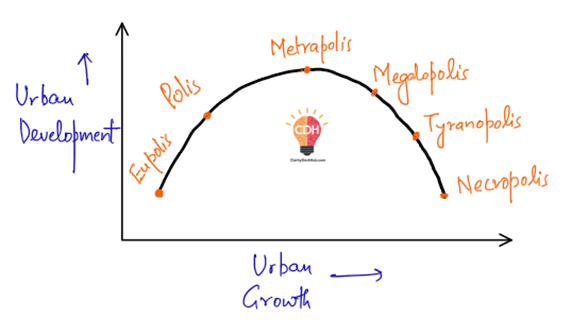
🧠 Final Thought – A Moral Message in Urban Geography
Lewis Mumford wasn’t just a geographer — he was a humanist urban thinker.
His theory gives a warning:
If cities lose their connection to people, values, and sustainability — they may grow, but eventually die.
From Eopolis to Necropolis, it’s not just the journey of a city — it’s the journey of human civilization itself.