
Major Ports of India
Introduction
Classification of Indian Ports: Major vs. Non-Major
Let us begin with the constitutional classification.
🧭 On What Basis Are Ports Classified?
- Indian ports are mainly of two types:
✅ Major Ports
✅ Non-Major Ports
This classification is not just administrative — it is rooted in the Constitution of India.
📜 Constitutional Placement:
- Major Ports fall under the Union List – meaning the Central Government has exclusive authority over them.
- Non-Major Ports fall under the Concurrent List – hence, both Centre and States can legislate on them. However, in practice, these are managed mainly by State Governments.
Legal Definition of Major Ports
“What makes a port ‘Major’?”
This is defined under the Indian Ports Act of 1908.
A Major Port is declared officially through:
- Gazette Notification by the Government of India, or
- Under existing laws if it meets specific criteria.
In other words, it’s not just about size or traffic — the legal status matters.
How Many Major Ports Does India Have?
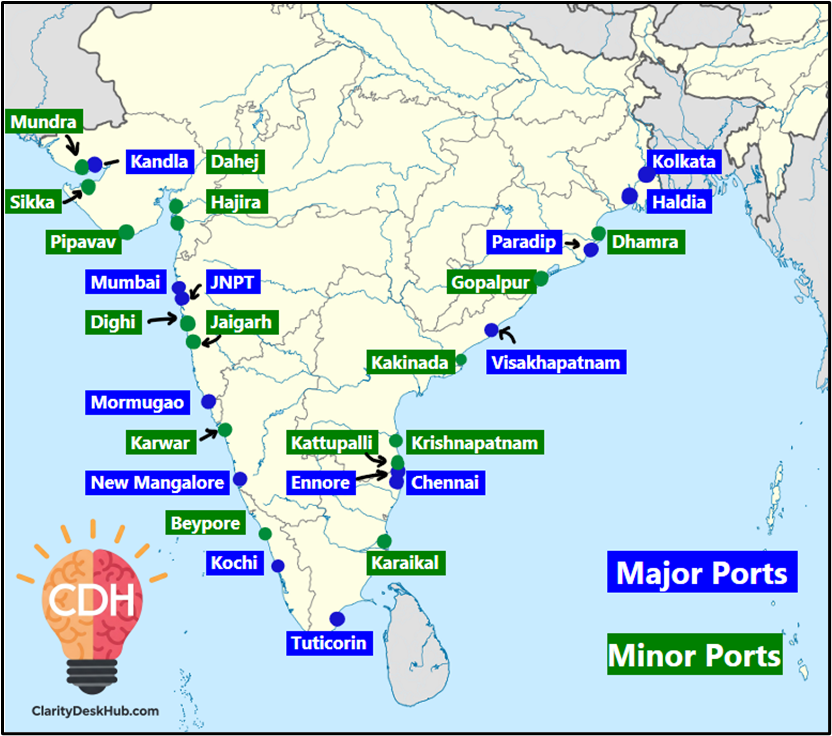
📦 India has 12 Major Ports (as per current government recognition):
- These handle around 58% of India’s sea-borne traffic — in terms of volume (cargo quantity).
Among them:
- 11 ports are managed under the Major Port Trusts Act of 1963 (they function like autonomous trusts).
- 1 port — Ennore Port Ltd (now renamed Kamarajar Port Ltd) — is run as a company, not a trust.
Non-Major Ports – The Other Side of the Picture
- India has about 200 Non-Major Ports.
- They handle 42% of the sea-borne cargo.
- These are controlled by State Maritime Boards or State Governments.
So, in terms of numbers, non-major ports are more. But major ports handle more cargo per port.
Importance of Ports in India’s Economy
🔁 EXIM (Export-Import) Trade Dependency:
- 90% of India’s foreign trade by volume is handled by ports.
- 70% of India’s foreign trade by value is handled through ports.
✅ Hence, ports are not just geographic features — they are economic lifelines.
⚓ Important Terms You Must Know
To understand port geography more deeply, let’s clarify some key technical terms.
📌 Inland Port:
- A port not located on the sea but on an inland water body — like a river, lake, or canal.
- Sometimes used interchangeably with dry port, which is an inland terminal connected to a seaport via rail or road.
📌 Riverine Port:
- These are ports located on riverbanks.
- Usually, they connect to larger seaports and are often considered a type of inland port.
📌 Difference from Seaport?
Riverine ports are inland, while seaports are located directly on sea or ocean coasts.
📌 Natural Harbour:
- A naturally protected waterbody where ships can dock safely.
- No significant construction is needed.
- Ex: Mumbai Port
✳️ Remember:
Harbour = Natural
Port = Human-developed infrastructure within the harbour
📌 Trans-shipment:
- It refers to transfer of goods from one ship to another, often mid-sea.
- Mostly used in global fishing and cargo logistics.
- Especially between smaller vessels and large refrigerated ships known as “reefers”.
📌 Tidal Port:
- A port where water level changes due to ocean tides.
- Operations like docking must align with tidal cycles.
- Commonly found in coastal areas.
📌 Satellite Port:
- A secondary port developed near a major port to reduce congestion.
- Helps distribute traffic load and improve efficiency.
📘 Important Facts – UPSC-Friendly One-Liners
These are direct factual questions UPSC often asks in Prelims and can be used as examples in Mains:
| 🏷️ Fact Type | 🚢 Port Name |
|---|---|
| Oldest Port in India | Lothal Port (Gujarat, from Indus Valley Civilization) |
| Mughal Era’s most famous port | Surat Port |
| Deepest Port | Gangavaram Port, Visakhapatnam |
| Largest Container Port | Jawaharlal Nehru Port (JNPT) |
| Largest Natural Port | Mumbai Port |
| Largest Artificial Port | JNPT (Nhava Sheva) |
| Largest Port by Cargo Volume | Kandla Port (Deendayal Port) |
| Largest Port on East Coast | Chennai Port |
| First Port Post-Independence | Kandla Port |
| Southernmost Port | Tuticorin Port (V.O. Chidambaranar Port) |
| State with Highest Number of Ports | Maharashtra |
🧠 Conceptual Understanding Recap
Let’s summarise the core conceptual structure till now:
- Major Ports are constitutionally under Union List, legally defined, and strategically vital for trade.
- Non-Major Ports are numerous and state-managed.
- Ports are supported by various types – inland, riverine, natural, tidal, artificial.
- Understanding terminology is key for both MCQs and Mains explanations.
- India’s port geography is a blend of ancient heritage (Lothal) and modern infrastructure (JNPT).
🌊 Major Ports on the East Coast of India
India’s East Coast faces the Bay of Bengal, and the ports here are strategically crucial for:
- Trade with Southeast Asia
- Serving the mineral-rich hinterlands of eastern and central India
- Connecting to international sea routes
Let’s now take each port one by one.
1. Kolkata Port (KoPT)
🔹 Location: On the left bank of the Hugli River, West Bengal
🔹 Official Name: Syama Prasad Mookerjee Port Trust
🔹 Type: Riverine port – in fact, India’s only major riverine port
Key Highlights:
- It is the oldest major port in India.
- Being a tidal port, it depends on high tide for navigability.
- However, this also leads to siltation, meaning sediment deposits accumulate and block ship movement.
- Result: Frequent dredging is required to maintain navigational depth.
🧪 Why dredging is necessary?
When the tide rises, it brings sediment-rich water into the Hugli. Over time, this reduces the depth, making it unfit for large ships unless cleared regularly.
Trade Profile:
- Exports: Iron ore, leather, cotton textiles
- Imports: Wheat, raw cotton, iron & steel
Extra Insight: The Bhagirathi-Hugli system is a tide-influenced distributary of the Ganga, and this tidal influence extends up to 280 km inland — all the way to Nabadwip!
2. Haldia Port (Haldia Dock Complex)
🔹 Located at the confluence of the Haldi and Hugli Rivers
🔹 Built to ease congestion at Kolkata Port
🔹 Also known as Diamond Harbour
🔹 It is a part of the Kolkata Port Trust
- Located downstream, it handles bulk cargo and is more accessible for larger vessels due to less siltation compared to Kolkata Dock.
3. Paradip Port (PPT), Odisha
🔹 Located at the confluence of the Mahanadi River and the Bay of Bengal
🔹 A natural port, and the first major port on the East Coast commissioned after independence.
Key Points:
- Visionary project by Late Biju Patnaik, then CM of Odisha.
- It serves a huge hinterland: Odisha, Jharkhand, Chhattisgarh, MP, UP, Bihar, and West Bengal.
Trade:
- Exports: Mainly iron ore
- Imports: Crude oil, fertilisers, etc.
Latest Achievement (2023-24):
- Cargo Handled: 145.38 MMT
- Surpassed Deendayal Port (Kandla) as India’s top cargo-handling major port
- Also has the highest berth productivity in India
Berth productivity means the efficiency with which cargo is loaded/unloaded at each berth.
4. Visakhapatnam Port (VPT), Andhra Pradesh
🔹 Located midway between Kolkata and Chennai
🔹 It is Andhra Pradesh’s only major port
🔹 Built around a natural harbour and enclosed like a landlocked port, with an opening to the sea.
Unique Features:
- A breakwater port – it has man-made structures to protect against wave action
- Joined by Meghadrigedda River in its Inner Harbour
Trade:
- Exports: Manganese ore (dominant)
- Imports: Coking coal, gypsum, steam coal, coke, iron ore
5. Tuticorin Port (TPT), Tamil Nadu
🔹 Officially: V.O. Chidambaram Port
🔹 Located in the Gulf of Mannar
🔹 Artificial port, yet strategically located on the East-West Sea route
Features:
- Sheltered naturally by Sri Lanka and India, making it an all-weather port
- 4th-largest container terminal in India
- Tamil Nadu’s third international port
Trade:
- Exports: Sugar, granite, limonite ore
- Imports: Coal, cement, fertilisers, rock phosphate, petroleum products, edible oils
6. Chennai Port (ChPT)
🔹 Second largest and third oldest major port
🔹 Also located in Tamil Nadu
🔹 An artificial harbour – built by humans, not naturally sheltered
Challenges:
- Vulnerable to cyclones
- Affected by sand accretion due to underwater currents – reduces depth
Trade:
- Exports: Automobiles, leather, iron ore
- Imports: Wheat, raw cotton, iron, steel, machinery
7. Ennore Port (Kamarajar Port), Tamil Nadu
🔹 Located 24 km north of Chennai Port
🔹 India’s 12th major port
🔹 Most importantly, it is India’s only corporatised port — run as a company, not a trust
Incorporated as Ennore Port Ltd. under Companies Act, 1956
Trade:
- Exports: Automobiles
- Imports: Bulk cargo like propylene oxide
📌 Corporatisation here implies a more business-like structure, aiming for greater efficiency and autonomy.
8. Port Blair Port, Andaman & Nicobar Islands
🔹 Legally notified under the Indian Ports Act, 1908
🔹 Intended to be a major port, and the Major Port Trusts Act, 1963 has been applied
🔹 However, in practical terms, no major development has yet occurred
Hence, while legally declared, it is functionally undeveloped as a major port.
🧠 Summary Table: East Coast Ports
| 🛳️ Port | 📍 Location | 🧱 Type | 📦 Major Exports/Imports | 🌟 Unique Feature |
|---|---|---|---|---|
| Kolkata (KoPT) | West Bengal | Riverine | Iron ore, leather / Wheat | Only major riverine port |
| Haldia | West Bengal | Dock Complex | Bulk cargo | Relief to KoPT |
| Paradip | Odisha | Natural | Iron ore / Crude oil | Highest cargo handling (2023-24) |
| Visakhapatnam | Andhra Pradesh | Natural, Landlocked | Manganese / Coal | Breakwater port |
| Tuticorin | Tamil Nadu | Artificial | Sugar, granite / Petroleum | In Gulf of Mannar |
| Chennai | Tamil Nadu | Artificial | Automobiles / Machinery | Cyclone-vulnerable |
| Ennore (Kamarajar) | Tamil Nadu | Artificial | Automobiles / Propylene | Only corporatised port |
| Port Blair | A&N Islands | Undeveloped major | — | Legal status, not yet functional |
🌊 Major Ports on the West Coast of India
The West Coast of India, bordering the Arabian Sea, is home to some of the most important ports — both public and private, natural and artificial. These ports are vital for India’s trade with:
- Middle East
- Africa
- Europe
Let’s now go through each port:
1. Kandla Port (Deendayal Port), Gujarat
🔹 Location: Gulf of Kutch, near Gandhidham, Gujarat
🔹 Built after Partition (1950s) – to replace Karachi Port (which went to Pakistan)
Key Features:
- Natural harbour
- Modern container terminal and dry dock facility
- Largest public port in India by cargo volume
Trade:
- Imports: Petroleum, chemicals, steel, iron machinery
- Exports: Grains, processed food, textiles
Tuna Tekra Deep Draft Terminal, Gujarat
🔹 New project announced at the Global Maritime India Summit 2023
🔹 All-weather terminal, developed in PPP mode
Purpose:
- Part of the India-Middle East-Europe Economic Corridor
- Will act as a new gateway for trade, especially large vessels needing deep draft capacity
🔍 Deep draft refers to how deep the ship sinks in water — bigger ships need deeper ports.
2. Mundra Port, Gujarat
🔹 Located on the north shore of the Gulf of Kutch
🔹 India’s largest private port, run by Adani Ports
🔹 Also the largest container port in the country
Features:
- Deep draft, all-weather port
- Largest coal import terminal in India
- Also declared a Special Economic Zone (SEZ)
✳️ Mundra is a classic example of the corporatised model in port management.
3. Mumbai Port, Maharashtra
🔹 Situated in Thane Creek, on the lee side of Salsette Island
“Lee side” means the side protected from strong sea winds — naturally sheltered.
Historical Importance:
- Developed as India’s primary trade gateway after the Suez Canal opened (1869)
- Was once India’s busiest port
Trade:
- Exports: Textiles, raw cotton
- Imports: Petroleum, fertilisers, chemicals, paper, raw cotton
4. Jawaharlal Nehru Port (JNPT or Nhava Sheva), Navi Mumbai
🔹 Built as a modern alternative to Mumbai Port
🔹 India’s largest public container port
🔹 Developed a multi-product SEZ
Trade:
- Exports: Textiles, carpets, sports goods, boneless meat, pharma
- Imports: Chemicals, vegetable oils, non-ferrous metals, plastics, machinery
Hinterland:
- Maharashtra, Madhya Pradesh, Gujarat, Karnataka, and most of North India
5. Mormugao Port, Goa
🔹 Located at the Zuari Estuary entrance
Significance:
- Handles nearly 40% of India’s iron ore exports
Hinterland:
- Goa, Karnataka, Maharashtra
Trade:
- Exports: Iron ore, manganese, granite, bauxite
- Imports: Coal, fertilisers, petroleum products, cement, timber
6. New Mangalore Port, Karnataka
🔹 Located in Panambur, near Mangalore
🔹 Only major port in Karnataka
Features:
- A natural port with modern infrastructure
- Important for containerised cargo and liquid chemicals
Trade:
- Exports: Cashews, coffee, iron ore pellets, granite
- Imports: LPG, phosphoric acid, crude oil, fertilisers, wood pulp, ammonia
Hinterland:
- Karnataka, Kerala, Tamil Nadu, Andhra Pradesh
7. Cochin Port, Kerala
🔹 Located on Willingdon and Vallarpadam islands, Lake Kochi
🔹 Natural port on the Arabian Sea–Laccadive Sea–Indian Ocean route
Significance:
- India’s first trans-shipment port
- Gateway to Sri Lanka, Maldives, Middle East
Trade:
- Exports: Tea, coffee
- Imports: Chemical fertilisers, mineral oils
Hinterland:
- Kerala, Karnataka, parts of Tamil Nad
Vizhinjam International Seaport, Kerala (Upcoming)
🔹 Located near Thiruvananthapuram
🔹 Developed by Adani Ports under DBFOT model
🧾 DBFOT = Design, Build, Finance, Operate, Transfer
After concession period, the asset returns to govt control
Strategic Purpose:
- India’s first deepwater trans-shipment port
- Competes with Colombo, Singapore, Dubai
Advantages:
- ✅ Natural depth of 18 meters – no dredging required
- ✅ Close to international shipping lanes
- ✅ Excellent road and rail connectivity
✳️ Currently, 75% of India’s trans-shipment cargo is handled outside India. Vizhinjam aims to reverse this dependency.
Vadhavan Port (Upcoming), Maharashtra
🔹 A planned satellite port of JNPT
🔹 Will be India’s 13th major port once complete
🔹 Designed as an “All Weather, All Cargo” deep draft port
Key Concept:
- Landlord Model: Govt owns the infrastructure, private players operate in PPP mode
Purpose:
- Handle overflow from JNPT
- Accommodate large ships that require greater draft than JNPT can handle
🔄 Comparative Geography:
- East Coast ports are mostly riverine or natural, often facing cyclones, but have less depth.
- West Coast ports are more natural and deep-drafted, often all-weather and better suited for global shipping.
✍️ UPSC Linkages for Mains
In a Mains answer, you can use these case examples to enrich your argument:
- “Paradip and JNPT outperform legacy ports like Mumbai due to corporatisation and modernisation.”
- “Vizhinjam represents India’s attempt to reduce trans-shipment dependency on foreign ports.”
- “Ports like Tuna Tekra and Vadhavan show a shift toward PPP-based greenfield infrastructure.”
🇮🇳 Indian Ports as Gateways of Trade
🔍 Why Are Ports More Numerous and Effective on the West Coast?
This is a conceptual question UPSC loves — not just memorizing ports, but understanding why they are where they are.
Let’s analyze it:
🔄 Difference Between West Coast and East Coast Ports
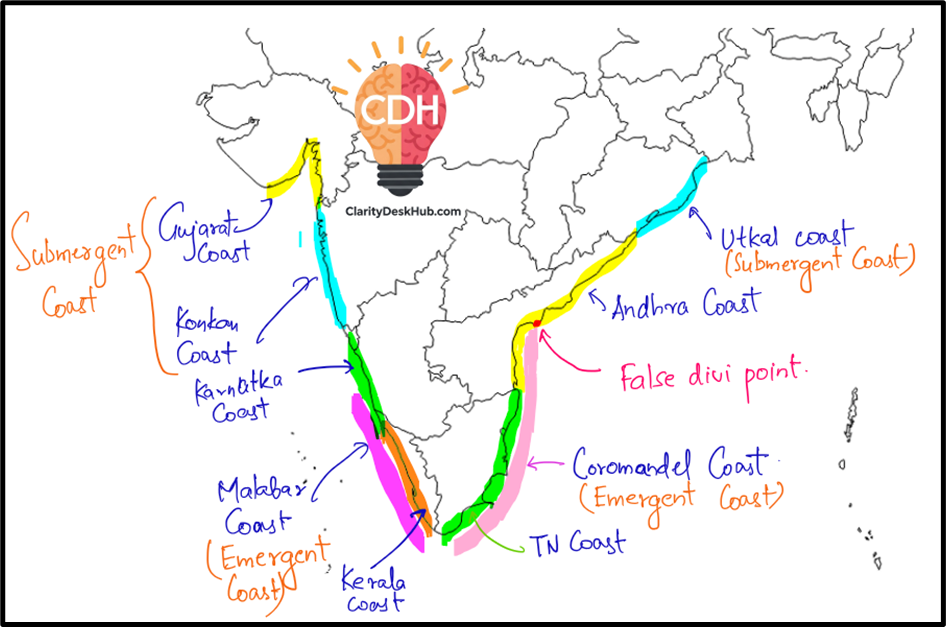
| Parameter | West Coast | East Coast |
|---|---|---|
| Geological Nature | Coastline of submergence | Coastline of emergence |
| Shelf Depth | Deep continental shelf | Shallow continental shelf |
| Port Construction | Easier to construct deep natural harbours | Requires dredging and maintenance |
| Examples | Mumbai, Mormugao, Cochin | Chennai, Paradip, Kolkata |
📍 Understanding Coastlines – Submergence vs. Emergence
🟦 Konkan Coast (Maharashtra + Goa):
- Submergence Coastline ⇒ Deep water near shore
- Ports here (e.g., Mumbai, Mormugao) can naturally accommodate large ships.
🟩 Coromandel & Malabar Coasts (TN & Kerala):
- Emergence Coastline ⇒ Shallow continental shelf
- Port-building is technically harder, and requires dredging.
🌊 Role of Rivers in Port Construction
| Direction | Landform | Port Impact |
|---|---|---|
| West-flowing rivers | Estuaries | Ideal for port construction – deep, narrow inlets |
| East-flowing rivers | Deltas | Not suitable – sediment accumulation blocks shipping |
✳️ Estuaries are better for ports because they’re deep, stable, and naturally sheltered.
🛡️ Additional Estuarine Benefits
- Estuarine vegetation + sand bars prevent shoreline erosion
- Make port maintenance easier and cheaper
Thus, more natural ports exist on the West Coast.
🗺️ Major Ports and Their Hinterlands
“Hinterland” = The inland region served by a port (i.e., the region whose exports and imports pass through that port)
Here’s a quick reference table that links major ports to their respective hinterlands 👇
| 🛳️ Port | 🧭 Hinterland States |
|---|---|
| Kandla (Deendayal) | J&K, Punjab, HP, Haryana, Rajasthan, Delhi, Gujarat, MP, Uttarakhand, UP |
| Mumbai | Maharashtra, MP, Gujarat, UP, parts of Rajasthan |
| JNPT (Nhava Sheva) | Maharashtra, MP, Gujarat, Rajasthan, Delhi |
| Mormugao | Goa, Karnataka, Southern Maharashtra |
| New Mangalore | Karnataka, parts of Kerala |
| Kochi | Kerala, Southern Karnataka, SW Tamil Nadu |
| Kolkata | UP, Bihar, Jharkhand, WB, Sikkim, NE States, Nepal, Bhutan |
| Paradip | Odisha, Chhattisgarh, Jharkhand |
| Visakhapatnam | Andhra Pradesh, Telangana |
| Tuticorin (VOC) | Coimbatore, Tirupur, Erode, Karur (TN), parts of Kerala |
| Chennai | TN, Kerala, Karnataka, Andhra Pradesh |
| Ennore (Kamarajar) | Parts of TN |
✅ This kind of tabular detail helps in both UPSC Prelims factual recall and Mains analytical mapping.
🌍 India-Middle East-Europe Economic Corridor (IMEC)
This is where geography meets international relations and economy, and hence a very high-value UPSC topic.
🌐 What is IMEC?
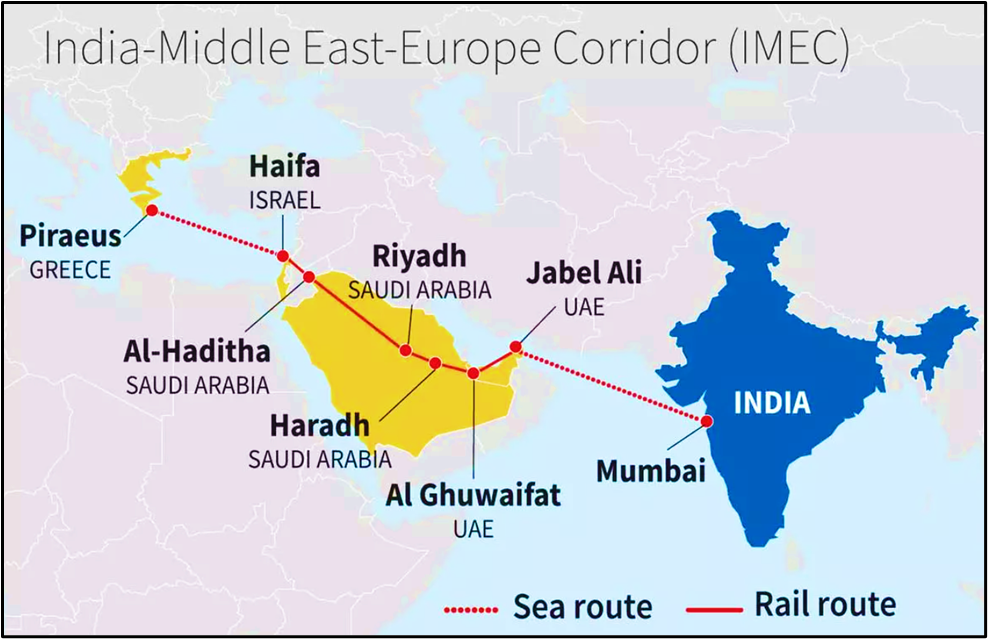
The India-Middle East-Europe Economic Corridor is a multimodal trade and connectivity project.
🔹 Proposed at the G20 Summit 2023 in New Delhi
🔹 Seen as a counter to China’s Belt and Road Initiative (BRI)
🛣️ Route and Components
| Corridor | Route |
|---|---|
| East Corridor | India → Persian Gulf (via UAE, Saudi Arabia) |
| North Corridor | Persian Gulf → Europe (via Jordan, Israel, Greece) |
IMEC will use a combination of railways, shipping lanes, and roads
🔌 Additional Connectivity Goals
- Promote digital connectivity
- Lay submarine fibre optic cables, create data centers along the route
🇮🇳 Indian Ports Involved in IMEC
| Port | State |
|---|---|
| Mundra Port | Gujarat |
| Kandla (Deendayal Port) | Gujarat |
| Jawaharlal Nehru Port (JNPT) | Maharashtra |
These ports will act as entry points for goods heading westward via IMEC.
📦 Issues and Challenges with Indian Ports
Ports are the gateways of trade, but in India, these gateways are not as smooth or efficient as they should be. Below is an explanation of the core challenges.
1. Draught Levels – Depth Deficiency
Draught (or Draft) refers to the depth of water needed for a ship to float and dock.
🔹 Large modern ships, especially mother vessels, require 18 metres or more.
🔹 Most Indian ports offer much shallower draughts (~12–14 m).
🟠 Problem:
- Limits the size of vessels that can dock.
- India is forced to use feeder ships, which increases cost and time.
2. Weak Hinterland Connectivity
Hinterland is the region that relies on a port for export-import.
🔹 Roads and railways connecting production zones to ports are often poor or underdeveloped.
🔹 Logistics costs become high due to:
- Overdependence on roads
- Lack of multi-modal transport (rail + water + pipeline)
🟠 Example:
- A textile unit in Surat may take longer to export goods via JNPT due to delays in rail loading.
3. Lack of Transshipment Capability
Transshipment Port is where cargo is transferred between large and small ships.
🔹 Currently, India doesn’t have a fully functional transshipment port.
🔹 So, containers are diverted to foreign hubs like:
- Colombo
- Singapore
- Dubai
- Salah (Oman)
🟠 Consequences:
- High feeder vessel costs
- Dependency on foreign ports
- Strategic vulnerability
Vizhinjam and Cochin are being developed, but India still lags behind.
4. High Turnaround Times
Turnaround time = Time taken for a ship to dock, unload/load, and leave
🔹 Global best practices (e.g., Singapore) average < 1 day.
🔹 Indian ports average > 2 days, and even longer in some cases.
🟠 Why?
- Manual processes
- Poor port equipment
- Delays in customs clearance
- Berth unavailability
5. Port Congestion
Especially visible in major container ports like Nhava Sheva (JNPT)
🔹 High container volume
🔹 Shortage of cranes and unloading equipment
🔹 Inefficient berth allocation
🟠 Result:
- Longer waiting time for ships
- Wastage of port space
- Demurrage charges (penalty paid by ships for delays)
6. Sub-optimal Modal Mix in Transport
Ideal logistics involves a balance between road, rail, inland water, and coastal shipping.
🔹 But in India:
- Road dominates (~60%)
- Rail and water transport are underused
🟠 Why?
- Poor first-mile and last-mile rail links
- Underdeveloped coastal shipping and river transport
7. Lengthy Inspections and Customs Scrutiny
Though India is moving toward paperless and faceless customs, problems persist.
🔹 Physical inspection delays
🔹 Unpredictable scrutiny practices
🔹 Lack of integration between IT systems (Customs, shipping, logistics)
🟠 Impact:
- Exporters face uncertainty, which reduces India’s export competitiveness
8. Inadequate Infrastructure & Technology
Applies more severely to non-major ports, but affects major ports too.
Issues:
- Lack of berthing space
- Shortage of loading/unloading equipment
- Poor IT systems for tracking cargo
- Inadequate navigational aids (radar, GPS-guided tugs)
🟠 Example:
- In a modern port, every crane movement is software-guided. In India, many ports still use manual crane operations.
9. Jurisdictional and Regulatory Issues
India has 12 Major Ports (under Union control) and 200+ Non-Major Ports (under States)
🔹 Different laws govern each:
- Major Port Trusts Act, 1963
- Indian Ports Act, 1908
🟠 Problems:
- Lack of uniform regulation
- Poor coordination between Centre and States
- Rigid port tariff regimes discourage private investment
10. Environmental Concerns
🔹 Common issues:
- Oil spills
- Spillage during loading/unloading of cargo
- Ballast water discharge (contains invasive marine species)
- Discharge of toxic cleaning water
🟠 Result:
- Threat to marine biodiversity
- Weak enforcement of pollution control laws by Port Authorities
Ballast water is the water a ship carries for stability. When released at foreign ports, it brings alien species into Indian waters
11. Manpower Issues
Ports are not just about machines; people operate them.
🔹 Key concerns:
- Inadequate training in modern IT and logistics
- Resistance to reforms by port workers
- Decline in manpower quality due to contractualisation
🟠 Impact:
- Even with new tech, human inefficiency slows down operations
🧠 Conceptual Summary – For UPSC Mains
| Issue Category | Key Points |
|---|---|
| Technical | Inadequate draught, old equipment, poor modal mix |
| Operational | Long turnaround times, congestion, manpower inefficiency |
| Regulatory | Dual jurisdiction, rigid laws |
| Environmental | Pollution from oil, cargo, ballast water |
| Strategic | No transshipment hub, high foreign dependency |
| Economic | Higher logistics cost, poor global competitiveness |
🇮🇳 Government Initiatives for Port Development in India
India’s port sector is strategically critical — not only for domestic trade but also for international supply chains, blue economy, and maritime diplomacy. Let’s understand the key initiatives that address infrastructure, governance, connectivity, and innovation.
1. Institutional and Legislative Reforms
🔹 Ministry Renaming (2020)
- The Ministry of Shipping was renamed to:
Ministry of Ports, Shipping and Waterways (MoPSW)
- Reflects a broader mandate: not just shipping, but also port-led development and inland waterways.
🔹 Major Port Authorities Act, 2021
- Replaced the outdated Major Port Trusts Act of 1963
- Key Objectives:
- Decentralise decision-making
- Enable corporate-style governance in ports
- Provide greater autonomy to port authorities
🟢 Promotes efficiency, private investment, and alignment with global standards.
2. Cybersecurity in Ports
- All major ports instructed to conduct comprehensive cybersecurity audits
- Necessary due to rising threats of cyberattacks on maritime infrastructure
- Aims to ensure safe and secure cargo handling, digital operations, and ship movement system
3. Foreign Direct Investment (FDI)
- India permits 100% FDI in port development under the automatic route
- Encourages private and foreign players to invest in:
- Container terminals
- Berthing facilities
- Port-led industrial areas
4. Project UNNATI
“Unnati” = Progress/Improvement
- Benchmarks the performance of 12 major ports with:
- Indian private ports like Mundra
- Top global ports like Singapore, Rotterdam
- Goal: Identify gaps and implement best practices in:
- Cargo handling
- Turnaround time
- Cost-effectiveness
5. Coastal Berth Scheme
- Provides financial support to:
- Ports
- State governments
- Aims to improve coastal infrastructure for both cargo and passengers
- Integrated into the larger Sagarmala Programme
🟢 Encourages short-sea shipping and reduces pressure on roads.
6. SAROD-Ports (2020)
SAROD = Society for Affordable Redressal of Disputes – Ports
- Institutional dispute resolution system
- Features:
- Time-bound arbitration
- Technical experts as arbitrators
- Cost-effective and fair mechanisms
- Boosts Ease of Doing Business in maritime sector
🌊 Sagarmala Programme – The Flagship Reform
Vision: Transform India into a logistics power through port-led development
🌐 What is Sagarmala?
- A Central Sector Scheme launched in 2015
- Anchored by the Ministry of Ports, Shipping and Waterways
- Utilises India’s:
- 7,500 km coastline
- 14,500 km navigable waterways
- Strategic maritime position
🧱 The 5 Pillars of Sagarmala
| # | Component | Objective |
|---|---|---|
| 1️⃣ | Port Modernisation | Upgrade existing ports & build new mega ports |
| 2️⃣ | Port Connectivity | Enhance rail, road, and waterway links to ports |
| 3️⃣ | Port-led Industrialisation | Develop coastal economic zones, clusters |
| 4️⃣ | Coastal Community Development | Skilling, employment, and infrastructure for fishing & coastal populations |
| 5️⃣ | Coastal Shipping & IWT | Reduce transport cost & road congestion via sea/inland water transport |
⚓ Six Mega Ports Planned under Sagarmala
| State | Location | Port Name |
|---|---|---|
| Kerala | Vizhinjam | Vizhinjam International Seaport |
| Tamil Nadu | Colachel | Colachel Seaport |
| Maharashtra | Vadhavan | Vadhavan Port |
| Karnataka | Tadadi | Tadadi Port |
| Andhra Pradesh | Machilipatnam | Machilipatnam Port |
| West Bengal | Sagar Island | Sagar Island Port |
🟢 These ports are chosen for:
- Deep draught potential
- Strategic location
- Global cargo handling capacity
🔬 Innovation & Research: NTCWPC
National Technology Centre for Ports, Waterways and Coasts
Established under Sagarmala at IIT Madras
Focus Areas:
- Port infrastructure and engineering design
- Siltation and dredging management
- Ocean renewable energy
- Autonomous vehicles and tech-driven solutions
- Coastal erosion & climate resilience
🔗 Connectivity-Focused Schemes
📍 1. Comprehensive Port Connectivity Plan (CPCP)
- A multi-ministerial coordination effort under PM Gati Shakti
- Ensures “last-mile” and “hinterland” connectivity to all ports
- Participating ministries:
- Ministry of Ports
- Ministry of Railways
- Ministry of Road Transport and Highways
- State Maritime Boards
🟢 Bridges the gap between production hubs and export-import gateways
🗺️ 2. PM Gati Shakti – Digital Backbone
A National Master Plan launched in 2021 for multi-modal connectivity
- Integrates 16 infrastructure ministries
- Unifies schemes like:
- Sagarmala
- Bharatmala
- UDAN
- Dry/land ports
- Inland waterways
🟢 Allows GIS-based coordination, fast approvals, and reduced infrastructure duplication