
Concepts of Microeconomics
Microeconomics forms the analytical foundation of economics by examining how individual economic units—such as consumers and producers—make decisions under conditions of scarcity. It explains how choices regarding consumption and production are influenced by prices, income, preferences, technology, and institutional factors.
Through concepts like demand, supply, elasticity, and market equilibrium, microeconomics helps us understand price formation, resource allocation, and consumer–producer behaviour in markets.
A clear grasp of these concepts is essential not only for theoretical understanding but also for analysing real-world economic issues and policy interventions, making microeconomics a crucial component of the UPSC General Studies syllabus.
Demand: The Starting Point of Microeconomics
What Is Demand?
In economics, demand does not mean mere desire. It has a precise meaning.
Demand refers to the quantity of a good or service that consumers are willing and able to buy at a given price, during a specific period of time.
So, demand has three essential elements:
- Willingness to buy (desire)
- Ability to buy (purchasing power)
- Price and time reference
If any one of these is missing, it is not demand in the economic sense.
👉 For example, wanting a luxury car without having the income to buy it is a desire, not demand.
Determinants of Demand
Demand does not remain constant. It changes due to several factors, called determinants of demand. Let us understand them one by one.
1. Price of the Product (Most Important Determinant)
There is an inverse relationship between price and quantity demanded, other things remaining the same.
- When price falls, quantity demanded increases
- When price rises, quantity demanded decreases
Example:
- If the price of smartphones decreases, more consumers can afford them, so demand rises.
This relationship forms the basis of the law of demand, which you will study in detail later.
2. Income of Consumers
Income determines the purchasing power of consumers.
- When income increases, people can buy more goods and services
- When income decreases, demand usually falls
Example:
- With higher salaries, people may start buying luxury goods such as expensive jewellery or premium cars.
👉 In UPSC terms, income changes explain variations in demand due to economic growth, employment, and wage changes.
3. Price of Related Goods
Demand for a product is also influenced by the prices of related goods, which are of two types:
(a) Substitutes
Substitutes are goods that can be used in place of each other.
Examples:
- Tea and coffee
- Butter and margarine
If the price of one substitute rises, consumers shift to the other, increasing its demand.
Example:
- If coffee becomes expensive, demand for tea may increase.
(b) Complementary Goods
Complementary goods are goods that are used together.
Examples:
- Smartphones and mobile data plans
- Cars and petrol
If the price of one complementary good falls, demand for the other usually increases.
Example:
- If smartphones become cheaper, more people buy them, which increases demand for mobile data plans.
4. Consumer Preferences and Tastes
Demand is also shaped by tastes, preferences, habits, and fashion trends.
- A change in lifestyle
- Influence of advertising
- Cultural or social trends
Example:
- If a new fashion trend becomes popular, demand for related clothing items increases, even if prices remain unchanged.
👉 This factor explains why demand can change without any change in price or income.
5. Population
The size and composition of the population significantly affect demand.
- Increase in population → higher demand
- Changes in age structure, urbanisation, or family size also matter
Example:
- Development of a new housing complex increases demand for → Furniture, Home appliances, Household goods
In GS answers, population is often linked to urbanisation, housing demand, and consumption patterns.
Law of Demand
What Does the Law of Demand State?
The law of demand states that:
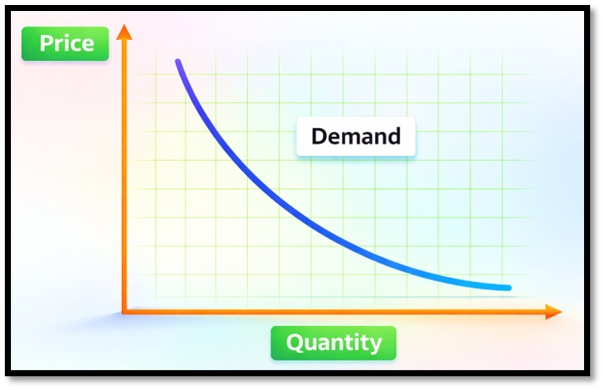
There is an inverse relationship between the price of a product and the quantity demanded, other factors remaining constant (ceteris paribus).
In simple terms:
- When price falls, quantity demanded increases
- When price rises, quantity demanded decreases
This relationship is visually represented by a downward-sloping demand curve.
Why Does the Law of Demand Operate?
The inverse relationship exists because of:
- Diminishing marginal utility – as consumption increases, additional satisfaction falls
- Income effect – a fall in price increases real purchasing power
- Substitution effect – consumers shift to cheaper alternatives
Together, these forces ensure that consumers generally buy more at lower prices and less at higher prices.
Elasticity of Demand: Measuring Responsiveness
While the law of demand tells us the direction of change, it does not tell us how much demand changes. This is where elasticity of demand becomes important.
What Is Elasticity of Demand?
Elasticity of demand measures the responsiveness of quantity demanded to a change in price.
It answers the question: How sensitive are consumers to price changes?
Types of Price Elasticity of Demand
1. Elastic Demand
Demand is said to be elastic when → A small change in price causes a large change in quantity demanded
This usually happens in the case of:
- Luxury goods
- Goods with close substitutes
- Goods that can be postponed
Example: If the price of a luxury car rises, consumers may delay purchase or shift to another brand.
👉 Consumers are highly responsive to price changes.
2. Inelastic Demand
Demand is inelastic when → A change in price causes a relatively small change in quantity demanded
This is common for → Necessities, Goods with no close substitutes
Example:
- Even if the price of basic groceries rises slightly, people continue buying them because they are essential for survival.
👉 Consumers are less responsive to price changes.
3. Unit Elastic Demand
Demand is unit elastic when → The percentage change in price is exactly equal to the percentage change in quantity demanded
Here:
- Responsiveness is proportionate
- Total expenditure remains unchanged
Exceptions to the Law of Demand
Although the law of demand generally holds true, economics recognises certain exceptions, which are extremely important from an examination point of view.
Giffen Goods: The Giffen Paradox
Giffen goods are inferior goods that violate the law of demand.
In this case → When price increases, quantity demanded also increases
Why Does This Happen?
This occurs due to severe budget constraints faced by very poor consumers.
Let us understand this with the given example:
- A poor family consumes:
- Rice (cheap staple)
- Meat (expensive protein)
- When the price of rice increases:
- Their real income falls
- They can no longer afford meat
- They compensate by buying more rice, despite its higher price, to meet calorie needs
This phenomenon is known as the Giffen Paradox.
👉 The income effect dominates the substitution effect, leading to a violation of the law of demand.
Veblen Goods: Demand Driven by Status
Veblen goods are luxury goods whose demand increases as their price rises.
Here:
- High price itself becomes a symbol of status
- Consumers buy the good because it is expensive
Examples (conceptual) → Designer brands, Exclusive luxury items
For such goods:
- Higher prices increase prestige
- Demand rises not despite high price, but because of it
Supply: The Producer’s Perspective
What Is Supply?
Supply refers to the quantity of a good or service that producers are willing and able to offer for sale at different prices, during a given period of time.
Just like demand, supply also has three essential elements:
- Willingness to sell
- Ability to produce
- Price and time reference
Supply shows the relationship between price and quantity supplied, from the point of view of producers.
Law of Supply
The law of supply states that:
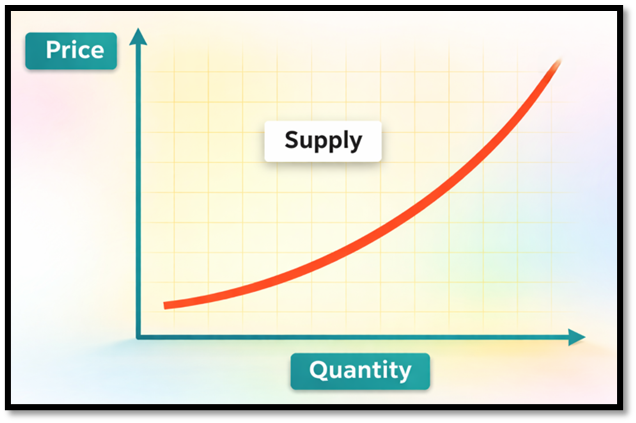
There is a direct relationship between the price of a product and the quantity supplied, other factors remaining constant.
In simple terms:
- When price increases, producers are willing to supply more
- When price decreases, producers supply less
This relationship is represented by an upward-sloping supply curve.
Why Does the Law of Supply Operate?
The law operates because:
- Higher prices mean higher profits
- Producers are encouraged to expand production
- Lower prices reduce profitability and discourage production
Thus, price acts as an incentive signal for producers.
Determinants of Supply
Supply is influenced by several factors beyond price. These are called determinants of supply.
1. Price of Inputs
Inputs include → Raw materials, Labour, Energy, Capital equipment
If the cost of inputs rises, production becomes more expensive, which may:
- Reduce profitability
- Decrease supply
Example → An increase in the price of raw materials used in manufacturing can reduce the supply of the final product.
2. Technology
Technology plays a crucial role in determining supply.
- Better technology increases efficiency
- Reduces cost per unit
- Enables higher output with the same resources
Example:
- Automation and modern machinery allow producers to supply more goods at lower cost.
👉 Technological progress generally shifts the supply curve to the right.
3. Number of Sellers
The total supply in a market depends on how many firms are producing.
- Entry of new firms → increase in supply
- Exit of firms → decrease in supply
This determinant is especially important in competitive markets.
4. Expectations
Producers’ expectations about future prices influence current supply.
Example:
- If producers expect prices to rise significantly in the future:
- They may reduce current supply
- Store goods to sell later at higher prices
Thus, expectations can cause temporary shortages.
5. Government Regulations
Government policies have a strong influence on supply.
- Taxes, restrictions, licensing → reduce supply
- Subsidies, incentives, tax exemptions → increase supply
Example:
- Environmental regulations may restrict supply in polluting industries
- Subsidies to agriculture can increase food supply
Elasticity of Supply
Just like demand, supply also responds differently to price changes.
What Is Elasticity of Supply?
Elasticity of supply measures the responsiveness of quantity supplied to changes in price.
It tells us:
How easily can producers adjust output when prices change?
Types of Elasticity of Supply
1. Elastic Supply
Supply is elastic when → A small change in price leads to a large change in quantity supplied
This occurs when:
- Production can be easily adjusted
- Inputs are readily available
Example → Farmers increasing production of a crop after a price rise by reallocating land.
2. Inelastic Supply
Supply is inelastic when → Quantity supplied changes very little despite price changes
This usually happens when:
- Resources are scarce
- Production cannot be quickly expanded
Example → Precious metals or rare natural resources, where supply is limited by nature.
3. Unitary Elastic Supply
Supply is unitary elastic when → Percentage change in quantity supplied equals percentage change in price
Example → A 10% increase in price leads to a 10% increase in quantity supplied
Here, elasticity of supply equals one.
Market Equilibrium: Where Demand Meets Supply
Now we arrive at the most important integrative concept.
What Is Market Equilibrium?
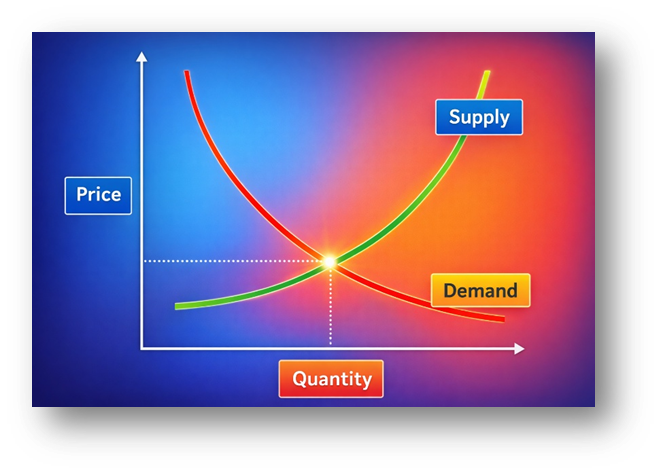
Market equilibrium is the situation where the quantity demanded equals the quantity supplied at a particular price.
At this point:
- Buyers’ intentions match sellers’ intentions
- There is no tendency for price to change
The equilibrium price is also called the market-clearing price.
Disequilibrium: Surplus and Shortage
If the market is not at equilibrium, two situations can arise:
1. Excess Supply (Surplus)
- Quantity supplied > quantity demanded
- Occurs at prices above equilibrium
- Leads to downward pressure on price
2. Excess Demand (Shortage)
- Quantity demanded > quantity supplied
- Occurs at prices below equilibrium
- Leads to upward pressure on price
Market forces eventually push the price back toward equilibrium.
This topic is part of the complete Indian Economy Notes for UPSC. Explore the full subject coverage here.