
Foundations of Money
Money is one of those concepts that looks simple on the surface, yet it quietly runs the entire economic system. From buying a cup of tea to running multinational corporations, money acts as the invisible thread connecting all economic activities. Without money, economic life would become extremely cumbersome, inefficient, and uncertain.
To truly understand how an economy functions—production, exchange, savings, investment, and growth—we must first understand what money is, how it evolved, and what functions it performs.
Evolution of Money
(From Direct Exchange to Digital Payments)
Economics always teaches us one important lesson: institutions evolve to solve problems. Money is no exception. Each stage in the evolution of money emerged to overcome the limitations of the previous system.
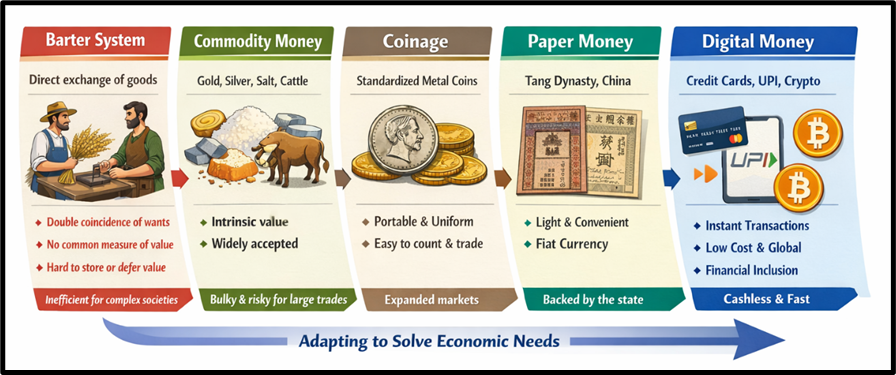
1. Barter System
The barter system was the earliest form of economic exchange. Goods and services were exchanged directly for other goods and services.
Example:
A farmer exchanges wheat for the blacksmith’s tools.
Core problem:
- Double coincidence of wants – both parties must want what the other offers at the same time.
- Lack of a common measure of value.
- Difficulty in storing value and making deferred payments.
As societies grew more complex, barter became inefficient, creating the need for a better system.
2. Commodity Money
To overcome barter’s limitations, societies adopted commodity money—objects that had intrinsic value and were widely accepted.
Examples: Gold, silver, salt, cattle.
Why it worked better:
- Generally accepted by society
- Had intrinsic value
- More divisible and durable than barter goods
However, carrying commodities like gold or silver was risky and inconvenient for large transactions.
3. Coinage
The next major leap was the introduction of coins, usually made from precious metals and issued with standardized weight and purity.
Example: The Roman denarius coin.
Advantages:
→ Portability
→ Uniform value
→ Easy counting and storage
→ Reduced fraud in transactions
Coinage significantly expanded trade and market activity.
4. Paper Money
Paper money marked a revolutionary shift. It was lighter, easier to carry, and suitable for large transactions.
Historical origin → First used in China during the Tang Dynasty (7th Century).
Initially backed by commodities like gold or silver, paper money later evolved into fiat money, backed by the authority of the state rather than intrinsic value.
5. Digital Money
In the modern era, money has become increasingly digital and cashless.
Examples → Credit and debit cards, UPI systems, Cryptocurrencies like Bitcoin and Ethereum
Digital money enables → Instant transactions, Low transaction costs, Global connectivity, Financial inclusion
This stage reflects how money adapts to technological progress.
Functions of Money
What Makes Money “Money”?
For something to be called money, it must perform certain core functions. These functions explain why money is universally accepted and indispensable.
1. Medium of Exchange
Money’s most basic function is to act as a medium of exchange. It eliminates the need for barter.
Example:
Instead of exchanging a bicycle for a smartphone, you simply pay money.
Why it matters:
→ Removes double coincidence of wants
→ Speeds up transactions
→ Encourages specialization and division of labour
This function alone makes large-scale economic activity possible.
2. Unit of Account
Money serves as a unit of account, meaning it provides a common measure of value.
Example:
A carton of eggs costs ₹50.
Because prices are expressed in monetary terms:
- Values of different goods can be compared
- Economic calculations become possible
- Accounting, budgeting, and planning are simplified
Without this function, rational economic decision-making would be nearly impossible.
3. Store of Value
Money allows people to store purchasing power over time.
Example:
You may spend your salary today or save it for future needs.
This function enables → Savings, Investment, Wealth accumulation, Long-term economic planning
However, inflation can erode this function if money loses its value rapidly.
4. Standard of Deferred Payment
Money also acts as a standard of deferred payment, meaning it is used to settle future obligations.
Example:
A car loan taken today is repaid over several years in monetary terms.
This function is essential for → Credit systems, Loans and mortgages, Modern financial markets
A stable and widely accepted monetary system is crucial for this function to work effectively.
Conclusion
Money as the Backbone of the Modern Economy
Money is far more than just notes, coins, or digital numbers. It is a social institution that has evolved over centuries to facilitate exchange, measure value, store wealth, and support complex economic relationships.
In a modern economy, the smooth functioning of markets, financial systems, and economic planning depends fundamentally on how efficiently money performs its functions. Understanding money, therefore, is not just an economic necessity—it is the starting point of understanding the entire economic system.
To explore all Indian Economy topics in a structured manner, visit the complete Indian Economy index page.