
Primary Market Instruments
To understand Primary Market Instruments, imagine the capital market as a place where companies raise money directly from investors for the first time or for expansion. This happens in the Primary Market, where securities are issued directly by the company to investors.
Now let us understand the major instruments.
Initial Public Offer (IPO)
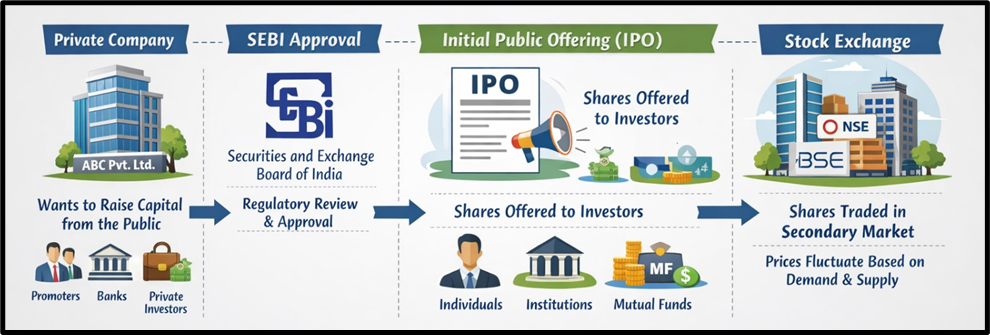
An Initial Public Offering (IPO) is the process through which a private company becomes a public company by offering its shares to the general public for the first time.
Until this point, the company is owned by promoters, founders, and early investors. Through an IPO, the company opens its ownership to the public investors.
The company issuing shares is called the issuer.
What happens during an IPO?
- The company decides to raise capital.
- It offers a fixed number of shares to the public.
- Investors subscribe to these shares.
- After the issue closes, the shares are listed on a stock exchange (such as National Stock Exchange of India or Bombay Stock Exchange).
Once listed, the shares begin trading in the secondary market.
Demand and Price Movement
- If demand > supply → the IPO is oversubscribed and price may rise.
- If demand < supply → price may fall after listing.
Example
A famous example is the IPO of Zomato in 2021.
- Zomato offered shares to the public for the first time.
- The IPO was heavily oversubscribed.
- When the shares got listed on the stock exchange, the price rose significantly, giving listing gains to investors.
Why do companies launch IPOs?
- To raise capital for expansion
- To repay debt
- To fund new projects
- To increase public visibility and credibility
In simple words:
IPO = Entry of a company into the public capital market.
Follow-on Public Offer (FPO)
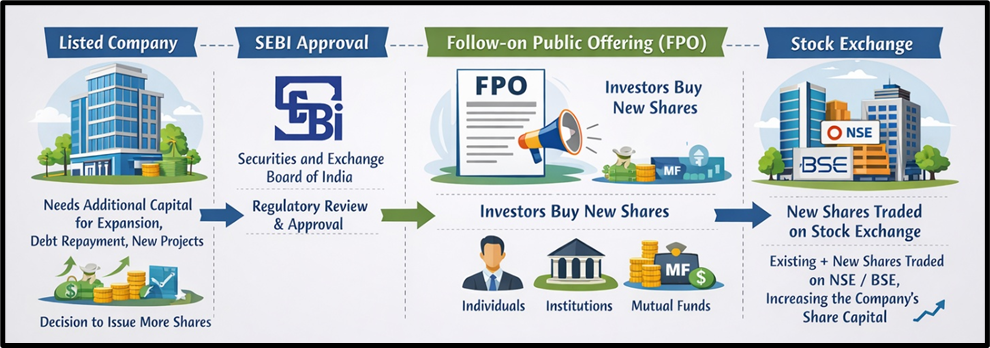
Now suppose a company is already listed on the stock exchange but needs more capital.
In that case, it issues additional shares through a Follow-on Public Offer (FPO).
Key Difference from IPO
- IPO: First time shares are issued to the public.
- FPO: Additional shares issued by an already listed company.
Important Feature: Dilution
When new shares are issued:
- Total number of shares increases.
- The percentage ownership of existing shareholders reduces.
This is called ownership dilution.
Example
Reliance Industries Limited announced an FPO in 2020.
The objective was:
- Debt reduction
- Funding capital expenditure
- Strengthening financial position
Thus, FPO = A listed company raising additional capital from the public.
Preferential Issue
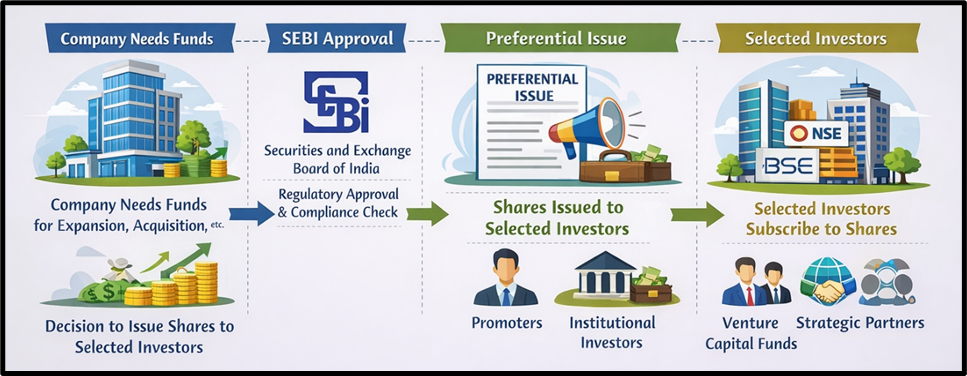
Now imagine a company wants to raise funds quickly, but does not want to go through the long process of a public issue.
In that case, the company may choose a Preferential Issue.
What is it?
A Preferential Issue means issuing shares to a select group of investors instead of the general public.
These investors can include:
- Promoters
- Institutional investors
- High Net Worth Individuals (HNIs)
Usually, these shares are issued at a price lower than the market price.
Why do companies use this method?
- Faster fundraising
- Less regulatory complexity
- Strategic investment from specific investors
Example
Adani Ports and Special Economic Zone Limited raised about ₹3000 crore through a preferential issue in 2021. Investors included a subsidiary of the Qatar Investment Authority.
The funds were used for → Debt reduction and Capital expenditure
Thus, Preferential Issue = Shares issued to selected investors at a predetermined price.
Rights Issue
Now let us consider another situation.
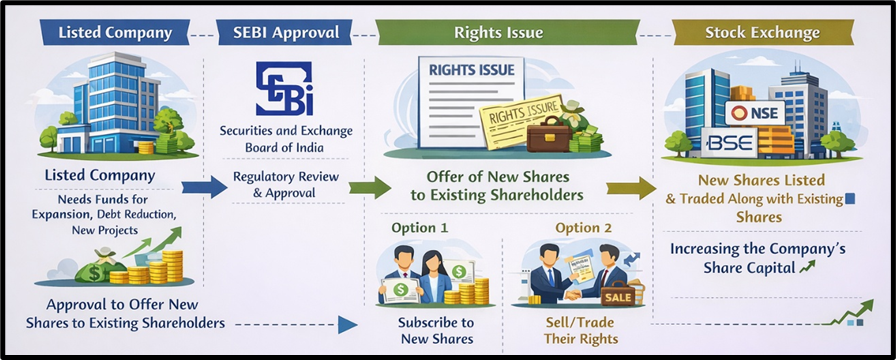
Suppose a company wants to raise capital but does not want to dilute the ownership of existing shareholders significantly.
In that case, it offers shares first to existing shareholders.
This is called a Rights Issue.
Concept
A Rights Issue allows existing shareholders to buy additional shares before the company offers them to the public.
These shares are usually offered at a discounted price.
Example: 1:3 Rights Issue
If the company announces a 1:3 rights issue:
- For every 3 shares held, the shareholder can buy 1 additional share.
Shareholders have following options
- Exercise the right → Buy the additional shares.
- Ignore the right → Do nothing.
- Sell the right → Transfer the right to another investor.
Example
Tata Motors Limited launched a rights issue in 2021.
- Shares were offered at ₹150 per share.
- Around 10% discount from market price.
- Funds were used for debt repayment and growth plans.
Thus, Rights Issue = Additional shares offered to existing shareholders first.
Debt and Equity: The Two Ways of Raising Capital
Whenever companies raise funds from capital markets, they typically use two broad instruments:
- Debt
- Equity
Let us understand them.
Debt
Debt means borrowing money. The company promises to repay the principal amount with interest.
Examples include:
- Bonds
- Debentures
- Money market instruments
- Bank loans
Key Features
- Investors receive fixed interest (coupon)
- Company must repay at maturity
- Debt holders do not own the company
Equity
Equity represents ownership in the company. When someone buys shares, they become a partial owner of the company.
Key Features
- Returns come from:
- Dividends
- Capital appreciation
- No mandatory repayment
- Shareholders may get voting rights
Key Differences Between Debt and Equity
| Aspect | Debt | Equity |
|---|---|---|
| Nature | Loan or borrowing | Ownership in company |
| Return | Fixed interest (coupon) | Dividends + capital gains |
| Repayment | Must be repaid at maturity | No repayment obligation |
| Risk | Lower risk | Higher risk |
| Voting Rights | No voting rights | Voting rights usually available |
| Control | No control over management | Shareholders influence management |
| Priority in liquidation | Paid first | Paid after debt holders |
| Examples | Bonds, Debentures | Shares, Stocks |
Conceptual Summary
In the Primary Market, companies raise funds through different instruments depending on their situation:
- IPO → When a private company becomes public
- FPO → When a listed company raises additional capital
- Preferential Issue → Shares issued to select investors
- Rights Issue → Shares offered to existing shareholders
And broadly, the capital raised can be either:
- Debt (borrowed funds)
- Equity (ownership capital)
This article forms part of the broader Indian Economy syllabus for UPSC preparation.