
Foreign Exchange Reserves
When a country trades internationally, it earns and spends foreign currencies such as the US dollar, euro, yen, or yuan. However, global trade and finance are uncertain—exchange rates fluctuate, imports may suddenly increase, or external debts may need repayment.
To deal with such uncertainties, every country maintains a stock of international financial assets, known as Foreign Exchange Reserves (Forex Reserves). These reserves are held by the central bank (in India’s case, the Reserve Bank of India – RBI) and function as a financial safety cushion for the economy.
Let us understand this concept.
What are Foreign Exchange Reserves?
Foreign exchange reserves are the foreign currencies and reserve assets held by a country’s central bank.
Their primary purpose is to:
- Maintain stability in the foreign exchange market
- Ensure smooth international trade
- Manage Balance of Payments (BoP) shocks
- Maintain confidence in the domestic currency
In simple terms, forex reserves act like a country’s emergency savings in foreign currency.
For India, these reserves are managed by the RBI and include multiple assets such as foreign currencies, gold, Special Drawing Rights (SDRs), and the Reserve Tranche Position (RTP) in the IMF.
Relationship Between Forex Reserves and Balance of Payments (BoP)
Forex reserves change depending on whether the country is experiencing a BoP surplus or BoP deficit.
(A) When There is a BOP Surplus
A BoP surplus occurs when foreign currency inflows exceed outflows.
Examples of inflows:
- Exports of goods and services
- Foreign investment (FDI/FPI)
- External borrowings
- Remittances
When this happens:
- Excess foreign currency enters the economy.
- The central bank purchases this foreign currency from the market.
- In return, it releases domestic currency.
This process leads to an increase in forex reserves.
Why does the central bank do this?
If the central bank does not absorb the excess foreign currency, the domestic currency may appreciate sharply, which can harm exports.
Therefore, accumulating reserves helps in:
- Exchange rate management
- Creating a buffer for future economic shocks
These reserves can later be used to:
- Pay for imports
- Service external debt
- Handle future BoP deficits
(B) When There is a BOP Deficit
A BoP deficit occurs when foreign currency outflows exceed inflows.
Examples:
- Large import bills
- Capital outflows
- High external debt repayments
In such a situation:
- The demand for foreign currency rises.
- The domestic currency may depreciate sharply.
- The central bank intervenes by selling foreign currency from its reserves.
This helps to:
- Stabilize the exchange rate
- Prevent excessive currency depreciation
- Maintain confidence in the economy
What Happens if Forex Reserves Fall Too Much?
If the deficit persists and reserves deplete significantly, serious problems can arise:
- Currency crisis
- Difficulty in paying for essential imports
- Inability to repay external debt
- Loss of investor confidence
In extreme cases, countries may need:
- IMF assistance
- Policy reforms
- External borrowing
Import Cover
An important indicator of external sector strength is Import Cover.
Import cover means: The number of months a country can continue importing goods and services using its existing forex reserves.
Higher import cover indicates greater economic resilience.
For example, → If India has reserves sufficient for 10 months of imports, its import cover is 10 months.
Components of Foreign Exchange Reserves
India’s forex reserves consist of four major components:
- Foreign Currency Assets (FCA)
- Gold Reserves
- Special Drawing Rights (SDRs)
- Reserve Tranche Position (RTP) in IMF
Let us understand each one in detail.
Foreign Currency Assets (FCA)
This is the largest component of forex reserves. It consists of holdings of foreign currencies, such as → US Dollar, Euro, Japanese Yen, Chinese Renminbi, British Pound
These assets are usually invested in safe government securities of advanced economies, such as US Treasury bonds.
How Do Central Banks Accumulate Foreign Currency?
There are three major ways.
(1) Trade Surplus
If a country exports more than it imports, it earns foreign currency.
Example:
- India exports IT services to Europe.
- Payment is received in euros.
- The RBI may acquire these euros and add them to reserves.
(2) Capital Inflows
Foreign investors bring foreign currency when they invest in India.
Examples:
- Foreign Direct Investment (FDI)
- Foreign Portfolio Investment (FPI)
The RBI may purchase these currencies and add them to reserves.
(3) International Borrowing
When a country borrows from International financial institutions and Global bond markets, the loan proceeds come in foreign currency, which may increase reserves.
Role of Foreign Currency Assets
Foreign currencies in reserves serve several purposes:
1. Exchange Rate Stability
The central bank can buy or sell foreign currency to stabilize the exchange rate.
Example: If the rupee depreciates sharply, the RBI may sell dollars in the forex market.
2. Facilitating International Trade
Imports are typically paid in foreign currency.
Example: India imports crude oil from Saudi Arabia and pays using foreign currency.
3. Meeting External Obligations
Forex reserves are used to:
- Repay external debt
- Pay interest on foreign borrowings
4. Building Global Confidence
Large reserves reassure → Foreign investors, international lenders and Trading partners.
It signals that the country can meet its international financial commitments.
Gold Reserves
Another important component is gold held by the central bank. Gold reserves consist of physical gold bars or coins stored securely in vaults.
Central banks hold gold for several strategic reasons.
(1) Store of Value
Gold is considered a stable store of value.
Unlike paper currency, gold:
- Cannot be printed
- Has limited supply
- Retains value over long periods
(2) Universal Acceptance
Gold is accepted globally. If a country faces a shortage of foreign currency, it can sell gold in international markets to obtain foreign exchange.
(3) Confidence in the Monetary System
Gold holdings strengthen the credibility of the central bank. They signal that the country has tangible reserve assets, increasing trust in the currency.
(4) Crisis Hedge
During economic crises:
- Currencies may depreciate
- Financial markets may become unstable
Gold often retains value or appreciates, making it a safe-haven asset.
Example
If India accumulates large foreign currency reserves, the RBI may diversify its reserves by purchasing gold.
If a future crisis occurs, the RBI can sell part of its gold reserves to obtain foreign currency and stabilize the economy.
Special Drawing Rights (SDRs)
Special Drawing Rights (SDRs) are an international reserve asset created by the International Monetary Fund (IMF).
Important point: SDRs are not a physical currency.
They are an accounting unit used in international financial transactions between central banks and the IMF.
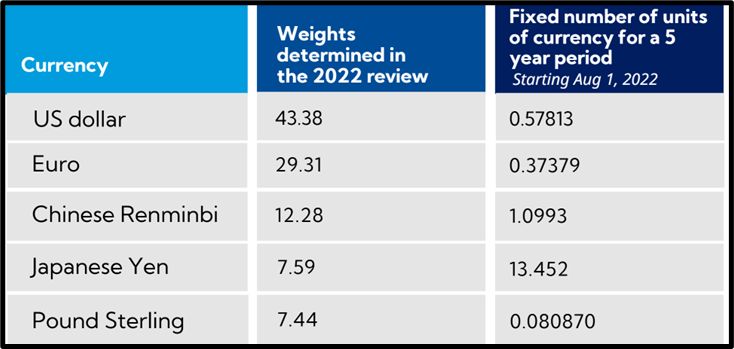
How Is the Value of SDR Determined?
The value of SDR is based on a basket of major global currencies, including → US Dollar, Euro, Chinese Yuan, Japanese Yen, British Pound
The IMF periodically reviews the weights of these currencies.
How Do SDRs Work?
Suppose, India receives SDRs worth $5 billion from the IMF. These SDRs represent India’s claim on foreign currencies held by other IMF members.
If India suddenly needs foreign currency:
- India can exchange SDRs with another IMF member country.
- In return, it receives actual foreign currency such as euros or dollars.
Thus, SDRs help maintain international liquidity. They are also used as a unit of account for international organizations.
Reserve Tranche Position (RTP)
The Reserve Tranche Position represents the portion of a country’s IMF quota that it can withdraw without conditions.
Understanding IMF Quotas
Each IMF member country is assigned a quota, based on the size of its economy.
This quota determines:
- Financial contribution to the IMF
- Voting power
- Access to IMF funds
Example: India
Suppose: India’s IMF quota = $10 billion
Generally, about 25% of this quota is the Reserve Tranche Position.
So, RTP ≈ $2.5 billion
Important Concept
The RTP is not actual reserves held by India. Instead, it represents a potential claim on IMF resources.
If India faces a Balance of Payments crisis, it can immediately withdraw this amount from the IMF.
This access is almost automatic and without strict conditions, unlike other IMF lending programs. However, the country must cooperate with the IMF and eventually repay the funds.
Overall Importance of Forex Reserves
Foreign exchange reserves play a critical role in macroeconomic stability.
They help a country to:
- Manage Balance of Payments imbalances
- Stabilize exchange rates
- Maintain investor confidence
- Ensure uninterrupted imports
- Handle financial crises
Therefore, forex reserves function as a nation’s economic insurance against external shocks.
✅ In essence:
Foreign exchange reserves are the financial shield that protects a country’s economy from external instability, ensuring that international trade, currency stability, and economic confidence remain intact even during global uncertainties.
To explore all Indian Economy topics in a structured manner, visit the complete Indian Economy UPSC Notes page.
3 Comments