
Exchange Rate
To understand Exchange Rate, imagine the global economy as a vast marketplace where every country uses its own currency. Since currencies are different, there must be a conversion mechanism that tells us how much of one currency equals another. That mechanism is called the Foreign Exchange Rate.
Meaning of Exchange Rate
A Foreign Exchange Rate refers to the rate at which one country’s currency can be exchanged for another country’s currency.
In simple terms, it is the price of one currency expressed in terms of another currency.
Example
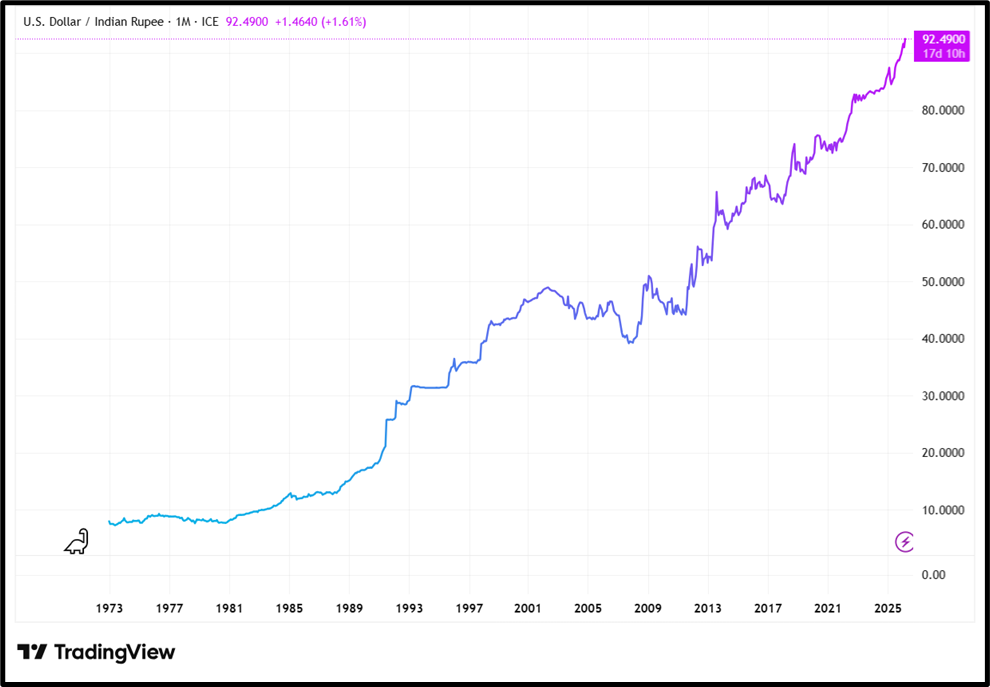
Suppose: 1 US Dollar = ₹83
This means that to obtain 1 dollar, an Indian citizen must give ₹83.
Thus, the exchange rate determines the purchasing power of one currency relative to another.
Why Exchange Rate is Important
Exchange rates are extremely important because countries constantly interact economically with each other. These interactions include:
- International trade (imports and exports)
- Foreign investment
- Tourism
- International loans and payments
Illustration
Consider two simple situations:
1. Travel Example
If an Indian citizen travels to the United States, they cannot spend Indian Rupees there. They must convert rupees into US Dollars at the prevailing exchange rate.
2. Import Example
If an Indian company imports machinery from Japan, it must pay the Japanese exporter in Japanese Yen. Therefore, the Indian firm converts Rupees into Yen using the exchange rate.
Thus, exchange rates are the backbone of international economic transactions.
Where Exchange Rates are Determined
Exchange rates are determined in the Foreign Exchange Market (Forex Market).
The Forex market is a global marketplace where currencies are bought and sold by → Commercial banks, Central banks, Corporations, Governments, Traders and investors
Just like the price of any commodity, the value of a currency depends on demand and supply.
Factors Influencing Exchange Rates
Exchange rates constantly fluctuate because the demand and supply of currencies keep changing.
Major factors include:
1. Supply and Demand
If demand for a currency rises, its value appreciates.
If supply rises, its value depreciates.
Example:
If many countries want to buy Indian goods, they must buy Rupees, increasing its demand and raising its value.
2. Economic Conditions
Strong economic growth increases confidence in a currency.
3. Interest Rates
Higher interest rates attract foreign investors, increasing demand for that currency.
4. Inflation
High inflation weakens a currency because its purchasing power declines.
5. Political Stability
Stable governments attract investment, strengthening the currency.
6. Market Sentiment
Expectations of investors also influence exchange rates.
Government and Central Bank Intervention
Sometimes governments do not leave exchange rates entirely to the market.
Central banks may intervene by:
- Buying foreign currency
- Selling foreign currency
- Changing monetary policy
- Imposing capital controls
For example, in India, the Reserve Bank of India (RBI) may intervene in the forex market to stabilize the Indian Rupee.
Types of Exchange Rate Systems
Economists broadly classify exchange rate systems into three major categories:
- Fixed Exchange Rate System
- Flexible Exchange Rate System
- Managed Floating Exchange Rate System
Let us understand each of them carefully.
Fixed Exchange Rate System
In a Fixed Exchange Rate System, the government fixes the value of its currency relative to another currency or a standard like gold.
This means the exchange rate does not fluctuate freely. Instead, the government or central bank actively intervenes in the foreign exchange market to maintain the fixed value.
Because the currency is tied to another currency, this system is also called a Pegged Exchange Rate System.
The fixed value is known as the Parity Value.
Historical Examples of Fixed Exchange Rate
1. Gold Standard System (1870–1914)
Under this system:
- Countries defined their currencies in terms of gold.
- Each currency had a fixed gold content.
Exchange rates were determined by comparing the gold content.
Example:
- 1 UK Pound = 5 grams of gold
- 1 US Dollar = 2 grams of gold
Therefore,
£1 = 5/2 dollars
£1 = $2.5
Thus, exchange rates were automatically determined by gold.
2. Bretton Woods System (1944–1971)
After World War II, a new international monetary system was created at the Bretton Woods Conference.
Key features:
- The US Dollar became the global reserve currency
- Other countries fixed their currencies to the US Dollar
- The US Dollar itself was pegged to gold
So indirectly, all currencies were tied to gold through the US Dollar. The International Monetary Fund (IMF) was created to supervise this system.
However, the system collapsed in 1971, leading to the adoption of flexible exchange rates.
Merits of Fixed Exchange Rate System
- Exchange rate stability
Stable exchange rates encourage international trade and investment. - Inflation control
Governments can better manage inflation. - Reduced speculation
Since exchange rates are fixed, currency speculation reduces. - Encourages capital movement
Investors face less uncertainty regarding currency value. - Prevents capital flight
Predictable currency value discourages sudden outflows.
Demerits of Fixed Exchange Rate System
- Requires large foreign exchange reserves
Governments must hold large reserves to maintain the peg. - Currency misalignment
The currency may become overvalued or undervalued. - Restricts free market forces
Government intervention distorts natural price discovery. - Limits policy flexibility
Countries may struggle during recessions or economic crises.
Flexible Exchange Rate System
A Flexible Exchange Rate System (also called Floating Exchange Rate System) is one in which the exchange rate is determined purely by market forces of demand and supply.
The government does not fix or control the exchange rate. Instead, the market determines the equilibrium exchange rate.
This equilibrium rate is also known as:
- Equilibrium rate
- Par rate
- Normal rate of foreign exchange
How It Works
If demand for a currency increases: → the currency appreciates
If demand decreases: → the currency depreciates
Example:
If India’s exports increase, foreign buyers need more Rupees, so demand for rupees rises and the rupee may appreciate.
Merits of Flexible Exchange Rate System
- No need for large reserves
Governments do not need to maintain large forex reserves. - Correct valuation
The currency reflects true market value. - Efficient resource allocation
Markets determine the best allocation of resources. - Automatic adjustment
The system adjusts automatically to economic shocks.
Demerits of Flexible Exchange Rate System
- Encourages speculation
Traders may speculate on currency movements. - Exchange rate volatility
Constant fluctuations create uncertainty. - Policy coordination challenges
Managing macroeconomic policies becomes complex.
Managed Floating Exchange Rate System
A Managed Floating Exchange Rate System is a hybrid system combining elements of both fixed and flexible exchange rates.
In this system:
- Exchange rates are primarily determined by market forces
- But the central bank occasionally intervenes to stabilize extreme fluctuations.
India follows this system.
Example: Managed Floating in India
Suppose the RBI wants the exchange rate to remain around: $1 = ₹80
It allows fluctuations between: ₹78 – ₹82
Case 1: Rupee Depreciates Too Much
If the rupee falls below ₹78 per dollar, it means:
→ Demand for dollars is high
→ Rupee supply is excessive
RBI intervenes by selling dollars and buying rupees, strengthening the rupee.
Case 2: Rupee Appreciates Too Much
If the rupee rises above ₹82 per dollar, RBI buys dollars, releases rupees. This prevents excessive appreciation.
Thus, the RBI smooths out extreme volatility without completely controlling the exchange rate.
Dirty Floating
If a country manipulates exchange rates without following international norms, it is called Dirty Floating.
In contrast, in a managed float, the central bank follows transparent and regulated interventions.
Other Exchange Rate Systems
Over time, different hybrid systems have evolved.
1. Adjustable Peg System
Currencies are fixed for a certain period but can be repegged if necessary.
This adjustment may involve:
- Devaluation → lowering currency value
- Revaluation → increasing currency value
2. Wider Band System
Countries allow exchange rates to fluctuate within a band (range) around the parity value.
Example: ±10% variation allowed to correct Balance of Payments imbalances.
3. Crawling Peg System
This system lies between fixed and floating systems.
Key features:
- A parity value is fixed
- Small variations are allowed
- The parity is adjusted periodically based on economic indicators like:
- International reserves
- Inflation
- Money supply
Devaluation/Revaluation vs Depreciation/Appreciation
| Basis | Devaluation / Revaluation | Depreciation / Appreciation |
|---|---|---|
| Meaning | A deliberate decrease or increase in the value of domestic currency by the government relative to foreign currencies. | A fall or rise in the value of domestic currency caused by market forces of demand and supply. |
| Exchange Rate System | Occurs under a Fixed Exchange Rate System. | Occurs under a Flexible Exchange Rate System. |
| Who Causes It | Government or Central Bank decision. | Foreign exchange market forces. |
Simple Way to Remember (UPSC trick)
- Government decision → Devaluation / Revaluation
- Market forces → Depreciation / Appreciation
Devaluation
Devaluation refers to a deliberate reduction in the value of a country’s currency by the government.
Example: Suppose earlier → $1 = ₹70
Government changes the rate to → $1 = ₹85
This means the Rupee has been devalued. This policy is used to make exports cheaper and imports costlier.
Revaluation
Revaluation is the deliberate increase in the value of the domestic currency under a fixed exchange rate system.
Example:
If the government changes the exchange rate from: $1 = ₹80 → $1 = ₹70
This means the Rupee has been revalued.
Depreciation
Depreciation occurs when the value of a currency falls automatically due to market forces.
Example:
If market demand for the Rupee falls: $1 = ₹80 → $1 = ₹88
The rupee has depreciated. No government action is involved.
Appreciation
Appreciation occurs when the currency becomes stronger in the foreign exchange market.
Example:
If demand for the Rupee rises: $1 = ₹80 → $1 = ₹72
The rupee has appreciated.
Pros (Advantages) of Currency Devaluation
Governments sometimes deliberately devalue their currency to achieve economic objectives.
1. Boosts Export Competitiveness
When a currency is devalued, exports become cheaper for foreign buyers.
Example:
If ₹ weakens, Indian goods become cheaper in dollar terms, making them more attractive globally.
This increases → Export demand, Production, Employment
2. Increases Tourism
Foreign tourists can now buy more local currency with their own currency.
Example:
A US tourist visiting India can spend fewer dollars for the same services, making the destination cheaper.
This boosts → Tourism industry, Hospitality sector and Foreign exchange earnings
3. Helps Reduce Trade Deficit
Devaluation makes → Exports cheaper and Imports costlier
Thus:
- Exports increase
- Imports decrease
This helps reduce the Trade Deficit.
4. Supports Domestic Industries
When imports become expensive: Consumers shift to domestically produced goods
This encourages:
- Local manufacturing
- Employment generation
- Industrial growth
Cons (Disadvantages) of Currency Devaluation
While devaluation can help exports, it also creates several challenges.
1. Higher Import Costs
Imports such as crude oil, machinery, electronics and raw materials become expensive. This can lead to inflation.
2. Capital Flight
Foreign investors may lose confidence in the currency and move their funds to safer economies. This is called capital flight.
Consequences include → fall in stock markets, reduction in foreign investment and financial instability
3. Increase in External Debt Burden
Many countries borrow money in foreign currencies (like USD).
If the domestic currency weakens, more local currency is needed to repay the same loan.
Example:
Loan = $1 billion
If:
- $1 = ₹70 → repayment = ₹70 billion
- $1 = ₹85 → repayment = ₹85 billion
Thus, the debt burden increases.
4. Damage to International Credibility
Frequent devaluation may signal that the economy is weak and the currency is unstable
This reduces investor confidence and affects international reputation.
J-Curve Effect
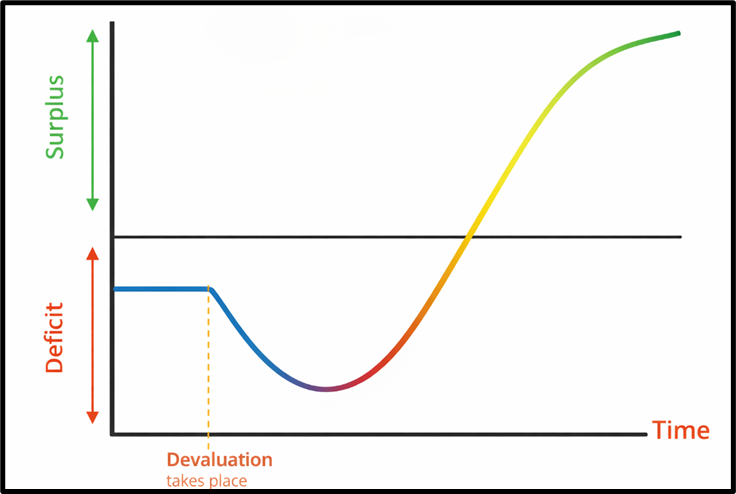
One of the most interesting concepts related to currency depreciation or devaluation is the J-Curve Effect. It describes how a country’s trade balance behaves after its currency depreciates.
What Happens After Currency Depreciation?
When a currency weakens:
- Exports become cheaper
- Imports become more expensive
Ideally, this should improve the trade balance.
But in reality, something different happens initially.
Short-Term Impact: Trade Balance Worsens
Immediately after depreciation:
- Import prices rise instantly
- Export volumes do not increase immediately
Why?
Because:
- Export contracts take time
- Foreign buyers need time to respond
- Production cannot increase instantly
Therefore:
- Import bills rise quickly
- Export earnings increase slowly
Result: Trade deficit temporarily increases.
Long-Term Impact: Trade Balance Improves
After some time:
- Foreign demand for cheaper exports rises
- Domestic consumers reduce imports
- Local industries increase production
Gradually:
- Exports increase
- Imports decrease
This improves the trade balance.
Why It is Called the J-Curve
If we graph Trade Balance vs Time, the pattern looks like the letter “J”.
- Initial fall in trade balance
- Gradual recovery and improvement
So the curve first goes down, then rises upward, forming a J-shaped curve.
Conditions for the J-Curve to Work
The J-curve effect does not occur automatically. Its success depends on several factors:
- Elasticity of Demand
Foreign buyers must respond to cheaper exports.- Industrial Competitiveness
Domestic industries must be able to increase production.
- Availability of Domestic Substitutes
Consumers should be able to replace imports with local goods.
- Global Economic Conditions
Strong global demand helps exports grow faster.
- Industrial Competitiveness
NEER (Nominal Effective Exchange Rate)
The Nominal Effective Exchange Rate (NEER) measures the average value of a country’s currency relative to a basket of other currencies.
Instead of comparing the Indian Rupee with only one currency (like the US Dollar), NEER compares the Rupee with multiple currencies of major trading partners.
This is important because India trades with many countries, not just one.
Thus, NEER gives a broader picture of how the rupee performs globally.
Why NEER is Needed
Suppose we only track ₹ vs $ (US Dollar)
But India also trades heavily with → Eurozone, China, Japan, UK, UAE and Singapore
If the rupee strengthens against the dollar but weakens against other currencies, looking at only one exchange rate would give a misleading picture.
Therefore, economists construct NEER using a basket of currencies.
How RBI Calculates NEER
The Reserve Bank of India (RBI) calculates NEER using a systematic process.
Step 1: Selecting a Currency Basket
The RBI chooses currencies of major trading partners.
Currently, RBI uses:
- 6-currency basket
- 40-currency basket
The larger basket gives a more comprehensive global comparison.
Step 2: Assigning Weights
Each currency is assigned a weight based on India’s trade share with that country
Example: If India trades more with the USA than Japan, the US Dollar gets higher weight.
Thus, currencies of more important trading partners influence the index more.
Step 3: Calculating Bilateral Exchange Rates
The RBI collects data for the exchange rate between Indian Rupee and each currency in the basket
For example:
- ₹ vs USD
- ₹ vs Euro
- ₹ vs Yen
- ₹ vs Pound
These are called bilateral exchange rates.
Step 4: Computing the NEER Index
Finally, a weighted average of these bilateral exchange rates is calculated.
This gives the NEER index.
Interpretation of NEER
NEER helps understand whether the currency is strengthening or weakening overall.
- NEER increases (appreciates)
→ The domestic currency is strengthening against the basket of currencies - NEER decreases (depreciates)
→ The domestic currency is weakening against the basket
However, NEER has a limitation. It does not consider inflation differences between countries.
That is where REER becomes important.
REER (Real Effective Exchange Rate)
The Real Effective Exchange Rate (REER) improves upon NEER.
While NEER measures nominal exchange rate movements, REER also considers price levels or inflation differences between countries. Thus, REER provides a more realistic measure of international competitiveness.
In simple words:
REER = NEER adjusted for inflation differences
Why Inflation Adjustment is Necessary
Suppose two countries have the same exchange rate movement. But if one country has higher inflation, its goods become more expensive.
Even if the exchange rate remains stable, that country may lose export competitiveness. Therefore, economists adjust exchange rates for inflation differentials.
That adjustment produces REER.
How RBI Calculates REER
The process involves two main steps.
Step 1: Calculate NEER
The NEER index is first computed using the currency basket and trade weights.
Step 2: Adjust for Inflation Differences
The RBI adjusts NEER using relative price levels between India and trading partners. This incorporates inflation differentials.
Currently, the base year used by RBI is 2015–16.
Interpretation of REER
REER indicates whether a currency is overvalued or undervalued.
If REER increases
The domestic currency becomes overvalued.
This means:
- Domestic goods become relatively expensive
- Export competitiveness decreases
- Imports become cheaper
If REER decreases
The domestic currency becomes undervalued.
This means:
- Exports become more competitive
- Domestic goods are cheaper internationally
- Trade balance may improve
Importance of NEER and REER for Policymakers
These indices are extremely important tools for:
- Central banks
- Government policymakers
- Economic analysts
They help in:
- Monitoring currency competitiveness
- Evaluating external sector stability
- Formulating monetary policy
- Designing trade policy
- Assessing exchange rate misalignment
The RBI regularly tracks NEER and REER to understand how the Indian Rupee behaves in the global economy.
Purchasing Power Parity (PPP) Exchange Rate
Another important concept used to compare currencies is Purchasing Power Parity (PPP).
PPP states that:
Exchange rates between two countries should equalize the purchasing power of their currencies.
In other words, after currency conversion, the same basket of goods should cost the same in both countries.
Understanding PPP with an Example
Suppose we compare the price of a standard basket of goods in two countries.
| Country | Price of Basket |
| United States | $20 |
| India | ₹1000 |
Now calculate PPP.
If: $20 = ₹1000, Then: 1 USD = ₹50 (PPP exchange rate)
This means ₹50 should equal the purchasing power of $1.
Market Exchange Rate vs PPP
However, the actual exchange rate in the forex market may be different.
Example: Market exchange rate: 1 USD = ₹80
But PPP rate: 1 USD = ₹50
This means the Indian Rupee is undervalued.
Why?
Because with the same dollar you can buy more goods in India than in the USA.
Why PPP Exchange Rate Matters
PPP is used for:
- Comparing living standards across countries
- International income comparisons
- Global economic statistics
- GDP comparisons by institutions like the World Bank and IMF
For example, when economists say, India is the third largest economy in PPP terms they mean GDP adjusted for purchasing power, not nominal exchange rates.
To explore all Indian Economy topics in a structured manner, visit the complete Indian Economy UPSC Notes page.