
Asbestos
Asbestos refers to a group of six naturally occurring fibrous silicate minerals, known for their extreme durability and resistance.
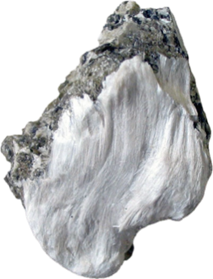
These minerals are not one single mineral, but a category defined by their fibrous crystal structure.
Key Physical Properties:
| Property | Importance |
|---|---|
| Fibrous texture | Can be woven into cloth or rope. |
| Flexibility & Tensile Strength | Strong yet bendable — ideal for industrial use. |
| Resistant to Heat, Electricity, and Acids | Makes it fireproof, insulating, and chemically durable. |
Due to these properties, asbestos became known as a “miracle material” — especially in the early industrial era.
Types of Commercial Asbestos
Asbestos is classified into two broad groups:
| Group | Type | Characteristics |
|---|---|---|
| Serpentine | Chrysotile (White Asbestos) | Curly fibres, flexible, most widely used, superior properties |
| Amphibole | Includes amosite, crocidolite, tremolite, etc. | Straight, needle-like fibres, more brittle, less used commercially |
Among these, Chrysotile accounts for nearly 95% of asbestos used worldwide due to its superior workability and performance.
Formation of Asbestos
Asbestos forms through metamorphic and hydrothermal processes:
Metamorphism of Ultramafic Igneous Rocks:
- Rocks like serpentine and soapstone, when subjected to heat and pressure, reorganise their atomic structure into fine, fibrous crystals — forming asbestos.
Hydrothermal Alteration:
- When hot, mineral-rich fluids percolate through ultramafic rocks, they chemically alter the minerals, leading to asbestos formation.
So, asbestos is geologically linked with ultramafic rocks — rocks rich in magnesium and iron.
Applications of Asbestos
Because of its fireproofing and insulating properties, asbestos was widely used in industries:
| Sector | Use |
|---|---|
| Textile | Fireproof cloth, rope, padding |
| Construction | Asbestos cement sheets, pipes, floor tiles — low-cost and fire-resistant |
| Shipbuilding and Insulation | Used in boilers, furnaces, engines, etc., due to high thermal resistance |
⚠️ Health Concern:
It’s worth noting that asbestos is now globally controversial due to its links with asbestosis, lung cancer, and mesothelioma. Hence, many countries have banned or restricted its use.
Global Distribution of Asbestos
The world’s asbestos resources are highly concentrated:
| Country | Role |
| Russia | Largest producer and exporter |
| China | Major producer |
| Brazil | Holds significant reserves |
| Kazakhstan | Active producer |
These four countries account for 99% of global asbestos reserves.
Asbestos in India – Resources & Trade
✅ Reserves (2020):
22.90 million tonnes
| State | Share of Resources |
| Rajasthan | 59% |
| Karnataka | 36% |
| Others (Jharkhand, AP, Odisha, Uttarakhand) | Minor |
👉 Rajasthan and Karnataka dominate India’s geological endowment of asbestos.
❌ Production:
No asbestos production reported in 2022–23.
Why? Because of environmental and health concerns, India has stopped mining asbestos, but still imports it.
📦 Imports:
| Source Country | Share of Imports |
| Russia | 63% |
| Brazil | 21% |
| Kazakhstan | 16% |
📝 Despite health risks, India imports asbestos for limited industrial and construction use.
✅ Conclusion
Asbestos is a classic example of:
- A geologically unique fibrous mineral
- Once hailed for industrial utility
- Now restricted due to health and environmental externalities
It is a mineral that lies at the intersection of geology, economy, public health, and international trade