
Author: CDH

  • Development – A Governance Perspective

    When we talk about development, we must first clear a common misunderstanding. Development is not merely economic growth, not just GDP numbers, highways, or factories. According to the United Nations, development is a comprehensive economic, social, and political process aimed at improving the overall quality of life of people. In simple terms—development is about people….
  • Aspirational Districts Programme (ADP)

    Overview Aspect Aspirational Districts Programme (ADP) Aspirational Blocks Programme (ABP) Launch January 2018 by the Hon’ble Prime Minister January 2023 by the Hon’ble Prime Minister Coverage 112 districts 500 blocks Objective Accelerate development of relatively backward and remote districts Achieve saturation of essential government services at the block level Approach Outcome-based, competitive, and cooperative governance…

  • NITI Aayog in Governance

    What Makes NITI Aayog Successful Decentralized Planning Evidence-Based Policymaking Long-Term Vision Cooperative and Competitive Federalism Expert-Driven Approach Monitoring and Evaluation Driving Innovation NITI Aayog: Challenges, Solutions, and Contemporary Examples 1. Limited Influence 2. Financial Constraints 3. Socioeconomic Concerns 4. Questionable Neutrality 5. Data Transparency Issues Major Initiatives / Steps by NITI Aayog A. Economic Development…

  • Planning in Governance

    What is Planning in Governance? At the most basic level, planning is about foresight. In governance, planning means: So, planning is not just budgeting or writing reports. It is a systematic, organized, and future-oriented exercise through which the state tries to shape development outcomes—economic growth, social justice, and regional balance. In short: Policy decides “what”…

  • Public Policy

    What is a Public Policy? At its core, a policy is a plan of action. It is not just an idea or intention, but a deliberate course chosen to achieve specific goals. Now, when the government makes such plans, they are called Public Policies. In simple words: Public policy answers three fundamental questions:What will be…

  • Local Governance in India

    You have already studied the 73rd and 74th Constitutional Amendments in detail under Indian Polity. In this section, we are not repeating the constitutional provisions, but revisiting Local Governance from a Governance lens—focusing on decentralization, participation, accountability, service delivery, and outcomes. The notes are structured in a Mains-ready format, so that you can directly reproduce…

  • Governance in India

    When we talk about Governance in India, we must understand that India is large, diverse, federal, and democratic. Therefore, governance here cannot be one-dimensional. Recognising this complexity, the Department of Administrative Reforms and Public Grievances (DARPG), in its report “State of Governance – A Framework of Assessment”, breaks governance into five interrelated dimensions. Dimensions of…

  • Introduction to Governance

    What is Governance? When we hear the word government, we usually think of ministers, officers, laws, and offices.But governance is much wider than government. According to the United Nations Development Programme (UNDP, 1997), governance is: The exercise of economic, political, and administrative authority to manage a country’s affairs at all levels. This definition highlights three…

  • SDG Related Reports and Indices

    UN Sustainable Development Report According to the UN Sustainable Development Solutions Network‘s 10th Sustainable Development Report (SDR) 2025, India ranks 99th in the Sustainable Development Goals (SDG) Index, marking its first time in the top 100 out of 167 countries with a score of 67.  Key Findings of the 10th Sustainable Development Report (SDR) 2025 SDG India Index Key Highlights of the SDG India Index for 2023-24

  • |

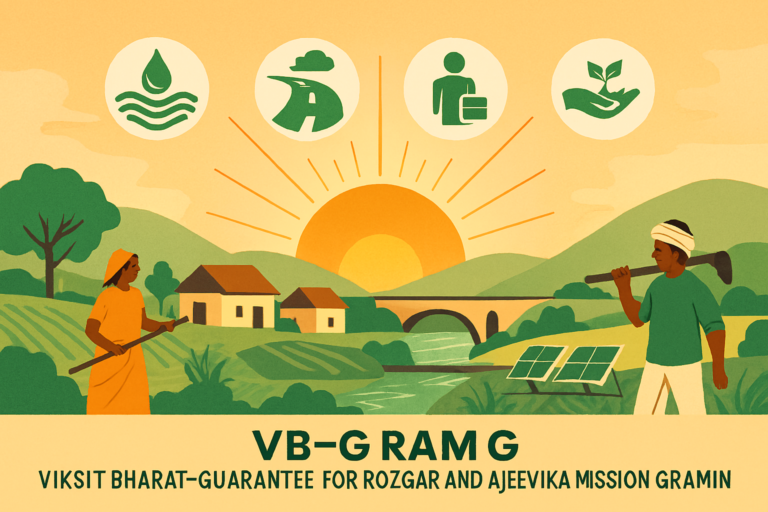
    VB–G RAM G

    The Starting Point: Why Rural Employment Matters India has always been a rural-majority country. Even today, a significant portion of the population depends directly or indirectly on agriculture. After Independence, three major problems existed in rural India: So the State gradually moved towards wage employment programmes — not just as poverty relief, but as a…