
Commercial Dairy Farming
Commercial dairy farming refers to the specialised and scientific rearing of milch animals (animals that produce milk), with the primary objective of producing milk and milk products for sale.
Unlike subsistence livestock rearing, this system is market-oriented, technologically advanced, and runs 365 days a year, without any offseason.
🏭 Key Characteristics
✅ Highly Capital-Intensive
- Huge investment is required in:
- Animal sheds for shelter
- Feeding and milking machines
- Fodder storage facilities
- Cold storage and transport systems
- In simple terms, think of it like a milk factory that runs continuously and needs both machines and skilled labour.
✅ Advanced Animal Care
- Special focus is given to:
- Cattle breeding for high-yielding varieties
- Veterinary care for health and productivity
- Balanced feeding to maintain milk quality
- This scientific management helps ensure maximum output with minimal wastage.
✅ Labour-Intensive
- Despite all the machines, human effort is still critical—particularly in feeding, cleaning, and monitoring animal health.
- Milking (though mechanised) still requires close supervision and hygiene maintenance.
✅ Continuous Activity
- Unlike crop farming which depends on seasons, dairy farming operates year-round.
- This makes it both demanding and economically rewarding, provided proper infrastructure is in place.
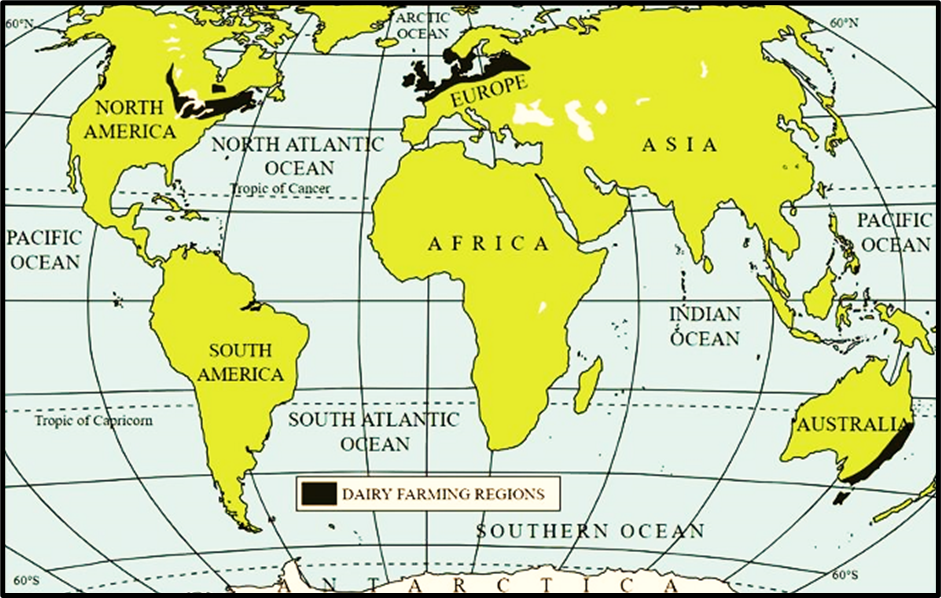
🧭 Where Is It Practised?
Commercial dairy farming is most successful in developed regions where:
- There’s good infrastructure (roads, electricity, cold chains),
- And a strong urban market for milk and dairy products.
🗺️ Major regions include:
| Rank | Region | Countries |
|---|---|---|
| 1️⃣ | North-Western Europe | Netherlands, Denmark, Germany |
| 2️⃣ | Canada | Especially in the southern provinces |
| 3️⃣ | Australia–New Zealand belt | Southeastern Australia, New Zealand, Tasmania |
These areas have all the right conditions: technological support, capital investment, and access to urban consumers.
🚚🧊 Supporting Technologies
Commercial dairy farming wouldn’t be possible at scale without modern technology:
- Refrigeration: Keeps milk fresh during transport.
- Pasteurisation: Eliminates bacteria and increases shelf life.
- Efficient transportation: Ensures timely delivery to markets.
- Preservation processes: Allow for global trade in cheese, butter, yogurt, etc.
These innovations have made fresh milk and dairy products accessible even to distant consumers, creating a global dairy economy.
📌 Real-World Analogy
Imagine a modern tech-enabled hospital—just like it runs 24×7 with doctors, nurses, machines, and labs, a commercial dairy farm functions continuously with animal specialists, machines, and cold chains. Every cow is treated like a productive unit that requires nutritional, medical, and operational care.
🧾 Summary Table
| Characteristic | Description |
|---|---|
| Purpose | Commercial milk production |
| Capital Requirement | Very high |
| Labour Requirement | High (daily care required) |
| Key Technologies | Pasteurisation, refrigeration, veterinary care |
| Animals | Specialised milch cattle (e.g. Holstein, Jersey) |
| Key Regions | NW Europe, Canada, SE Australia, New Zealand, Tasmania |
🌍 Conclusion
Commercial dairy farming represents:
- The most advanced form of livestock rearing
- A 24/7 agricultural enterprise
- Highly resource- and labour-intensive
- Integrated with technology, urban markets, and food supply chains
It stands in stark contrast to traditional or subsistence livestock systems and is vital for meeting the global demand for high-quality dairy products.