
Commercial Grain Farming
This is a form of commercial agriculture where the main crop is grain—particularly wheat, and to a lesser extent corn, barley, oats, and rye.
It is not grown for self-consumption but for sale in national and international markets.
📌 Key idea: This is “grain farming at industrial scale”—highly mechanised, covering vast tracts of land, and focused on global demand.
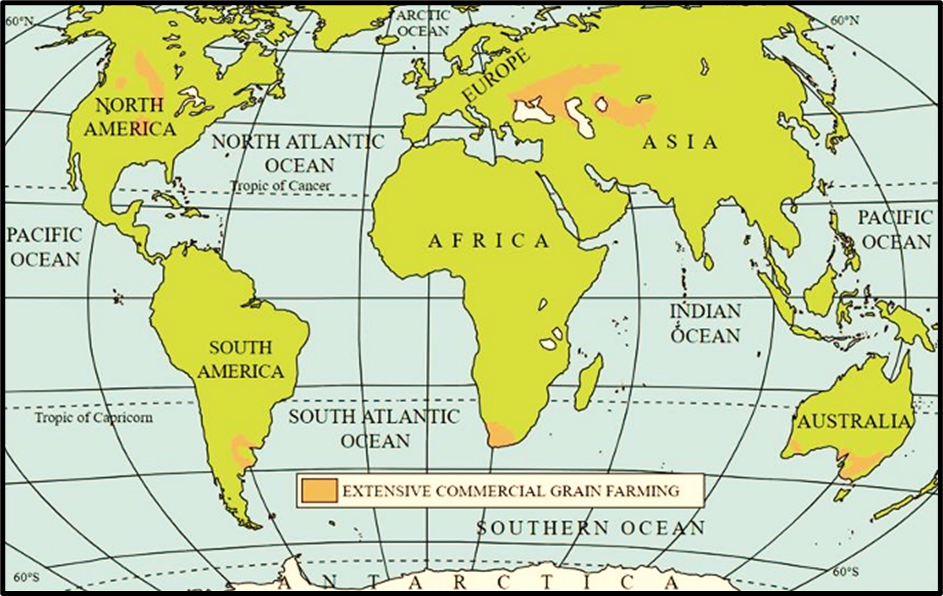
🧭 Where Is It Practised?
Commercial grain farming is typically found in the interior regions of semi-arid mid-latitudes—regions with moderate rainfall and flat terrain.
Let’s look at the major global zones:
| Region | Examples |
|---|---|
| Eurasian Steppes | Russia, Ukraine, Kazakhstan |
| North American Prairies | USA (Great Plains), Canada |
| Pampas of Argentina | Flatlands ideal for wheat and corn |
| Velds of South Africa | High plateaus suited for dryland crops |
| Australian Downs | South-eastern Australia |
| Canterbury Plains of New Zealand | South Island’s fertile plains |
📌 These areas are often called the world’s grain baskets.
🏭 Key Characteristics
Let’s understand what makes commercial grain farming unique:
| Feature | Explanation |
|---|---|
| Principal crop | Wheat is the dominant crop |
| Large-scale farms | Very large landholdings (hundreds to thousands of acres) |
| Highly mechanised | From ploughing to harvesting—everything is done using machines |
| Low yield per acre | Since land is abundant and soil is less fertile, yield per unit area is low |
| High yield per person | Due to heavy mechanisation, a small number of workers can handle large areas efficiently |
| Market-oriented | Crops are grown primarily for sale, not for personal consumption |
⚙️ Role of Mechanisation
Because the farms are so large, labour is not practical. So, every step—ploughing, sowing, irrigation, harvesting, and even storage—is done with the help of machines like:
- Tractors
- Combine harvesters
- Seed drills
- Sprayers
📌 Result? Even a small number of people can manage a massive farm efficiently.
🌍 Strategic Importance
Why is commercial grain farming crucial globally?
- It ensures food security by producing large quantities of staple grains.
- It makes countries like the USA, Canada, and Russia leading exporters of wheat and corn.
- These regions influence global food prices and trade flows.
🧾 Summary Table
| Characteristic | Details |
|---|---|
| Main Crop | Wheat (also corn, barley, oats, rye) |
| Location | Semi-arid midlatitudes |
| Farm Size | Very large |
| Labour Use | Minimal, replaced by machines |
| Market | Primarily commercial/export |
| Productivity | Low per acre, high per worker |
📌 Conclusion
Commercial Grain Farming is:
- A modern, mechanised system of agriculture
- Suited to vast, flat, semi-arid lands
- Focused on producing grains at a commercial scale
- Crucial to the global food trade
It represents a shift from labour-intensive farming to capital-intensive production, enabling a small workforce to feed large populations.