
Commercial Livestock and Crop Farming (Mixed Farming)
Mixed farming refers to a system where both crop cultivation and livestock rearing are practised on the same farm in a complementary manner.
The key idea here is integration: Crops support the animals (fodder), and animals support the crops (manure, income, labour in traditional settings).
This is a commercial and capital-intensive type of agriculture, unlike primitive systems where subsistence was the main goal.
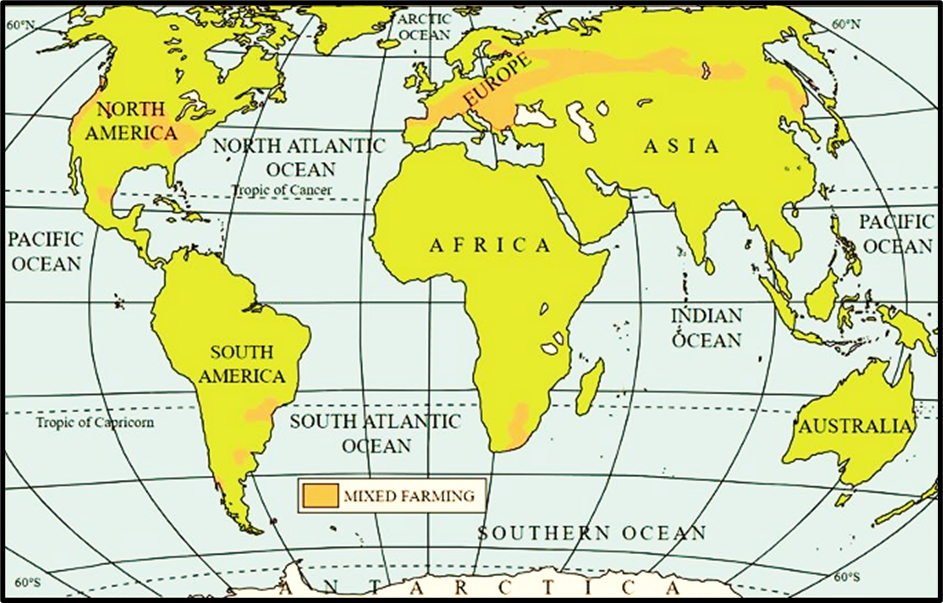
🧭 Where Is It Practised?
This system is widespread in highly developed regions of the temperate world:
| Region | Examples |
|---|---|
| North-western Europe | UK, France, Germany, Netherlands |
| Eastern North America | USA (Midwest), Canada |
| Southern continents (temperate zones) | South-east Australia, New Zealand, parts of South Africa |
These areas have favourable climatic conditions and technologically advanced agricultural infrastructure.
🌱🐑 Key Features of Mixed Farming
✅ Moderate Farm Size
- Unlike the vast ranches or grain farms, mixed farms are of moderate size—large enough for commercial operations, yet manageable.
✅ Dual Focus: Crops + Livestock
- Common crops: Wheat, barley, oats, maize, fodder crops, and root crops like potatoes and turnips.
- Common animals: Cattle (for milk), sheep (for wool), pigs and poultry (for meat and eggs).
📌 Insight: In many cases, livestock provides the major income, while crops provide stability and feed.
✅ Crop Rotation and Intercropping
- These practices are used to preserve soil fertility and break pest and disease cycles.
- For example, a farmer might alternate between wheat and a legume (like clover) to naturally restore nitrogen to the soil.
✅ High Capital Investment
- The farms are mechanised, requiring → Tractors, Harvesters, Storage facilities, Dairy or poultry sheds
- Use of chemical fertilisers, green manures, and veterinary care is extensive.
✅ Skilled Farmers
- This form of farming depends heavily on the knowledge and managerial skill of the farmer.
- Decision-making regarding market trends, breeding, rotation plans, and productivity is crucial.
🔄 Synergy Between Crops and Livestock
Mixed farming thrives on the mutual support between plant and animal components.
Manure from animals enriches the soil, while crops feed the animals—a closed-loop system that ensures sustainability and efficiency.
🧾 Summary Table
| Feature | Details |
|---|---|
| Main Regions | NW Europe, E North America, temperate Southern continents |
| Crops | Wheat, maize, fodder, root crops |
| Livestock | Cattle, sheep, pigs, poultry |
| Farm Size | Moderate |
| Capital Use | High (machinery, buildings, fertilisers) |
| Farming Skills | Essential for profitability |
| Environmental Practices | Crop rotation and intercropping |
🌍 Conclusion
Mixed Farming (Commercial Livestock and Crop Farming) is:
- A balanced, modern, and commercial system of agriculture
- Efficient due to the integration of plant and animal production
- Economically stable because it diversifies income sources
- Environmentally sustainable through practices like crop rotation
In many developed countries, this model remains a cornerstone of rural economies, offering both productivity and ecological balance.