
Core Concepts of Central Place Theory
Now that we’ve grasped the assumptions and spatial logic of Christaller’s model, it’s time to explore the conceptual backbone of the theory—the principles and definitions that give it life.
Think of this as opening up the ‘user manual’ of CPT to understand how and why settlements are structured in a particular way.
🔑 Foundational Principles of CPT
There are three core principles on which CPT stands. Let’s decode them one by one.
1️⃣ Principle of Centralization
- Every region has a ‘central place’, which works like a hub.
- This central place provides goods and services to the surrounding settlements.
- Now, here’s a key insight:
🔸 This central place does not have to be the geometric center of the region.
🎓 Example: In a district, the administrative or economic activities might be centered in a town at one edge—not necessarily in the middle. What matters is function, not location.
2️⃣ Principle of Hierarchy
- Not all settlements are equal—they are arranged in a hierarchical order.
- A village serves fewer people and offers basic goods, while a town or city offers a broader range of goods and services to a larger population.
🔺 Higher the position in the hierarchy → Larger the population, more services, and greater influence.
🎯 Think of it like a pyramid:
- Base → Many small villages (low-order centers)
- Middle → Fewer towns
- Top → Very few large cities (high-order centers)
3️⃣ Principle of Range
- This is about how far a person is willing to travel to get a good or service.
- This distance is called the Range.
“To what extent the influence of a central place spreads is defined by its Range.”
🧴 For example:
- You’ll walk 200 meters to buy soap.
- But you’ll travel 20 km to buy a laptop.
So, essential items have a small range, while luxury or specialized goods have a larger range.
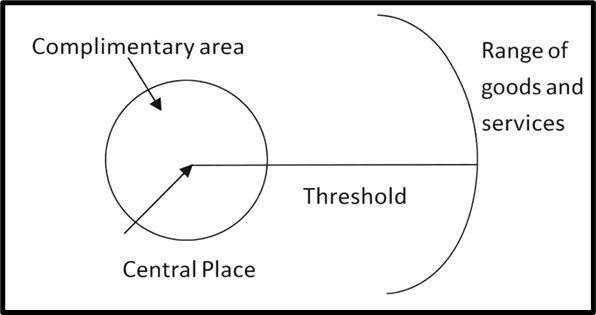
🧱 Six Core Concepts of CPT
Let’s now unpack the six central ideas of Christaller’s model. These are the bricks with which the whole theory is built.
1. Central Place
- This is the main town or city that serves as a nodal point for surrounding settlements.
- It must have:
- A permanent location, and
- Some tertiary activities—like shops, banks, schools—serving the population.
🎯 Example: Patna may act as a central place for multiple small towns in Bihar.
2. Threshold
- This refers to the minimum population required to support a particular economic activity.
If the number of people is below the threshold, the business will shut down.
🧁 For example:
- A tea stall needs only 30–40 people regularly.
- A multiplex cinema needs a few thousand.
So, larger and rarer services require a higher threshold.
3. Range of Goods and Services
- Already discussed, but here with a slight nuance:
The range differs for different items based on their importance, price, and frequency of use.
🎯 Grocery → low range
🎯 Specialty hospital → high range
People will travel farther for important, high-value, or infrequent services.
4. Complementary Area
- This is the area around the central place consisting of smaller settlements.
These areas depend on the central place for goods and services.
🎓 Analogy: Like small towns or villages depending on a district headquarters for healthcare, education, banking, etc.
5. Central Goods and Services
- This is the main function of central places: to provide goods and services.
The scale and quality of goods vary by the level of the central place.
🛒 Smaller settlements → only basic goods
🏬 Larger towns/cities → both basic and luxury goods
So, the larger the central place, the more diverse the services.
6. Concept of Centrality
- This refers to the importance or influence of a central place in its region.
Centrality is not just about population but also about:
- What kind of goods it provides
- How big its complementary area is
- How many people travel there for services
🎯 Example: A town with a railway junction, hospitals, and shopping malls may have more centrality than a larger village with none of these.
🎯 Summary
| Concept | Key Idea |
|---|---|
| Central Place | Functional hub providing services |
| Threshold | Minimum people required to sustain a service |
| Range | Max distance people travel for a good/service |
| Complementary Area | Area depending on central place |
| Central Goods/Services | Nature of services provided |
| Centrality | Influence & importance of central place |
📝 Closing Thoughts
What Christaller did was bring logic to the spatial chaos of human settlements. By introducing the idea of service zones, hierarchy, and efficiency, he helped us understand:
- Why cities are spaced the way they are,
- Why some grow larger,
- And how people interact with their space economically.
Even though the real world is more complex, CPT remains a cornerstone of spatial analysis in geography.