
Diamond
Diamonds—known to most people as precious stones—are much more than ornaments. From the lens of economic geography, they are strategic minerals with significant industrial and commercial value.
What is a Diamond?
Let’s begin with a fundamental definition:
- Diamond is the hardest naturally occurring substance on Earth.
- Composition? Just pure carbon—C. But what differentiates it from graphite (also pure carbon) is its crystal structure.
- While graphite has a hexagonal structure, diamond has a cubic (isometric) crystal structure—which is what gives it:
- Exceptional hardness
- High refractive index (i.e., how much it bends light)
- Strong dispersion (i.e., how it splits light into colors)
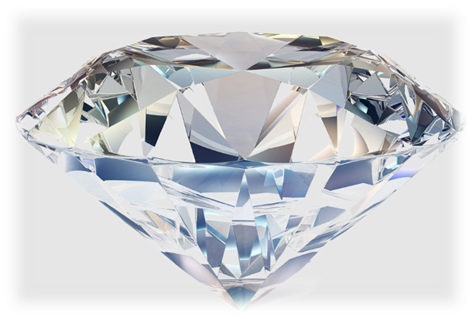
This is why faceted diamonds sparkle with brilliance—something geographers should understand not emotionally, but structurally.
How Are Diamonds Formed?
To understand this, let’s take a short geological journey—into the Earth’s mantle:
- Diamonds form deep within the mantle, at depths of 150–200 km.
- They need extremely high temperatures (~1000–1300°C) and pressures (~45–60 kilobars) to crystallize.
- But then, how do they reach the surface?
👉 Answer: They are transported to the crust via volcanic eruptions, particularly through Kimberlite and Lamproite pipes—types of igneous intrusive rocks.
These volcanic features form vertical conduits or dykes, which we call “diamond pipes”.
➤ Other Geological Settings:
- Alluvial deposits: Diamonds also appear in river beds and sediments, carried from primary rocks due to erosion.
- These are called secondary or placer deposits.
Applications of Diamond
Diamonds are not only for luxury; their industrial value is equally important.
A. Gem-quality Diamonds
- Transparent, colourless or slightly tinted.
- Used in ornaments and jewellery.
- Valued for clarity, cut, carat, and colour (the famous 4 Cs).
B. Industrial-grade Diamonds
These are less pure and may appear dark, opaque, or flawed.
Used in:
- Drill bits for mining, oil exploration, and geological surveys
- Cutting tools for glass, metals, and ceramics
- Polishing surfaces
📌 Types of Industrial Diamonds:
- Bort – shattered fragments
- Ballas – spherical, tough masses
- Carbonado – polycrystalline black diamonds, highly durable
C. Synthetic Diamonds
- Manufactured via HPHT (High Pressure High Temperature) or CVD (Chemical Vapour Deposition) techniques.
- They rival natural diamonds in industrial applications, often being more affordable and customised for specific purposes.
Global Distribution of Diamond Reserves & Production
Let’s analyse the current geopolitical geography of diamonds:
📦 World’s Reserves of Industrial Diamonds in million carats (2024)
| Country | Share of Reserves |
| Russia | 990 (46%) |
| Botswana | 250 (22%) |
| Congo (DRC) | 150 (9%) |
| Angola | 150 (9%) |
| World Total | ~1,700 million carats |
🏭 World’s Production of Diamonds in million carats (2024)
| Country | Share of Production |
| Russia | 16 (39%) |
| Botswana | 8 (20%) |
| Congo (DRC) | 7 (17%) |
| Total | 41 |
📌 Special Notes:
- Australia is famous for coloured diamonds—especially pink, purple, and red varieties.
- South Africa’s Kimberley Mine is one of the oldest and most iconic diamond mines—hence the term Kimberlite.
Distribution of Diamond Reserves and Production in India
Let’s begin with a key factual base from the National Mineral Inventory (NMI), 2020:
- Total estimated diamond reserves in India: 31.72 million carats
Now, let’s look at its state-wise data:
| State | Reserves (Million Carats) | % Share |
| Madhya Pradesh | 28.6 | ~90% |
| Andhra Pradesh | 1.8 | ~5.7% |
| Chhattisgarh | 1.3 | ~4% |
| Total (India) | 31.72 | 100% |
🟩 Geographical Zones of Occurrence:
- Madhya Pradesh – Especially the Panna diamond belt (includes Majhgawan in Satna district, India’s only active mine)
- Andhra Pradesh – Districts like Anantapur, Kadapa, and Guntur
- Chhattisgarh – Raipur and Bastar districts
- Karnataka – New findings in Raichur–Gulbarga region
- Odisha – Between Mahanadi and Godavari river valleys
📌 Production Highlights (2022-23):
- Madhya Pradesh alone accounts for 100% of India’s diamond production.
- Total production: 388 carats.
🌍 2. India’s Diamond Trade: Imports & Exports
- In terms of value, exports were mainly to USA (35%), Hong Kong (24%), Belgium (11%) and UAE (10%)
- In terms of value, imports were mainly from UAE (38%), USA (20%), Belgium (18%), Hong Kong (7%) and Russia (5%)
💎 Note: India, especially Surat (Gujarat), is the global hub for diamond cutting and polishing, handling ~90% of the world’s rough diamonds.
Graphite vs. Diamond: A Comparative View
| Feature | Graphite | Diamond |
|---|---|---|
| Carbon Content | 95–99% Carbon | 100% Carbon |
| Formation Zone | Earth’s crust and upper mantle (metamorphic rocks) | Deep mantle, under extreme heat and pressure |
| Structure | Carbon atoms in hexagonal sheets (layered) | Carbon atoms in tetrahedral 3D lattice |
| Stability | More stable than diamond | Less stable than graphite |
| Hardness | Very soft (used in pencils, lubricants) | Extremely hard (used in cutting tools) |
| Electric Conductivity | Excellent conductor (unique for a non-metal) | Insulator |
| Industrial Applications | Batteries, lubricants, brake linings, pencils | Gemstones, drills, cutting/polishing tools |
| Other Allotropes of Carbon | Anthracite coal, charcoal | Graphite, carbonado |
👉 Allotrope – Different physical forms of the same element. In carbon’s case: Graphite, Diamond, Charcoal, and Anthracite.