
Distribution of Coal Across the World
“Where there’s coal, there’s power – not just electric, but industrial and geopolitical.”
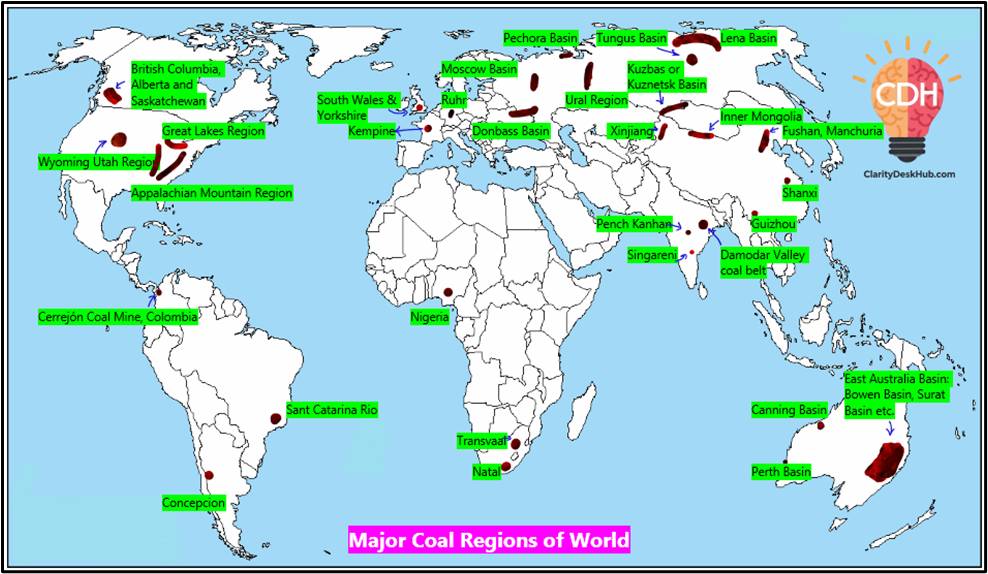
Coal is more than just a fuel; it’s the backbone of early industrialization. So, to understand how modern economies rose, and where industrial hubs emerged, you must trace coal belts across the globe. Let’s take it region by region. Zoom into the following map for better visualisation:
🌎 United States
- Allegheny and Appalachian Mountains—rich in Carboniferous-age coal (350 million years old, best quality).
- This coal was the fuel for American industrial growth—especially around the Great Lakes and Appalachians.
- But today, the action has shifted westward. The Powder River Basin in Wyoming is the coal capital now.
- It hosts the North Antelope Rochelle Mine, the largest coal mine in the world..
🐉 China
- China wears three badges:
- World’s largest producer
- World’s largest consumer
- But also—major polluter (photochemical smog is a serious issue).
- Ironically, despite its coal abundance, much of it is of low quality, especially for steel-making.
- So, China imports metallurgical coal—mostly from Australia.
- It’s a classic case of “quantity over quality.”
🇪🇺 Europe
- Germany owes much of its industrial might to the Ruhr and Rhineland coal belts, supported by iron ore deposits—a textbook case of resource-based industrial location.
- England, with coalfields in South Wales, Yorkshire, Manchester, and Liverpool, became the cradle of the Industrial Revolution.
- This is why they say: “Coal turned England into an empire.”
🌍 Russia: Vast but Underutilised
- Ural Region and Donbas Basin (Ukraine) are known coal zones.
- But most of Russia’s coal wealth lies in remote Siberia, still untapped due to harsh terrain and climate.
🌎 Other Key Regions
Brazil (South America)
- A leading coal producer in Latin America.
- Primarily uses coal for power generation, with surplus exported to China.
Australia
- Rich in coking coal (ideal for steel), making it a major exporter to India, China, and Japan.
- Australia is like the “coal exporter to the industrial world.”
Africa
- Only South Africa has significant coal reserves.
- Acts as a coal hub for the African continent
Global Coal Reserves
As of the latest available data, global coal reserves are estimated to be approximately 1.07 trillion tonnes. These reserves are unevenly distributed across countries, with a few nations holding the majority share. Here are the top countries by proven coal reserves:
🌍 Top Countries by Proven Coal Reserves (2020)
| Rank | Country | Coal Reserves (Million Tonnes) | Share of Global Reserves |
|---|---|---|---|
| 1 | United States | 248,941 | 23.2% |
| 2 | Russia | 162,166 | 15.1% |
| 3 | Australia | 150,227 | 14.0% |
| 4 | China | 143,197 | 13.3% |
| 5 | India | 111,052 | 10.3% |
🔍 Key Insights
- United States: Holds the largest share of global coal reserves, accounting for over 23% of the total.
- Russia and Australia: Together, they contribute approximately 29% to global reserves.
- China and India: Despite being the top consumers and producers of coal, they also possess significant reserves, with China at 13.3% and India at 10.3% of the global total.
Top Coal Producers and Consumers in the World (2023)
| Country | Production Share (%) |
|---|---|
| China | 51.8 |
| India | 11.1 |
| Indonesia | 8.5 |
| USA | 5.8 |
| Australia | 5.0 |
In 2023, China dominated both coal production and consumption, reflecting its coal-intensive energy and industrial sectors. India ranked second in both, highlighting its growing energy demand. Notably, Indonesia and Australia are major producers but not top consumers, indicating their role as key coal exporters.
| Country | Consumption Share (%) |
|---|---|
| China | 56 |
| India | 13.4 |
| USA | 5.0 |
| Japan | 2.8 |
| Indonesia | 2.6 |