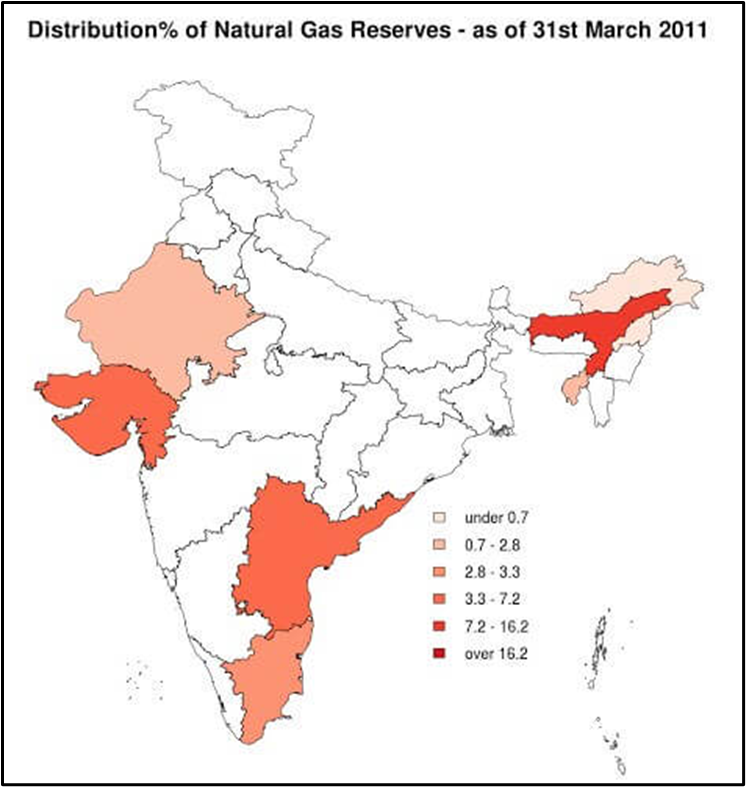
Distribution of Natural Gas Across India and the World
When we talk about natural gas, we’re talking about one of the cleanest-burning fossil fuels. It’s not just an energy source—it is also a geo-economic asset. Countries with large natural gas reserves often hold strategic influence in global geopolitics, industrial growth, and energy security.
Let’s break it into three parts to make it simple:
- Who has the natural gas?
- Who is producing it?
- Who is using it?
🛢️ Proven Reserves of Natural Gas (2023-Provisional)
Proven reserves refer to the amount of natural gas that is known to exist and is economically viable to extract with current technology.
| Rank | Country | Proven Reserves (Billion cubic meters) | % Share |
|---|---|---|---|
| 1. | Russia | 44150 | 21.4 |
| 2. | Iran | 33988 | 16.5 |
| 3. | Qatar | 23831 | 11.5 |
| 4. | United States | 17410 | 8.4 |
| 23. | India | 945 | 0.5 |
🧭 Explanation:
These countries are like giant fuel tanks of the world—having huge stockpiles of natural gas stored naturally beneath their soil. Russia alone accounts for nearly one-fifth of global reserves.
⚙️ Natural Gas Production (2023-Provisional)
Production means how much gas is actually being extracted and processed.
| Rank | Country | Production (Billion cubic meters) | % Share |
|---|---|---|---|
| 1. | United States | 1035.3 | 25.50 |
| 2. | Russia | 586.4 | 14.45 |
| 3. | Iran | 251.7 | 6.20 |
| 4. | China | 234.3 | 5.77 |
| 23. | India | 31.6 | 0.8 |
📌 Key Point:
The United States leads in production, thanks to its aggressive use of shale gas technology—a kind of extraction technique that has revolutionised gas production.
🧪 Analogy: Think of it like having access to underground water: reserves show how much water is in the tank, but production shows how much water you’re pumping and using daily.
🔥 Natural Gas Consumption (2023-Provisional)
Consumption means how much gas is being used domestically—by households, industries, power plants, vehicles, etc.
| Rank | Country | Consumption (Billion cubic meters) | % Share |
|---|---|---|---|
| 1. | United States | 886.5 | 22.1 |
| 2. | Russia | 453.4 | 11.3 |
| 3. | China | 404.8 | 10.1 |
| 4. | Iran | 245.6 | 6.1 |
| 12. | India | 62.6 | 1.6 |
🧠 Insight:
Countries with large populations and fast-growing industries like China and the US consume massive quantities of gas for power generation and manufacturing.
🚢 Leading Exporters & Importers (2023-Provisional)
Exporters (sending gas abroad):
| Rank | Country | % Share |
|---|---|---|
| 1. | United States | 15.6 |
| 2. | Russia | 12.7 |
| 3. | Qatar | 11.7 |
| 4. | Norway | 8.3 |
Importers (buying gas from other countries):
| Rank | Country | % Share |
|---|---|---|
| 1. | China | 12.9 |
| 2. | Germany | 7 |
| 3. | Japan | 6.9 |
| 4. | US | 6.6 |
| 15. | India | 1.9 |
📌 Note: LNG is used when natural gas is cooled to -162°C to be transported over long distances by ship.
🧭 Global Pattern:
- Western Asia and Russia dominate reserves.
- North America (especially the US) leads production and domestic use.
- East Asia (Japan, South Korea, China) are the biggest buyers due to lack of domestic reserves but high energy needs.
🌍 Distribution of Natural Gas Production in India (2023-Provisional)
| Region | % of Total Production |
|---|---|
| Offshore | 71% |
| Assam | 10% |
| Rajasthan | 6% |
| Tripura | 4% |
🧭 Key Insights
- The Offshore regions, especially in the Mumbai High and KG Basin, are the largest contributors.
- Northeast India (Assam and Tripura) also plays an important role.
- Onshore discoveries in Rajasthan and Gujarat are helping diversify production.
🧩 Final Takeaway
- Global natural gas reserves are concentrated in Russia, Iran, and Qatar, forming a sort of “Energy Triangle”.
- The United States leads production and consumption due to technology and domestic demand.
- India, though not rich in reserves, is a major LNG importer, and this will continue as it transitions to a cleaner energy economy.
- Geography meets economy in the case of natural gas—countries with reserves not only gain energy security but also geopolitical leverage.
🌍 Regional Distribution of Major Natural Gas Fields in the World
To understand where the world’s natural gas wealth is concentrated, we must look at geological formations shaped over millions of years—and how they align with modern geopolitics. Some gas fields lie under deep oceans, others under icy tundras, while many are linked with major oil reserves.
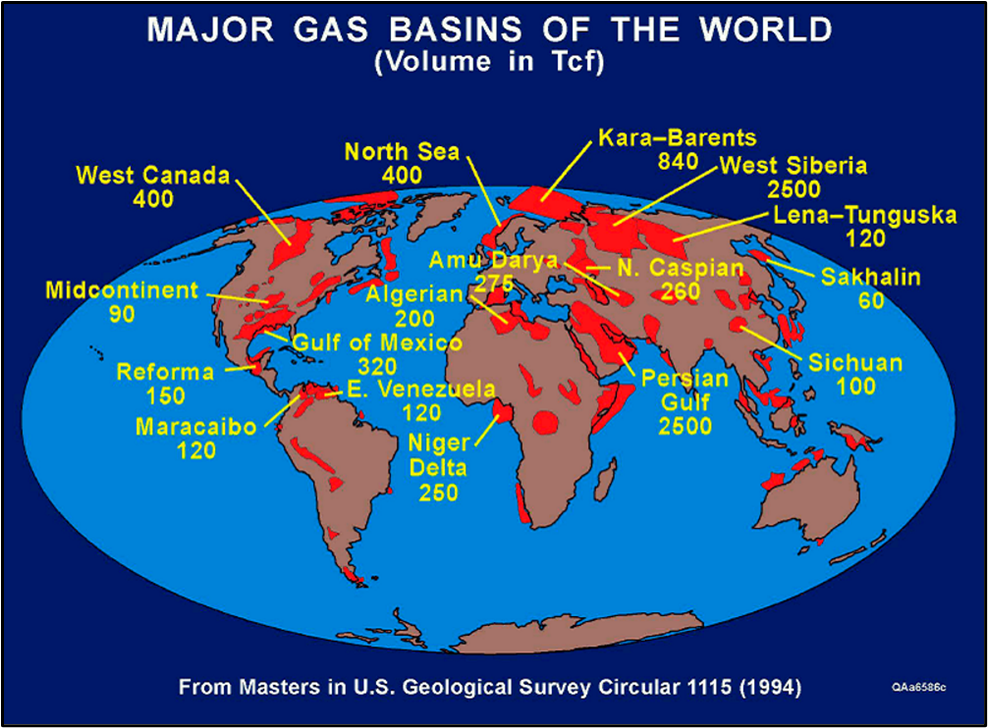
Let’s explore this continent-wise, like a world tour of natural gas hotspots.
🇷🇺 Russia – The Arctic Energy Giant
- West Siberia is the crown jewel of Russian gas—particularly the areas east of the Gulf of Ob, located close to the Arctic Circle.
- Urengoy Gas Field: The largest natural gas field in the world. Imagine a gas tank bigger than most countries’ reserves.
- Yamburg Field (in the Yamal Peninsula) is almost as large as Urengoy—a true rival in size and scale.
- The Volga-Urals region adds to Russia’s domestic gas strength.
- Most of these resources are controlled by Gazprom, Russia’s state-owned gas monopoly—a powerful player in global geopolitics.
🧠 Takeaway: Russia isn’t just an energy-rich nation; it’s a strategic superpower in natural gas. Its control over Arctic fields gives it long-term leverage.
North America – Technology-Driven Gas Power
United States
- Hugoton Field: Spreads across Oklahoma, Texas, and Kansas—one of the largest in North America.
- Marcellus Shale in the Appalachian Basin (Northeast US): A leader in unconventional shale gas.
- Shale gas is trapped in fine-grained rocks and requires techniques like hydraulic fracturing (fracking).
Canada
- Largest field located in Alberta, which is also rich in oil sands.
Mexico
- Most natural gas comes from the Gulf of Mexico, especially the Burgos Basin on the landward side.
🧠 Takeaway: North America’s strength lies not just in reserves but in technological innovation, allowing it to extract gas from unconventional sources.
🇪🇺 Europe – Small in Reserves, Big in Strategy
- North Sea (off Norway) and Dutch Coast hold major reserves.
- Groningen Field in the Netherlands was once the largest in Europe but is now declining.
- Troll Field (Norway) is one of the largest offshore gas fields globally—still highly active.
- Ukraine: Has significant reserves in the Eastern Dnieper-Donets Basin, but due to political conflict and infrastructure issues, utilization is limited.
🧠 Takeaway: Europe’s gas is concentrated in a few regions, but due to energy dependency, especially on Russia, it remains a sensitive geopolitical zone.
🌍 Africa – The Sleeping Giant of Gas
- Algeria’s Central Basin: A key supplier to Europe through trans-Mediterranean pipelines.
- Niger Delta (Nigeria): One of the most important gas hubs in sub-Saharan Africa.
- Mozambique’s Rovuma Basin: Holds massive offshore reserves, attracting global investment.
- Tanzania: Recent deep-water discoveries show high future potential.
🧠 Takeaway: Africa is rich in resources, but infrastructure and political instability often prevent full-scale development.
🏜️ Middle East – Where Oil and Gas Coexist
- The Arabian-Iranian Basin is a super-rich hydrocarbon zone, where gas is often associated with oil fields.
- Iran and Qatar: Among the top holders of proven gas reserves globally.
- Qatar’s North Field (which extends into Iran’s South Pars field): This is the world’s largest non-associated gas field (not linked to oil).
🧠 Takeaway: Middle East gas is often a byproduct of oil extraction, but now it’s becoming an economic focus in itself—especially for countries like Qatar, which has pivoted to LNG exports.
🌏 Asia – Diverse and Rapidly Developing
- North Sumatra Basin (Indonesia): Holds the largest gas reserves in Asia.
- Malaysia and Indonesia combined: Together, they form a Southeast Asian gas hub.
- Sichuan Basin (China): A major centre for shale gas development, still in progress.
- Turkmenistan’s Galkynysh Field: One of the largest onshore fields globally—critical for Central Asia’s gas strategy.
🧠 Takeaway: Asia’s reserves are scattered but substantial—particularly important for domestic consumption in large economies like China and India, as well as exports from Indonesia and Malaysia.
🧩 Guys, let’s summarise quickly:
| Region | Key Fields | Strategic Importance |
|---|---|---|
| Russia | Urengoy, Yamburg, West Siberia | Largest global reserves, key exporter |
| USA | Hugoton, Marcellus Shale | Top producer via shale gas technology |
| Canada | Alberta | Major North American source |
| Mexico | Burgos Basin (Gulf of Mexico) | Important for regional supply |
| Europe | Groningen, Troll, Dnieper-Donets (Ukraine) | Declining reserves, high import dependency |
| Africa | Niger Delta, Rovuma Basin, Algeria | Untapped potential, growing importance |
| Middle East | North Field (Qatar), South Pars (Iran) | Gas-rich zone with strong export orientation |
| Asia | North Sumatra, Galkynysh, Sichuan Basin | Domestic development and regional exports |
🇮🇳 Natural Gas in India – Fields and Allocation
📍 Where is Natural Gas Found in India?
India’s natural gas reserves are scattered across both onshore and offshore locations. Here’s a simple breakdown of the major natural gas fields:
| Region | Basin/Location | State | Type |
|---|---|---|---|
| East Coast | Krishna-Godavari (KG) Basin | Andhra Pradesh | Offshore |
| North-East | Assam (Upper Assam Basin) | Assam | Onshore |
| West Coast | Gulf of Khambhat (Cambay Basin) | Gujarat | Offshore |
| South | Cuddalore District | Tamil Nadu | Onshore |
| West | Barmer Region (Rajasthan Basin) | Rajasthan | Onshore |
🧠 Mnemonic to remember:
“KABCuG” → KG, Assam, Barmer, Cuddalore, Gulf (Khambhat)
🔄 Domestic Supply and Allocation of Natural Gas
Natural gas in India comes from two major sources:
- Domestic Natural Gas – From Indian fields.
- Imported R-LNG – Re-gasified Liquefied Natural Gas. Imported as LNG, then converted back into gas.
Now, let’s see how these are distributed across different priority sectors (2023-24 Provisional):
| Sector | Total Supply (%) |
|---|---|
| Fertilizer Industry | 30.6 |
| Power Sector | 13.2 |
| City Gas Distribution | 19.6 |