
Dolomite
In the last section, we’ve talked about limestone. Now, imagine a close cousin of limestone — similar in structure, but with a subtle chemical twist. That’s Dolomite.
What is Dolomite?
Let’s begin with the technical identity:
Dolomite is a mineral compound made up of calcium magnesium carbonate with the formula:
CaMg(CO₃)₂
If limestone is primarily calcium carbonate (CaCO₃), then dolomite introduces magnesium into the mix.
🔹 When does limestone become dolomite?
- If magnesium content exceeds 10%, we start calling it dolomite.
- In commercial terms, rocks containing 40–45% magnesium carbonate (MgCO₃) are considered dolomite-grade.
Geological Formation of Dolomite
The process through which dolomite forms is more chemically transformative than just sediment accumulation. It involves modification of existing limestone.
A. Diagenesis and Hydrothermal Metasomatism
Let’s understand this:
- Diagenesis: This is the suite of processes that alter sediments after deposition but before metamorphism. During diagenesis, magnesium-rich fluids percolate through limestone and replace some calcium ions with magnesium ions.
- Hydrothermal Metasomatism: This occurs when hot, mineral-rich fluids interact with pre-existing rocks, modifying their chemical composition — again introducing magnesium.
This replacement process is technically called:
Dolomitisation: The transformation of limestone into dolomite by substituting calcium with magnesium.
B. Where is dolomite found?
Dolomite is mostly present in:
- Hypersaline sedimentary environments – e.g., ancient shallow seas with high evaporation rates.
- Ultramafic rocks and carbonatites – rich in magnesium.
- Metamorphic rocks like marble
- Hydrothermal veins – where heated fluids have altered the rock chemistry.
C. Appearance
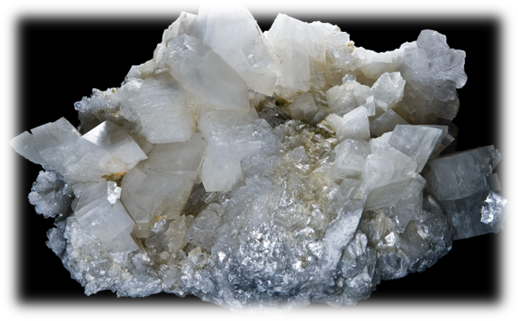
It comes in varied colours – white, grey, pink, green, or brown – depending on impurities and environmental conditions during formation.
Applications of Dolomite
So why do we care about dolomite?
Because it is a strategic mineral for several core industries:
🔹 Iron and Steel Industry – the primary consumer (≈90%)
- Dolomite acts as a flux in blast furnaces. It helps remove impurities from molten metal, particularly silica.
- Also used as a source of magnesium salts in steelmaking.
🔹 Fertiliser Industry
- Dolomite is a source of magnesium – essential for chlorophyll and plant health.
🔹 Glass Industry
- Used in manufacturing heat-resistant and durable glass products.
So essentially, wherever heat, purification, and chemical reactivity are needed, dolomite plays a role.
Distribution of Dolomite Across the World
Let’s take a geographical tour of dolomite-rich areas across the globe.
| Country | Key Dolomite Regions |
|---|---|
| USA | Dolomite Hills (California), Piedmont (Virginia, Maryland, Pennsylvania), Midwest (Indiana, Ohio, Michigan) |
| Canada | Rocky Mountains (British Columbia, Alberta), Northwest Territories, Nunavut |
| Italy | The Dolomites in NE Italy — iconic mountain range made of high-purity dolomite |
| Spain | Pyrenees Mountains |
| Germany | Bavarian Alps, Black Forest region |
| UK | Peak District and parts of Wales |
| China | Northwest and Southwest provinces – Xinjiang, Sichuan, Yunnan |
| Turkey | Taurus Mountains, Central Anatolia |
| Brazil | Minas Gerais, São Paulo |
| Australia | Pilbara and Kimberley regions in Western Australia |
The pattern is clear — dolomite occurs in both mountain belts and sedimentary basins, often associated with carbonate-rich environments.
Distribution of Dolomite in India
India, like with limestone, has abundant and geographically widespread dolomite reserves.
Reserves
- As of April 1, 2015, India had 8,415 million tonnes of dolomite reserves.
- The leading states in terms of reserves:
- Madhya Pradesh (27%)
- Andhra Pradesh (15%)
- Chhattisgarh (11%)
These three together hold a major chunk of India’s dolomite wealth.
Production (2019-20)
Major producing states: Andhra Pradesh, Gujarat, Telangana, Maharashtra, Rajasthan, Karnatka
Note: As per Govt of India Notification S.O. 423(E), dated 10th February 2015, ‘dolomite’ has been declared as ‘Minor Mineral’ and hence data is tough to search.
Conclusion
Dolomite might seem like an obscure geological term, but in reality, it is deeply integrated into:
- Steel production
- Soil health
- Glass manufacturing
- And even international trade
Understanding its formation, distribution, and applications not only helps you in UPSC Geography Optional but also links directly with industrial location, natural resources, and geo-economic strategy — all relevant for GS, Essay, and even Interview.