
Gas Hydrates
Let’s start with a simple analogy.
Imagine ice cubes that don’t just have frozen water, but also have natural gas molecules trapped inside. These aren’t ordinary ice cubes—they are crystalline cages of water, with gas (mostly methane) inside them.
That’s what Gas Hydrates are.
🔍 Definition:
Gas Hydrates are crystalline solids where gas molecules (mainly methane) are trapped within a lattice of frozen water molecules.
They form under very specific conditions:
- High Pressure
- Low Temperature
That’s why they are commonly found:
- Under the deep ocean floor, or
- Beneath the permafrost regions (frozen Arctic or sub-Arctic zones).
So, the “ice” here is not ordinary—it’s a solid structure of water and gas, stable only in cold and high-pressure environments.
🌍 Why are Gas Hydrates Important?
Now you may wonder—why is everyone so interested in this icy-gassy structure?
Because:
- One cubic meter of gas hydrate can release around 160–180 cubic meters of methane gas when broken down.
- That’s a huge energy reserve trapped in the form of ice.
Therefore, gas hydrates are seen as a potential source of unconventional energy in the future—especially as conventional hydrocarbon sources decline.
Think of it like a frozen treasure chest, holding vast amounts of methane that could power homes, industries, and even entire nations—if we can unlock it safely and economically.
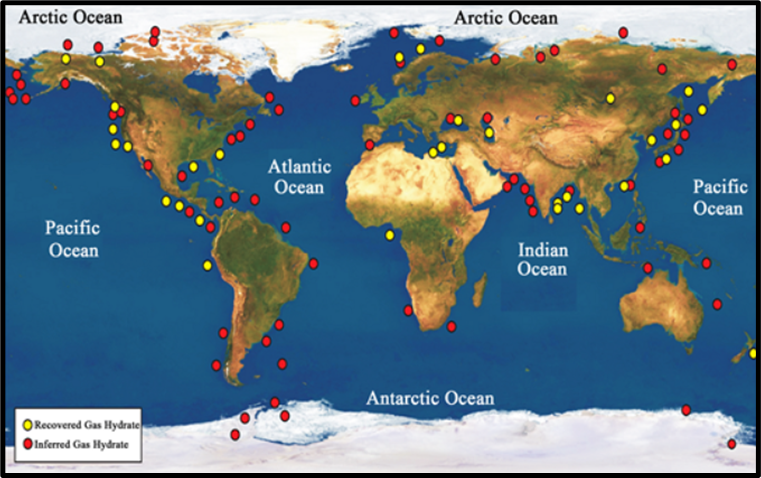
🌐 Where are Gas Hydrates Found?
Globally:
- Marine sediments—especially in continental margins at ocean depths beyond 500–1000 meters.
- Permafrost regions—like Siberia, Alaska, and parts of Canada.
🇮🇳 Gas Hydrates in India
India is geographically well-positioned to tap into gas hydrate resources due to its long coastline and deep marine basins.
🔑 Key Locations:
- Bay of Bengal
- Andaman Sea
- Some potential in the Arabian Sea
These offshore regions, especially the Krishna-Godavari Basin in the Bay of Bengal, have shown high concentrations of gas hydrates in marine sediments.
🏢 Institutional Framework
To explore this resource systematically, the Government of India launched:
National Gas Hydrate Program (NGHP) in 1997 — under the Ministry of Petroleum & Natural Gas
It is coordinated by the Directorate General of Hydrocarbons (DGH).
🔬 What NGHP Does:
- Conducts expeditions to explore, drill, and map gas hydrate-rich zones.
- Collects core samples and seismic data from offshore basins.
- Collaborates with global partners to develop extraction technologies.
This program aims to understand:
- Where hydrates are,
- How stable they are,
- And how they might be extracted safely and economically in the future.
⚠️ Current Status of Production
As of now, commercial production of gas hydrates is not yet feasible—in India or globally.
Why?
Because:
- It’s technologically challenging to extract methane from hydrates without destabilizing the seabed.
- There are environmental concerns, like:
- Methane leakage (a potent greenhouse gas)
- Subsea landslides
- Disturbance to marine ecosystems
- It’s expensive compared to existing energy sources.
🌱 Future Potential
However, if extraction becomes viable, gas hydrates could:
- Significantly boost India’s energy security,
- Reduce dependence on imported LNG (Liquefied Natural Gas),
- Align with India’s goals for a cleaner and diversified energy mix.
To summarize:
- Gas hydrates are ice-like solids with methane trapped inside, found in deep-sea sediments and permafrost zones.
- They are a potential source of unconventional natural gas, but not yet commercially exploited.
- India, with its vast offshore regions like the Bay of Bengal, holds significant reserves.
- The National Gas Hydrate Program (NGHP) is leading the research and exploration efforts.
- Commercial extraction is still a future prospect, limited by technological and environmental challenges.