
Global Control Theory of Daly: on Origin of Coral Reefs and Atolls
Let’s take a journey back to the Pleistocene Ice Age, a time when massive glaciers covered large parts of the Earth, and sea levels dropped drastically. Reginald Daly (1910) introduced the Global Control Theory, suggesting that coral reefs were formed due to the dramatic changes in sea level caused by glaciations.
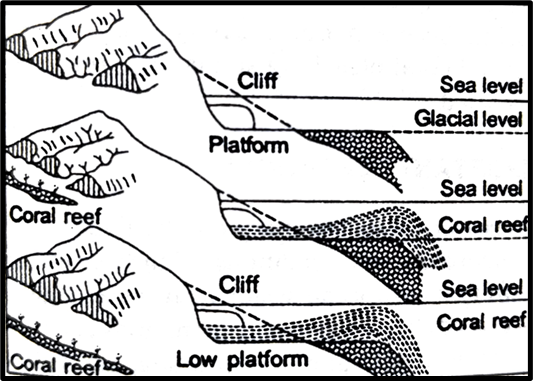
The Core Idea: Ice Age, Sea Level Change & Coral Growth
Daly argued that glaciation and deglaciation controlled coral reef formation. His theory hinges on two key events:
1. Glaciation (Ice Age Period) 🌨️
- During the Ice Age, huge amounts of water were locked in glaciers, causing the sea level to fall by 198 to 228 feet (33 to 38 fathoms).
- Coral reefs were exposed and died due to the extreme cold.
- Powerful waves eroded the continental coasts and islands, forming wave-cut platforms (flat surfaces created by wave abrasion).
2. Post-Glaciation (Ice Age Ends) ☀️
- As glaciers melted, the stored water returned to the ocean, raising sea levels by 198 to 228 feet.
- The submerged wave-cut platforms became ideal surfaces for coral recolonization.
- Surviving corals from deeper waters migrated and began growing on the edges of these submerged platforms.
Formation of Different Types of Coral Reefs
| Coral Reef Type | Formation According to Daly |
| Fringing Reefs | Formed on narrow wave-cut platforms along coastlines. |
| Barrier Reefs | Developed on broad wave-cut platforms further from shore. |
| Atolls | Grew around isolated, wave-eroded island peaks that were submerged. |
| Lagoons | Formed between the land and the reef due to uniform submersion. |
How is Daly’s Theory Different from Others?
| Theory | Main Concept |
| Darwin’s Subsidence Theory | Coral reefs form due to gradual sinking of land, forcing corals to grow upwards. |
| Murray’s Standstill Theory | Reefs grow on stable submarine platforms at a fixed depth. |
| Daly’s Global Control Theory | Reefs formed due to sea-level fluctuations caused by Ice Ages. |
Criticism & Limitations of Daly’s Theory
- Non-Uniform Lagoon Depths
- Daly’s theory predicts that all lagoons and barrier reefs should have uniform depth (since sea level rose evenly).
- However, real-world observations show varying depths, proving that other factors influence reef formation.
- Absence of Cliffed Coasts
- If wave erosion during the Ice Age was strong enough to create vast platforms, cliffed coastlines should be visible today—but they are not.
- Existence of Islands Between Reefs and Coasts
- If marine islands were eroded by 198–228 feet, they should have disappeared.
- Yet, many islands still exist between barrier reefs and the mainland, contradicting Daly’s predictions.
Final Thoughts
Daly’s Global Control Theory introduced an important link between glaciation and coral reef formation, emphasizing how sea-level fluctuations shape marine landscapes. However, its oversimplified assumptions about lagoon depth and coastal erosion limit its accuracy.
Today, scientists recognize that coral reef formation is influenced by a combination of factors, including:
✅ Tectonic activity (subsidence or uplift)
✅ Sea-level changes (as Daly suggested)
✅ Sedimentation and erosion
✅ Biological coral growth mechanisms
Thus, while Daly’s theory provides a glaciation-based perspective, it is not the sole explanation for coral reef formation. 🌊🐠