
Graphite
Graphite is a naturally occurring form of carbon, but it’s not just any form—it is the most stable form of pure carbon under normal temperature and pressure conditions.
You may also come across its older names—Plumbago or Black Lead. But be careful! Despite the name “black lead,” graphite has nothing to do with lead (Pb). These are historical misnomers.
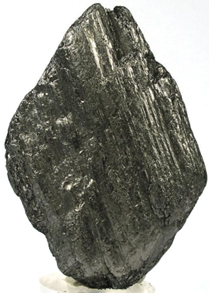
Key Characteristics of Graphite:
Let’s make a small list to remember:
- Crystal Structure: Hexagonal (this refers to how carbon atoms are arranged in layers).
- Softness: It’s so soft you can scratch it with a fingernail. That’s why it’s used in pencils.
- Low Specific Gravity: Meaning, it’s quite light.
- Electrical and Thermal Conductivity: It’s the only non-metal that conducts electricity well. (Important for Prelims!)
- Combustibility: Even though it’s carbon, it’s not normally used as fuel—because it’s hard to ignite.
Now, here’s a crucial point you should remember:
Carbon Content Comparison:
From lowest to highest carbon content:
Peat < Lignite < Bituminous < Anthracite < Graphite < Diamond
This sequence tells us that as we go from Peat to Diamond, the degree of carbon purity and metamorphism increases.
How is Graphite Formed?
Now let’s explore how nature creates graphite.
Natural Formation:
Graphite forms in igneous and metamorphic rocks—under high temperatures and pressures. But more specifically, it usually forms:
- At convergent plate boundaries, where tectonic plates collide.
- Through metamorphism of organic-rich shales and limestones—that is, when heat and pressure transform these rocks and the organic matter within them into graphite.
There’s a special case too:
- If graphite forms from the metamorphism of coal seams, it’s called Amorphous Graphite.
(Note: This “amorphous” is a commercial term—it still has some crystalline structure, but not well-defined.)
Synthetic Graphite:
Not all graphite is natural. Synthetic graphite is made in factories by:
- Heating carbon-rich materials like petroleum coke or coal-tar pitch.
- The temperature required is extremely high—2500 to 3000°C.
Applications of Graphite
This part is extremely important from the economic geography angle—why do we care about graphite?
Uses of Natural Graphite:
- Refractories: Used in high-temperature applications like furnaces.
- Steelmaking: As a lubricant and for carbon addition.
- Batteries: Especially Lithium-ion batteries (used in EVs).
- Lubricants: Because it reduces friction.
Uses of Synthetic Graphite:
- Both natural and synthetic graphite are used in battery anodes—a hot topic in energy technology.
Amorphous Graphite:
- Especially used in brake linings for heavy vehicles.
Graphite in Pencils:
- What we call “pencil lead” is actually a mixture of powdered graphite and clay.
(A nice factoid to remember for interviews.)
Distribution of Graphite in the World
Now let’s look at where in the world this mineral is found. This is critical for understanding resource geography.
Global Reserves (2024):
Let’s remember some key players here. Reserves are measured in Million Tons.
| Country | Graphite Reserves |
| China | 81 (≈28%) |
| Brazil | 74 (≈26%) |
| Madagascar | 27 (≈9%) |
| Mozambique | 25 (≈9%) |
| Tanzania | 18 (≈6%) |
| World Total | 290 |
Global Production (2024):
Now let’s talk about actual production, measured in Thousand Tons:
| Country | Production | Share (%) |
| China | 1270 | 79% |
| Madagascar | 89 | 5.5% |
| Mozambique | 75 | 4.7% |
| Brazil | 68 | 4.3% |
| World Total | 1600 |
Graphite in India: Distribution and Economic Significance
After understanding the global scenario, let’s now look inward—at India’s graphite story.
Total Resources vs Recoverable Reserves
First, let’s differentiate two terms clearly—Total Resources and Recoverable Reserves:
- Total Resources include both identified reserves and potential or inferred resources.
- Recoverable Reserves refer only to that portion which can be economically extracted with current technology.
A. Total Graphite Resources in India (2020)
India has an estimated 211.62 million tonnes of graphite resources. Here’s the state-wise distribution:
| State | Share of Total Resources |
| Arunachal Pradesh | 36% |
| Jammu & Kashmir | 29% |
| Jharkhand | 9% |
| Odisha | 9% |
| Madhya Pradesh | 5% |
| Tamil Nadu | 4% |
Arunachal Pradesh holds the lion’s share—over one-third of the country’s total resources. But here’s the twist: having resources doesn’t mean production is high, and that’s where the difference between resources and reserves becomes important.
B. Recoverable Reserves (8.56 million tonnes total)
Let’s now look at the states with the highest economically recoverable graphite:
| State | % Share |
| Tamil Nadu | 36% |
| Odisha | 33% |
| Jharkhand | 30% |
So, even though Arunachal Pradesh has the most resources, it is Tamil Nadu and Odisha that dominate reserves and production. This has real implications for investment, mining, and industrial planning.
Production Trends
In the year 2022–23, India produced approximately 89,645 tonnes of graphite.
| State | % of National Production |
| Tamil Nadu | 60% |
| Odisha | 26% |
| Jharkhand | 14% |
Types and Mining of Graphite in India
- India produces both crystalline and amorphous varieties.
- Mining Method: Most graphite mines in India are small and opencast (surface mining), though a few underground mines exist.
Key Mining Regions:
- Jharkhand: Palamu district
- Odisha: Nuapada and Balangir districts
- Tamil Nadu: Madurai and Sivaganga districts
This kind of specific data is useful for case studies and map-based questions in Mains.
Strategic Importance: Arunachal Pradesh
Arunachal Pradesh has recently requested the Geological Survey of India (GSI) to conduct mineral exploration near the India-China border.
This shows how graphite is not just an economic resource, but also has strategic geopolitical significance. Mineral surveys in border states can serve defence logistics and also help in asserting territorial rights.
Imports of Graphite (2022-23)
Despite domestic reserves, India imports a large share of graphite, especially for high-grade industrial applications.
| Country | % of India’s Imports |
| China | 45% |
| Madagascar | 30% |
| Mozambique | 18% |
This has implications for energy security and industrial self-reliance.
Graphene: A Revolutionary Material
Now, let’s briefly switch gears to Graphene—a material derived from graphite, but with revolutionary potential.
What is Graphene?
- Graphene is a single layer of carbon atoms arranged in a hexagonal lattice.
- It is an allotrope of carbon, extracted from graphite.
- If graphite is a 3D crystal, graphene is a 2D sheet.
This difference may seem minor, but it transforms its properties completely.
Properties of Graphene (Why it’s a ‘wonder material’)
Let’s list some unique features:
| Property | Detail |
|---|---|
| Thickness | Only 1 atom thick—thinnest known material |
| Weight | Lightest material ever discovered |
| Strength | 100–300 times stronger than steel |
| Conductivity | Excellent electrical and thermal conductivity |
| Flexibility & Transparency | Can bend and is optically transparent |
| Surface Area | Very large relative to its volume |
Recently, researchers have even created a functional semiconductor using graphene—opening doors to next-gen electronics.
Applications of Graphene
Graphene is multi-sectoral in its application:
- Electronics: Ideal for miniaturised circuits, faster processors.
- Biomedical: Used in drug delivery, implants, and smart devices.
- Automotive: Prevents corrosion, enhances battery efficiency.
- Battery Technology: Graphene batteries could be faster-charging, longer-lasting, and more compact than current lithium-ion batteries.