
Hydrogen Economy
Why Hydrogen? The Core Idea
Hydrogen is often called a clean energy fuel because when it is used, the only by-product released is water vapour — no carbon dioxide, no particulate matter, no sulphur.
The Hydrogen Economy refers to a long-term vision where hydrogen becomes a major low-carbon energy carrier, helping us decarbonise hard-to-abate sectors such as:
- Steel and cement industries
- Transport sector (which alone contributes nearly one-third of global GHG emissions)
- Power generation and heavy industries
In simple terms:
If fossil fuels powered the Industrial Age, hydrogen is expected to power the Decarbonised Age.
Understanding Hydrogen as a Substance
Hydrogen is:
- The most abundant chemical element in the universe
- A diatomic gas (H₂) at standard temperature and pressure
- Colourless, odourless, tasteless, non-toxic, but highly combustible
However, an important limitation:
- Hydrogen is rarely found in free form on Earth
- It is chemically bound with water (H₂O) or hydrocarbons (CH₄, biomass, alcohols)
Hence, hydrogen must be produced, not extracted directly.
Hydrogen as an Energy Carrier
Hydrogen is not an energy source like coal or sunlight.
👉 It is an energy carrier, just like electricity.
Why?
- Hydrogen stores energy produced elsewhere
- Energy is first used to produce hydrogen
- Hydrogen then transports that energy to another location or sector
Production Method: Electrolysis
- Electrolysis splits water into hydrogen and oxygen
- An electric current drives this chemical change
- The process involves oxidation and reduction reactions
So, remember:
The cleanliness of hydrogen depends on how electricity for electrolysis is produced.
Hydrogen as a Fuel – Why Is It Attractive?
Hydrogen fuel has several advantages:
- Renewable and non-polluting
- Fuel cells emit only water
- High energy density by weight (more energy per kg than diesel or petrol)
- Can be used in:
- Power generation
- Hydrogen fuel cell vehicles
- Industrial heating and feedstock
This makes hydrogen suitable for future low-carbon mobility and industry.
Challenges in the Hydrogen Economy
Despite its promise, hydrogen faces serious constraints:
Technical & Economic Challenges
- Difficult storage and transportation (very light, highly reactive)
- Lack of mature engine and fuel-cell technologies
- Energy-intensive production, especially via electrolysis
- If electricity comes from fossil fuels → high carbon footprint
Infrastructure & Safety Issues
- Safety concerns due to high flammability
- Very limited fuelling infrastructure
- Hydrogen vehicle economy not yet viable
Competition from EVs
- Electric vehicles are more energy-efficient overall
- Hydrogen vehicles lose energy during:
- Electricity → hydrogen conversion
- Storage → reconversion to electricity
Types of Hydrogen
Hydrogen is classified based on how it is produced:
| Type | Source | Carbon Impact |
|---|---|---|
| Brown Hydrogen | Coal | High emissions |
| Grey Hydrogen | Natural gas / fossil fuels | High CO₂ emissions |
| Blue Hydrogen | Fossil fuels + Carbon Sequestration | Lower emissions |
| Green Hydrogen | Renewable energy (solar, wind, tidal) | Near zero emissions |
👉 Green Hydrogen is the backbone of a sustainable Hydrogen Economy.
Hydrogen Economy in India
Present Situation
- India mainly produces Grey Hydrogen from methane reforming
- Used largely in ammonia-based fertiliser production
- Results in significant CO₂ emissions
Policy Initiatives
- National Hydrogen Energy Road Map (2006)
→ Gradual introduction of hydrogen and infrastructure creation - National Hydrogen Energy Mission (NHM) announced in Budget 2021-22
- Amendments to Central Motor Vehicles Rules, 1989 for hydrogen fuel cell vehicle safety
Pilot Projects
- Delhi became India’s first city to operate hydrogen-enriched CNG buses
Hydrogen-Enriched Compressed Natural Gas (HCNG)
HCNG is a transition fuel:
- Mixture of CNG + 4–9% hydrogen (energy basis)
- Increases Hydrogen-to-Carbon (H/C) ratio
- Flame speed up to 8 times higher than CNG
Benefits
- CO emissions reduced up to 70%
- Lower hydrocarbons and controllable NO emissions
- Better engine performance and ~5% fuel savings
- Ideal for heavy-duty and high-load vehicles
Government has allowed 18% hydrogen blending in CNG engines by amending CMVR, 1989.
Hydrogen Blending in Natural Gas Pipelines
This is another transition strategy:
- Blending hydrogen into PNG pipelines
- Government plans 15% green hydrogen blending
- For domestic, commercial and industrial use
This aligns with:
- National Hydrogen Energy Mission
- India’s Net Zero target by 2070
Green Hydrogen
Let us now move one level deeper. If hydrogen is the future fuel, then Green Hydrogen is the ideal form of that future. This is where environmental theory, climate commitments, and practical energy transition converge.
What Makes Green Hydrogen “Green”?
Green Hydrogen is produced by electrolysis of water using renewable energy sources such as: Solar, Wind, Tidal power
Since no fossil fuel is involved, the process releases:
→ No carbon dioxide
→ No greenhouse gases
👉 Water and water vapour are the only by-products, giving green hydrogen an extremely low carbon footprint.
Why Is Green Hydrogen Strategically Important?
(a) Solving the Renewable Energy Intermittency Problem
Renewable energy suffers from a core limitation:
- Solar works only during the day
- Wind is unpredictable
Green hydrogen acts as an energy buffer:
- Excess renewable power → used to produce hydrogen
- Hydrogen → stored and used later when energy demand arises
Thus, green hydrogen enables → Steady energy supply using unstable renewable sources.
(b) Storage and Mobility Advantage
Green hydrogen is → Lightweight, Energy-dense, Storable for long durations
This makes it suitable for:
- Long-distance transport
- Maritime shipping
- Long-haul trucking
- Industrial heat
Challenges in the Use of Green Hydrogen
Despite its promise, green hydrogen faces structural barriers:
- High transportation cost of renewable electricity
- High production cost due to expensive electrolysers
- Limited infrastructure for storage, transport, and utilisation
- Sectoral readiness gap (industry and transport not fully hydrogen-ready)
👉 Hence, green hydrogen is environmentally ideal but economically challenging—at least for now.
Hydrogen Fuel Cell – How Hydrogen Produces Electricity
Basic Principle
A Hydrogen Fuel Cell converts: Chemical Energy → Electrical Energy
This happens through an oxidation–reduction (redox) reaction between hydrogen and oxygen.
Structure of a Fuel Cell
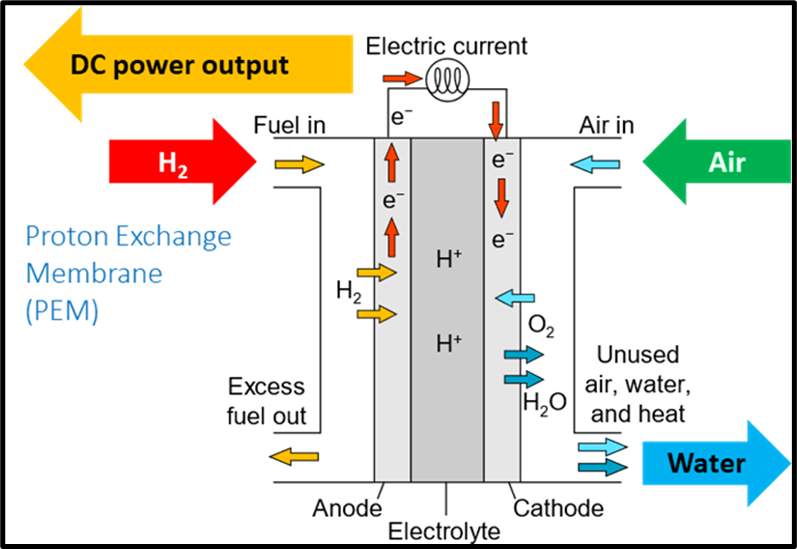
A fuel cell consists of:
- Anode
- Cathode
- Electrolyte (sandwiched in between)
Step-by-Step Working
- Hydrogen enters the anode
- A catalyst (usually platinum, palladium, or gold) splits hydrogen into:
- Protons (H⁺)
- Electrons (e⁻)
- Electrons flow through an external circuit, generating electricity
- Protons move through the electrolyte to the cathode
- At the cathode, protons + electrons + oxygen → water, heat, and electricity
This direct conversion avoids thermal losses.
Types and Efficiency of Fuel Cells
- Common fuel cells:
- Hydrogen fuel cells
- Phosphoric acid fuel cells
- Other variants use → Methanol, Ethanol, Natural gas
Efficiency Advantage
Fuel cells are more efficient than thermal power plants because:
- Thermal plants:
Chemical → Thermal → Mechanical → Electrical (multiple losses) - Fuel cells:
Chemical → Electrical (direct)
Limitation
- High cost, mainly due to precious metal catalysts
Vehicle Efficiency Comparison
Decreasing order of overall efficiency:
Electric Vehicles (EVs) > Hydrogen Vehicles > Diesel Vehicles > Petrol Vehicles
This explains why hydrogen is preferred for heavy-duty and long-range transport, not small passenger cars.
National Hydrogen Mission
National Hydrogen Mission (NHM), 2021
Launched in 2021, the National Hydrogen Mission aims to:
- Help India meet climate targets under the Paris Agreement
- Position India as a global green hydrogen hub
- Provide incentives for Green Hydrogen and Green Ammonia manufacturers
National Green Hydrogen Mission (NGHM), 2023
Building on NHM, the government approved the National Green Hydrogen Mission (NGHM) in January 2023.
Vision
- Make India energy-independent
- Decarbonise hard-to-abate sectors
Financial Outlay
- ₹19,744 crore (initial)
- Target to mobilise ₹8 lakh crore investment by 2030
Strategic Importance
Green hydrogen is critical for → Fertilisers, Oil refining, Methanol, Maritime shipping, Iron & steel, Long-haul transport
It is also a key pillar of India’s Long-Term Low Emissions Development Strategy (LT-LEDS).
Salient Features & Likely Outcomes by 2030
Targets
- ≥ 5 Million Metric Tonnes (MMT) green hydrogen production annually
- ₹1 lakh crore reduction in fossil fuel imports
- 6 lakh+ jobs creation
Environmental Gains
- 125 GW renewable capacity addition
- ~50 MMT annual GHG emission reduction
Key Interventions under NGHM
- Financial incentives for:
- Domestic electrolyser manufacturing
- Green hydrogen production
- Development of Green Hydrogen Hubs
- Demand creation + export facilitation
Policy Framework
- Enabling policies for hydrogen ecosystem
- Robust standards and safety regulations
- Public–Private Partnerships (PPP) for R&D and innovation
Opportunities for India
India enjoys structural advantages:
- Falling renewable tariffs
- Expected reduction in electrolyser costs
According to estimates by NITI Aayog:
- Green hydrogen market value:
- US$ 8 billion by 2030
- US$ 340 billion by 2050
- Electrolyser market:
- US$ 5 billion by 2030
- US$ 31 billion by 2050
- 3.6 Giga tonnes of cumulative CO₂ reduction by 2050
Key Challenges Ahead
- High electrolyser cost remains the biggest bottleneck
- Need for:
- Technological innovation
- Economies of scale
- Access to critical minerals (lithium, cobalt, nickel, rare earths) is constrained due to:
- Geographic concentration
- Supply monopolies