
Introduction to Transport and Communication
Let us begin with a simple but profound idea:
Transport is about moving things. Communication is about moving thoughts.
In Geography, both transport and communication are essential pillars of economic growth and social integration.
- Transport means the movement of people and goods. It involves vehicles, routes, and infrastructure.
- Communication is the transmission of ideas, messages, and information. It involves technology, media, and networks.
So essentially, Transport = Physical flow, and Communication = Informational flow.
Now, here is a precise definition that reflects the geographical angle:
Transport and Communication refer to the spatial linking of desired elements—like resources, markets, people, and information—through different physical and non-physical means.
This simple yet powerful idea tells us: movement—whether of wheat or WhatsApp—is central to development.
Means of Transport – The Classification
Transport is mainly classified on the basis of medium:
A. Land Transport
- Roadways – highways, expressways, village roads.
- Railways – including metro, suburban, and freight railways.
- Pipelines – especially for oil, gas, and water.
B. Water Transport
- Inland Waterways – rivers, canals, backwaters (like Kerala lagoons).
- Oceanic Routes – international shipping lanes via seas and oceans.
C. Air Transport
- Airways – both domestic and international flights.
Each mode has a distinct cost, speed, and suitability based on terrain, cargo, and distance.
Role of Transport – Why Does It Matter?
“Transport is a means to overcome space and conquer time.”
This quote beautifully captures its essence. Here’s what transport does:
- Reduces time for movement
- Promotes economic integration – linking producers with consumers
- Increases efficiency in logistics, trade, and mobility
📊 Observed the graph: as transport technology improves, time taken (T₁) reduces to T₂, even if the distance remains the same. That’s conquering space through speed.
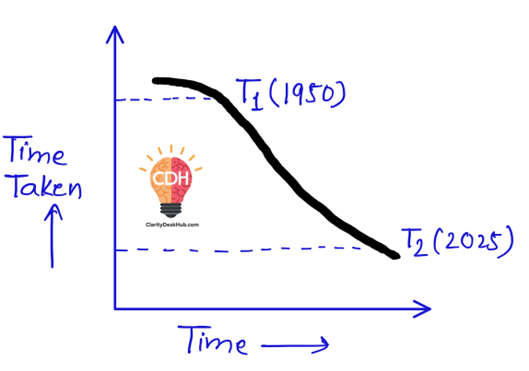
Importance of Conquering Space and Time
Transport is not just about moving things—it changes how societies function.
It enables:
- Accessibility to remote areas
- Social integration – migration, festivals, education
- Political unity – nation-building, administration
- Economic progress – better markets, supply chains
Also, it helps in:
- Geopolitical goals – like India’s connectivity with ASEAN via highways
- Achieving economies of scale
- Energy and cost savings
- Accelerating urbanisation
Transport is the infrastructure of interaction.
Types of Flow in Transportation – Patterns of Movement
Let’s understand how movement happens in space:
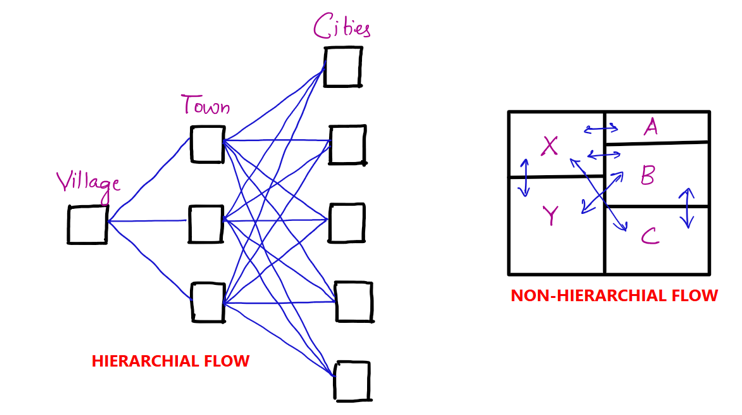
A. Hierarchical Flow
- Movement from lower order to higher order settlements.
- Example: Village → Town → City.
- Seen in trade networks, education migration, and government services.
B. Non-Hierarchical Flow
- Based on physical proximity or terrain suitability.
- No hierarchy. Example: pipelines, cable networks, local deliveries.
C. Distribution-Based Flow
- Movement from producer to consumer.
- Example: Factory → Distributor → Shop → Customer
- Here, human planning is key, unlike the natural terrain-based flow.
Barriers in Transport and Communication – What Hinders Flow?
Barriers are anything that interrupts or slows down movement.
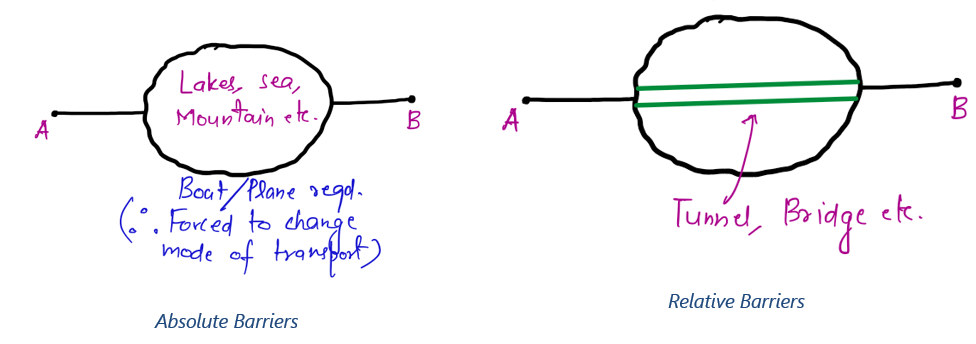
A. Absolute Barriers
- Natural and often unavoidable.
- Example: Sea, mountain, desert.
- Require a change in mode — e.g., road ends at sea → switch to ferry/air.
B. Relative Barriers
- Man-made solutions can bypass them.
- Examples: Bridges, tunnels, canals.
- E.g., Suez Canal cuts down months of sea travel.
- These are engineered solutions to nature’s obstacles.
Movement Models / Flow Models – How Systems Work
Movement isn’t random—it follows models or structures.
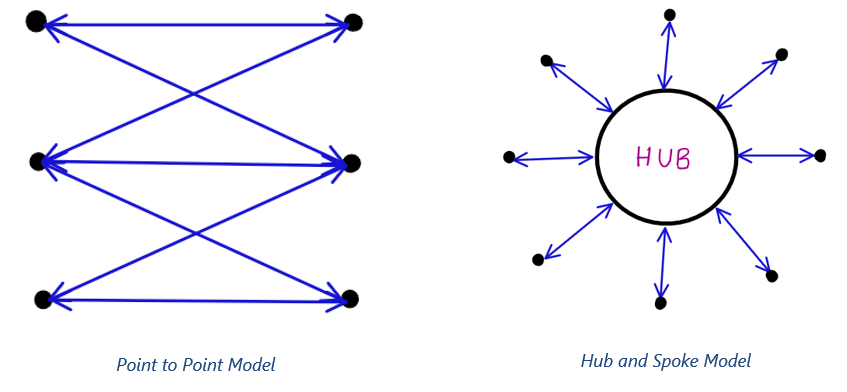
A. Point-to-Point Model
- Direct, from origin to destination.
- Example: Delhi → Mumbai by bullet train.
- Advantages:
- Saves time, money, and fuel
- Requires less infrastructure
- Causes less pollution
B. Hub and Spoke Model
- Central hub connects to many places.
- Example: Delhi Airport → Multiple cities.
- Common in airlines, postal services, cargo systems.
- Good for long-distance and bulk transport.
This model promotes centralisation, while point-to-point supports decentralisation.
Transport Network – Nodes, Links, and Relations
A transport network is made of:
| Component | Global Level | Regional Level | Local Level |
|---|---|---|---|
| Node | Major hubs (airports, ports) | Regional centres (cities) | Crossroads, marketplaces |
| Link | Sea and air routes | Railways, national highways | Local roads |
| Relation | Global trade, tourism, data flows | Urbanisation, industrial zones | Daily supply, local communication |
This classification helps understand scale-wise operation of transport systems.
Conclusion – The Backbone of Geography
In the end, remember this:
Transport and Communication are the veins and nerves of a nation.
They:
- Shape human settlements
- Enable regional integration
- Drive economic development
- Influence geopolitical strength
Without them, resources stay unused, markets stay isolated, and growth stays fragmented.
So, in the grand narrative of geography, transport and communication are not just topics—they are transformative forces.