
Limestone
Let’s begin by visualising this: imagine you are walking on a beach filled with shells, corals, and tiny marine organisms. Over millions of years, these remains get buried under more and more layers. What forms from them? Limestone.
So, what is Limestone?
Limestone is a sedimentary rock—this means it is formed by the accumulation and compaction of sediments over geological time. The primary component of limestone is calcium carbonate (CaCO₃).
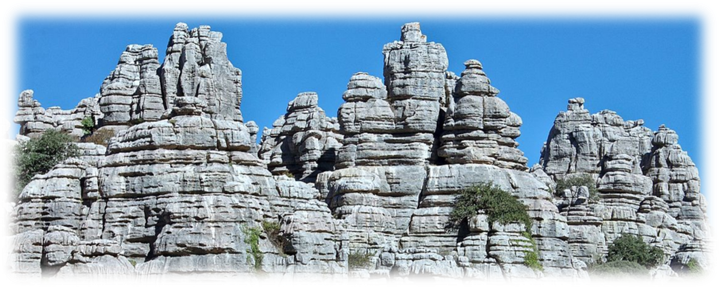
But it’s not just one uniform substance. Depending on what else gets mixed in during its formation, we get different varieties of limestone.
Let’s look at a few important forms:
- Calcite: The most common and pure form of calcium carbonate in limestone.
- Dolomitic limestone: Contains both calcium carbonate and magnesium carbonate. Here, magnesium replaces some of the calcium atoms.
- Marble and Crystalline Limestone: These are metamorphosed forms of limestone—meaning the original rock was subjected to heat and pressure, causing it to change in texture and appearance.
There are also some other specific varieties:
- Marl: Limestone mixed with clay.
- Oolite: Small spherical grains of CaCO₃.
- Shelly limestone: Made of broken shells.
- Coral limestone: Rich in coral remains.
- Travertine and Onyx: Precipitated varieties found near hot springs or caves.
Geological Formation of Limestone
Now, how exactly does limestone come into being? Let’s divide the process into three main stages:
A. Deposition
Most limestone forms in marine environments, especially in warm, shallow, and clear seas. Why such specific conditions? Because marine organisms like shellfish, coral, algae, etc., thrive here. When these organisms die, their calcium carbonate shells and skeletons settle down on the seafloor.
But it’s not limited to seas.
- In freshwater environments—like lakes and rivers—limestone can also form when:
- Calcium carbonate precipitates out of water, or
- Freshwater organisms contribute through their biological processes.
B. Compaction and Lithification
Over time, the accumulated sediments get buried deeper. As more layers pile on top, the pressure increases, squeezing out water from the spaces in between.
This process of transforming loose sediment into solid rock is called lithification.
Lithification = Compaction + Cementation
Unconsolidated sediment → Solid rock
C. Other Processes
There are a couple of additional ways limestone can form or get modified:
- Chemical Precipitation: In places like caves or springs, water rich in CaCO₃ loses carbon dioxide and directly precipitates limestone—forming beautiful features like stalactites and stalagmites.
- Recrystallization: Over geological time, small calcite crystals dissolve and re-form into larger crystals, making the limestone more crystalline and compact.
Applications of Limestone: Why is it So Valuable?
Limestone isn’t just a geological marvel—it’s an economic asset. Here’s how it’s used across industries:
A. Construction and Architecture
- Dolomitic limestone from Gujarat is famous for making slabs and tiles.
- Shahabad stones from Kalaburagi (Karnataka) are widely used for flooring.
B. Agriculture
- Pulverised limestone is used as agricultural lime—a soil conditioner that neutralises acidic soils. This improves soil health and crop productivity.
C. Cement and Steel Industries
- Limestone is a key raw material in the cement industry.
- In the iron and steel industry, limestone acts as a flux in blast furnaces—binding with silica and other impurities, forming a slag which can be easily removed.
D. Environmental Applications
- Fuel-gas desulfurisation: In thermal power plants, limestone helps remove sulfur dioxide from emissions—reducing air pollution.
- In underground coal mines, it is used to suppress methane explosions—making mining safer.
Distribution of Limestone: Global and Indian Context
We’ve understood what limestone is and how it forms. But now let’s ask: Where in the world is it found? And more importantly, what role does it play in the global and Indian economy?
Let’s split this discussion into two major parts:
- Global Distribution and Trade of Limestone
- Distribution of Limestone in India
Global Distribution and Trade of Limestone
Now imagine the world map—not with countries and capitals—but through the lens of geology. Limestone, being a marine sedimentary rock, is found where ancient shallow seas once existed or where tectonic uplift has exposed older seabeds.
Let’s understand this region-wise:
- North America:
- Limestone-rich zones include the Midwestern United States (think of states like Missouri, Indiana), the Appalachian Mountains, and Western Canada.
- Europe:
- Countries like France, Italy, and the United Kingdom have significant deposits. These regions have been historically important for construction, sculpture, and cement industries.
- Asia:
- China is a limestone giant—especially the southwestern and central provinces like Yunnan, Guizhou, and Sichuan.
- Japan has key reserves in the Ryukyu Islands and the Kanto Plain—both geologically active zones with sedimentary formations.
- Southeast Asian nations like Malaysia and Vietnam are also major producers.
- Australia:
- Key limestone zones include the vast Nullarbor Plain—one of the world’s largest exposed limestone karst landscapes—and the Kimberley region in the north.
Distribution of Limestone in India
Now let’s zoom in on India. India’s limestone scenario is not just about quantity but economic significance, especially for the cement industry, which is a major part of our industrial growth.
Reserves (2020)
- India has estimated limestone reserves of around 227 billion tonnes.
Here’s the top reserve-holding states:
| State | Share |
| Karnataka | 24% |
| Andhra Pradesh | 13% |
| Rajasthan | 12% |
| Gujarat | 10% |
| Meghalaya | 10% |
- A key point: 68% of these reserves are cement-grade, meaning they are economically viable for use in cement manufacturing—a major industrial sector.
Production
- In 2022–23, India produced about 406 million tonnes of limestone.
- Out of this, 97.31% was cement-grade—which tells you how tightly linked limestone is with the cement sector.
Here’s the top producers:
| State | Share | Major Regions |
| Rajasthan | 23% | Almost all districts |
| Andhra Pradesh | 13% | Kurnool, Guntur |
| Madhya Pradesh | 12% | Jabalpur, Satna, Betul |
| Chhattisgarh | 11% | Bastar, Durg, Raipur |
| Karnataka | 10% | Kalaburagi, Shimoga |
You’ll notice that the top reserve states don’t always match the top producers. This is due to factors like mining policy, environmental clearance, infrastructure, and regional demand.
Export-Import Dynamics
- Exports (2022-23):
- India exported 2.5 million tonnes, 98% of which went to Bangladesh
- Imports (2022-23):
- India also imported limestone 29.73 million tonnes—primarily for industries that require specific grades not locally available.
- Top limestone suppliers to India:
- UAE (83%)
- Oman (12%)
- Malaysia (2%)
So, despite being a limestone-rich country, India both exports and imports limestone depending on grade requirements, regional shortages, and cost economics.
Conclusion
Limestone, as we’ve seen, is not just a construction material. It’s a geo-economic resource—shaped by ancient seas, traded across modern borders, and vital to industrialisation. Its distribution, both global and domestic, is influenced by geology, infrastructure, and industrial demand.