
Livestock Ranching
At its core, livestock ranching refers to the commercial grazing of animals over vast areas of land.
Unlike nomadic herding—which is subsistence-based and migratory—livestock ranching is:
- Commercial → The goal is to sell animal products in the market.
- Organised → There is a system and infrastructure in place.
- Capital-intensive → It involves significant investment in land, technology, and veterinary care.
📌 Analogy:
Think of livestock ranching like running a well-managed animal factory on open land. The animals are not just raised, they are systematically bred, monitored, and prepared for market.
🏞️ Nature and Layout of a Ranch
Ranches are large farms—sometimes thousands of acres—permanently established for livestock.
- These are divided into parcels, like separate grazing zones.
- Each parcel is fenced, and animals are rotated from one parcel to another.
- This rotational grazing ensures that the grass has time to regenerate, preventing overgrazing and maintaining ecological balance.
📌 Real-world practice:
This method mimics crop rotation in farming but applies it to pastureland. It’s a smart and sustainable way to use large tracts of land without exhausting them.
🐑 Specialisation and Products
Livestock ranching is a highly specialised activity.
Generally, only one type of animal is raised per ranch. This allows for:
- Better management
- Focused breeding
- Easier disease control
Common Animals:
- Cattle → For beef and hides
- Sheep → For wool and meat
- Goats and horses → In some areas, for milk, hides, or transportation
The products—meat, wool, hides, and skins—are:
- Scientifically processed
- Packed and preserved
- Exported to global markets
🧪 Scientific Approach
One of the defining features of livestock ranching is its scientific and technological orientation:
- Breeding programs for genetic improvement
- Vaccination and health care to prevent diseases
- Feeding strategies for optimal growth
- Monitoring systems for tracking animal health and productivity
📌 Analogy:
If nomadic herding is like traditional craftsmanship, livestock ranching is like a modern assembly line—efficient, specialised, and market-focused.
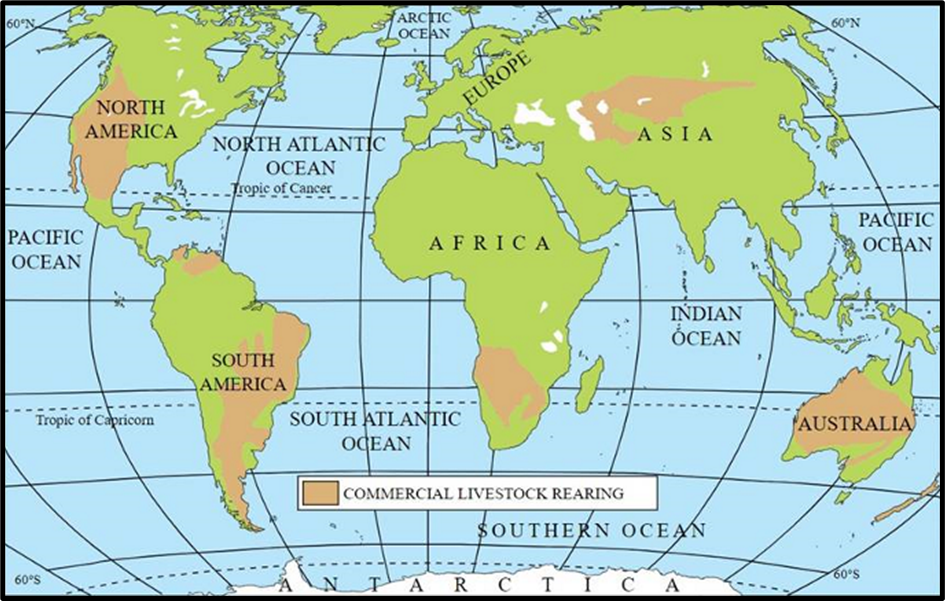
🌍 Where is Livestock Ranching Practised?
This system is strongly associated with Western cultures, particularly those with:
- Vast open lands
- Sparse population
- Strong market demand for animal products
Major Countries:
- United States of America
- Argentina and Uruguay
- Australia and New Zealand
These nations have:
- Suitable temperate grasslands (like the Pampas, Prairies, and Downs)
- Advanced infrastructure and export networks
- Strong emphasis on animal husbandry as an industry
📉 Key Differences from Nomadic Herding
| Feature | Nomadic Herding | Livestock Ranching |
|---|---|---|
| Purpose | Subsistence | Commercial |
| Mobility | Highly mobile | Fixed (permanent ranches) |
| Organisation | Traditional, informal | Systematic, scientific |
| Investment | Labour-based | Capital-intensive |
| Output | For personal use | For export/market |
🧭 Conclusion:
Livestock ranching is a modern, scientific, and market-oriented system of animal rearing, based on fixed land, specialised techniques, and commercial goals. It thrives in countries with open land, technological advancement, and strong market linkages.
In contrast to the mobile, survival-driven lifestyle of nomadic herders, ranching represents the industrial face of animal agriculture.